Swift is a NASA space observatory launched in 2004, designed to detect and rapidly observe gamma-ray bursts (GRBs) and other transient cosmic X-ray sources. It is a multi-wavelength mission, carrying three instruments: the Burst Alert Telescope (BAT), the X-Ray Telescope (XRT), and the Ultraviolet/Optical Telescope (UVOT). Swift's key capability is its speed: it can autonomously slew to a new burst within minutes, capturing the early afterglow that fades quickly. This has made it one of the most productive missions for studying the most energetic explosions in the universe.
History
Swift was proposed in the late 1990s and launched on November 20, 2004. It was built by an international collaboration led by NASA, with partners in the UK and Italy. The mission has been extended multiple times and continues to operate, having detected thousands of GRBs and other transients.
How it works
Swift's BAT detects gamma-ray bursts in a wide field of view, determining their position. Within seconds, the spacecraft autonomously reorients to point the XRT and UVOT at the burst location. These telescopes then observe the X-ray and optical/ultraviolet afterglow, which fades over hours to days. By simultaneously observing across these wavelengths, Swift provides a comprehensive picture of the burst's physics and its environment.
In practice
Swift is used to localize gamma-ray bursts for follow-up observations by ground-based and space telescopes, and it also monitors X-ray sources, tidal disruption events, and supernovae, contributing to time-domain astronomy.
Fun fact
Swift's name is not just a description of its speed; it is an acronym for 'Swift Gamma-Ray Burst Explorer,' and it was also named in honor of the swift bird, known for its quick movements.
A lighthouse doesn't flash steadily but in short, bright pulses. The neutron star in the system 4U 1323-62 is such a lighthouse in the X-ray range. It pulls gas from a companion star, and when enough material accumulates on its surface, a thermonuclear explosion occurs — an X-ray burst.
On March 26, 2026, the Chinese-European Einstein Probe observatory caught an X-ray flash that lasted a little over a quarter of an hour. A thousand seconds. The onboard WXT telescope registered a sharp rise in radiation, then a smooth decline, as if someone had screamed into silence, and the echo slowly faded.
The hunter of ancient light, the James Webb Telescope, aimed its mirrors at a tiny patch of sky and caught a strange beacon. The object, with the working name beacon_1420-$$5253_{4770}$$, flashed and faded. At first, it was logged as a candidate for the most distant galaxy, as if we were seeing it just 300 million years after the big bang.
Nearly 12 billion years ago, when the Universe was experiencing the turbulent 'cosmic noon'—the era of record-breaking star formation — at the heart of one galaxy, the quasar WISSH13 was flaring up.
Two beams of light race around a closed loop, heading toward each other. Since the speed of light is constant, when the ring turns, one beam has to catch up with a moving finish line, while the other meets it sooner. Their meeting creates a pattern, and from that pattern we can tell how fast the whole system is spinning.
A stone falls into a well, and the splash reaches your ears with a delay. Something similar happens to light as it leaves Earth: its oscillations become less frequent, the beam seems to 'tire.' This is gravitational redshift — a phenomenon Einstein spoke of a century ago.
Searching for extraterrestrial signals is like trying to hear a whisper at a roaring stadium. The Green Bank Telescope listened to 70,000 stars, but 100 million bursts turned out to be earthly noise — from phones, satellites, microwave ovens.
A supernova explosion is the death of a massive star, leaving behind a gas cloud. If there's plenty of hydrogen around, the shock wave spreads like an echo from a distant gunshot.
Deep beneath Japan's Mount Ikeno sits a tank holding 50,000 tons of the purest water. Inside, it catches neutrinos — ghostly particles that zip through Earth as if it weren't there. When a star explodes in our galaxy, neutrinos arrive first, hours before the light.
When an exoplanet briefly eclipses its star, starlight passes through its air and absorbs its chemical taste. This technique, the transit method, is the core of how the James Webb telescope works.
After a supernova explosion, a neutron star neutron star remains: a city-sized ball of unimaginably dense matter, spinning hundreds of times per second. Any tiny bump on its surface would make it wobble like an off-balance spinning top, humming faintly through the fabric of space.
A kitchen timer ticks once a second. The neutron star SRGA J144459.2-604207 ticks 448 times a second: that's its own rotation, and it shows up in X-ray bursts. In 2024, the star woke up and started throwing thermonuclear explosions on its surface, like a bubbling pot of boiling water.
On the night of August 18, 2025, the SVOM space telescope detected a short gamma-ray burst — a powerful flash of energy lasting less than two seconds. Such bursts are usually linked to mergers of neutron stars, the ultra-dense remnants of dead stars.
Light from a distant star, after passing through air and telescope lenses, loses its sharpness, like looking at a streetlamp through wet glass. Astronomers call this blur the telescope's "fingerprint": each instrument has its own, and you need to know it down to the smallest detail.
The Crab Nebula flickers with X-ray flashes thirty times per second. That's the beat of a pulsar — a dead star that spins and sends us pulses like a lighthouse. Japan's NinjaSat, a satellite the size of a shoebox, caught these flashes to figure out where it was.
In the binary system 4U 1624-49, a neutron star pulls gas from its companion star. This gas spirals into a glowing disk, like water in a funnel. And from the edge of this funnel, a hot stream tears away — hydrogen and other elements fly off at speeds up to 320 kilometers per second.
To spot life on other planets, you don't necessarily need to search for oxygen in the air. Living beings paint the surfaces of their worlds: Earth's plants in green, bacteria in purple. The future HWO space telescope will capture these "paints of life" on exoplanets.
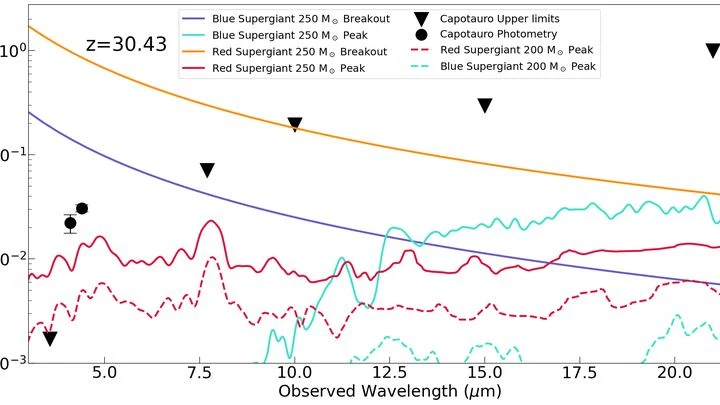
The James Webb Space Telescope spotted bright points of light from an era just 100–300 million years after the Big Bang. At first they were taken for distant galaxies, but now a hypothesis suggests they might be lone fireworks — explosions of the very first stars.