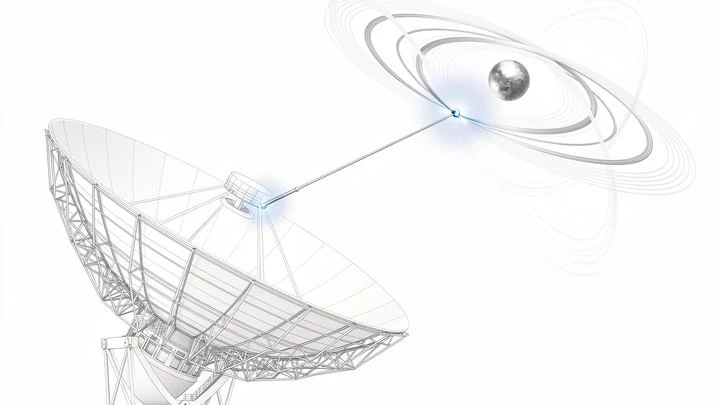
The Five-hundred-meter Aperture Spherical radio Telescope (FAST) is the world's largest filled-aperture radio telescope, located in a natural karst depression in Guizhou Province, China. With a reflecting surface of 500 meters in diameter, it is an extraordinarily sensitive instrument for detecting faint radio signals from celestial sources. FAST is used to study a wide range of astrophysical phenomena, including pulsars, fast radio bursts, neutral hydrogen in distant galaxies, and the search for extraterrestrial intelligence.
History
FAST was conceived in the 1990s and completed in 2016, with formal operations beginning in 2020. It was designed and built by the Chinese National Astronomical Observatory, with the project led by astronomer Nan Rendong until his passing in 2017.
How it works
FAST operates by focusing incoming radio waves onto a receiver suspended above the dish. Unlike older designs with a fixed spherical shape, FAST's reflecting surface is made of actively adjustable panels that deform to form a parabolic shape, allowing it to track celestial sources across a significant portion of the sky. This active surface technology enables the telescope to achieve high sensitivity and a large field of view, making it a powerful tool for surveying the radio sky.
In practice
FAST is used for astronomical research, including discovering new pulsars, studying fast radio bursts, mapping neutral hydrogen in the universe, and searching for signs of extraterrestrial intelligence. Its sensitivity also allows it to detect faint radio emissions from distant galaxies and quasars.
Fun fact
FAST's receiving area is equivalent to about 30 football fields, and it is so sensitive that it can detect a cell phone signal on the Moon.
The night sky is full of rings and bubbles, but in the radio band they look different. In data from the Australian radio telescope ASKAP, a structure has surfaced that resembles two soap bubbles blown from the same straw.
Picture a lighthouse on the shore at night. Its lamp is off almost all the time, but once every few days, for a split second, it blazes so brightly that the light is visible beyond the horizon.
Photographing an exoplanet orbiting another star is like trying to spot a firefly in front of a spotlight. Earth's atmosphere is constantly churning, which makes stars appear as dancing speckles through a telescope.
Fast radio bursts — millisecond radio pulses arriving from distant galaxies — long remained a puzzle. Their colossal energy, compressed into instants, pointed to cataclysms on neutron stars, perhaps pulsars or magnetars.
3I/ATLAS burst into the Solar System like an uninvited guest, a gift of fate for hunters of extraterrestrial intelligence. This comet-like wanderer from the depths of the Galaxy flew close enough to be heard in all its details — unlike distant exoplanets.
The universe is a vast orchestra playing the score of expansion. Galaxies race apart to the beat of inaudible music of dark energy. But here's the trouble: the conductor's baton held by Edwin Hubble, Adam Riess, and Vera Rubin sets two incompatible tempos.
The story began with a puzzle: in the 1930s, Fritz Zwicky noticed that clusters of galaxies behave as if an enormous invisible mass is hidden within them. Half a century later, Vera Rubin confirmed that stars on the outskirts of galaxies rotate too fast to be held by visible matter alone.
Nearly 12 billion years ago, when the Universe was experiencing the turbulent 'cosmic noon'—the era of record-breaking star formation — at the heart of one galaxy, the quasar WISSH13 was flaring up.
Two beams of light race around a closed loop, heading toward each other. Since the speed of light is constant, when the ring turns, one beam has to catch up with a moving finish line, while the other meets it sooner. Their meeting creates a pattern, and from that pattern we can tell how fast the whole system is spinning.
For decades, the search for extraterrestrial intelligence has waited for quiet, coherent signals from space — a kind of 'whistle' in the radio silence. However, our own technosphere has created a continuous radio background — the hum of a vast metropolis, emitted by all communications, radars, and broadcasting stations.
Searching for extraterrestrial signals is like trying to hear a whisper at a roaring stadium. The Green Bank Telescope listened to 70,000 stars, but 100 million bursts turned out to be earthly noise — from phones, satellites, microwave ovens.
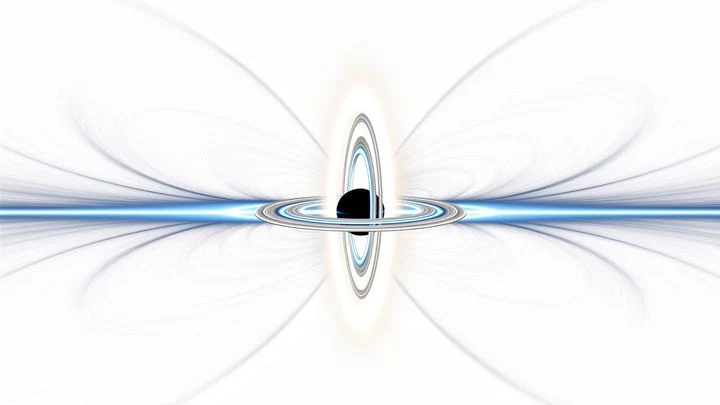
The plasma jet from the center of a distant galaxy is like a river that flows from its source and gradually becomes clear. Near the black hole, the flow is dense and opaque to radio waves, like muddy water.
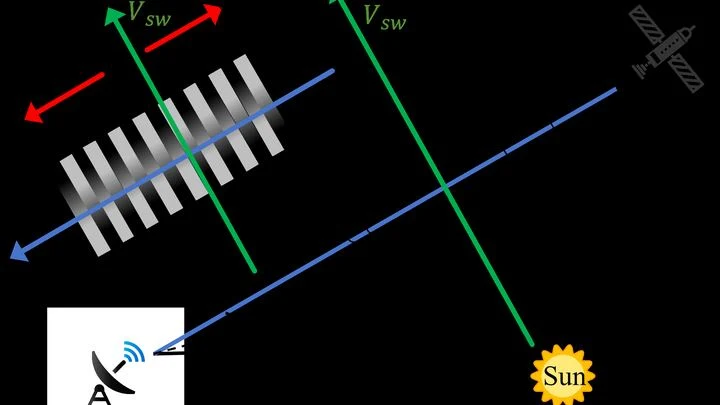
A radio signal travels from Mars to Earth, but on the way it has to push through the invisible "wind" of charged particles blowing from the Sun. This wind, like ripples on water, slightly distorts radio waves.
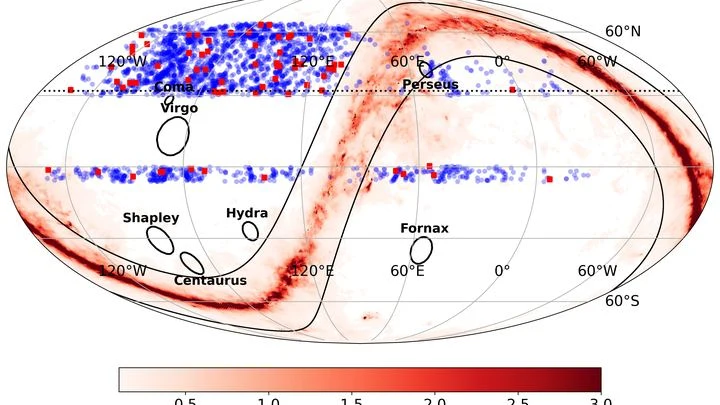
The night sky looks calm, but if you listen in on the radio band, it's full of short clicks and rustles. Astronomers are combing the sky for solitary radio pulses — bursts lasting milliseconds that come from various corners of the Galaxy and beyond.
One such search is underway at the 100-meter radio telescope in Effelsberg, Germany.
Globular clusters, dense swarms of hundreds of thousands of stars, hide millisecond pulsars. These are dead stars spinning at breakneck speed: one rotation every few milliseconds, like a kitchen blender on max.
Radio pulsar J1574+4703 behaves like a finicky lighthouse. Instead of shining steadily, it turns its radio beam on in short flashes and then falls silent for long stretches. Objects like this are called 'rotating radio transients', or RRATs for short.
Rhythmic flashes of a lighthouse in thick fog: that's what searching for pulsars looks like. The lighthouse spins, and its beam periodically sweeps across the telescope. But the fog smears the light, making the period seem slightly different. If the same lighthouse was observed twice, you can compare: the periods should nearly match, and the smearing should be similar.
In October 2022, the cosmos put on a fireworks show that every detector on Earth noticed. The explosion, named GRB 221009A, was so bright that it was called the brightest ever observed. It's a gamma-ray burst — a short but incredibly powerful flash that releases as much energy in seconds as the Sun will produce in its entire lifetime.
For a long time, astrophysics was dominated by the belief that giant jets of radio emission, radio outbursts blasting from central regions, were the exclusive privilege of elliptical galaxies. It was thought that only their calm, featureless internal environment could allow such colossal fountains of energy, powered by supermassive black holes, to form.
Fast radio bursts are instantaneous radio flashes from deep space. In a thousandth of a second they release as much energy as the Sun emits in a month. One such burst, repeating, allowed scientists to peer into the epicenter of a recent stellar explosion.
Terzan 5 is a globular star cluster, a tight swarm of hundreds of thousands of stars squeezed into a sphere a few dozen light-years across. In such a crowd, stars exchange matter and spin each other up, and some turn into pulsars — rapidly rotating neutron stars that emit radio pulses like lighthouses. New images taken with the Karl G.
In the neighboring galaxy, the Large Magellanic Cloud, lives the binary system A0538-66. There, a neutron star — a tiny sphere the size of a city but heavier than the Sun — spins on its axis every 69 milliseconds.
At night, while most people sleep, the giant dish of the Green Bank radio telescope in West Virginia keeps listening to the sky. Over 24,186 hours, that's nearly three years of continuous observation, it caught 50 pulsars and three fast radio bursts.
For twelve years, astronomers at the LPA radio telescope in Pushchino have been listening to the same patch of sky — the direction of the galaxy 3C 33. In that time, they caught just six short radio signals, each lasting from one to four minutes.
Seven billion years ago, a black hole at the center of a galaxy unleashed a gamma-ray flare — the most energetic form of light — with staggering power. Its light, after crossing cosmic distances, reached the MAGIC telescopes in December 2017.
A distant radio signal travels toward us through gas, and the more gas it encounters, the more the signal is 'slowed down.' Astronomers use this to weigh the invisible envelope of our Galaxy: its halo. But if the halo is uneven, like a thick scarf draped over the shoulders, measurements in different directions will differ.
In the vast darkness of interstellar space, the rogue planet WISE 0855 flickers with a barely perceptible heat glow, like a cooling ember. Its temperature is only a few dozen degrees above freezing — if life existed there, it would see a sunless sky, in an eternal icy haze.
At the heart of many galaxies lies an invisible beacon — a supermassive black hole. As it devours matter, it blasts a dazzling beam of gamma rays into space. If that beam points towards Earth, astronomers see a blazar — a bright but fickle point.
The night of March 4, 2024. The MeerKAT radio telescope in South Africa catches a millisecond pulse: a fast radio burst coming from a depth of 17.4 gigaparsecs. This is light that traveled 10.5 billion years to reach Earth.
At a distance of 8.58 megaparsecs, the spiral galaxy M51 spins its arms, while the VLA radio telescope in its most extended configuration observes it with a resolution of 0.16×0.14 arcseconds. That is like spotting a coin on the surface of the Moon from Earth.
The RATAN-600 radio telescope is a ring of hundreds of aluminum panels on a mountainside in Karachay-Cherkessia. In the spring of 2018, its mirror caught radio waves from sixteen red dwarfs — small, dim, but very long-lived stars.
Deep in the Siberian taiga, there are a hundred light traps: each about the size of a small table, but together they cover a square kilometer. At night, these traps gaze at the sky, catching faint flashes of light born when cosmic particles slam into the atmosphere. The setup is called TAIGA-HiSCORE, and it usually works as a giant "eye" for such particles.