The Large High Altitude Air Shower Observatory (LHAASO) is a ground-based cosmic-ray detector array located in the mountains of Sichuan, China, at an altitude of about 4,410 meters. It is designed to detect high-energy gamma rays and cosmic rays by observing the cascades of secondary particles, called air showers, that they produce when they strike the atmosphere. LHAASO has made significant contributions to the study of ultra-high-energy gamma-ray sources, including the discovery of photons with energies exceeding 1 peta-electronvolt (10^15 eV) from the Crab Nebula and other sources.
History
LHAASO was constructed in stages, with the first phase completed in 2019 and the full array operational by 2021. It is a Chinese-led project with international collaboration, and its high altitude and large detection area make it one of the most sensitive instruments for ultra-high-energy gamma-ray astronomy.
How it works
When a high-energy cosmic ray or gamma ray enters the atmosphere, it interacts with air molecules, producing a shower of particles that cascade downward. LHAASO uses a combination of water Cherenkov detectors, scintillator detectors, and muon detectors spread over a large area to measure the shower's components. By analyzing the arrival times and energies of these particles, scientists can reconstruct the direction and energy of the original cosmic ray, as well as distinguish between gamma rays and hadronic cosmic rays.
In practice
LHAASO is used to study the origins of cosmic rays, search for dark matter signals, and monitor variable gamma-ray sources such as blazars and gamma-ray bursts, providing insights into the most energetic processes in the universe.
Fun fact
LHAASO detected photons with energies up to 1.4 peta-electronvolts from the Crab Nebula, the highest-energy photons ever observed from a cosmic source, challenging existing models of particle acceleration.
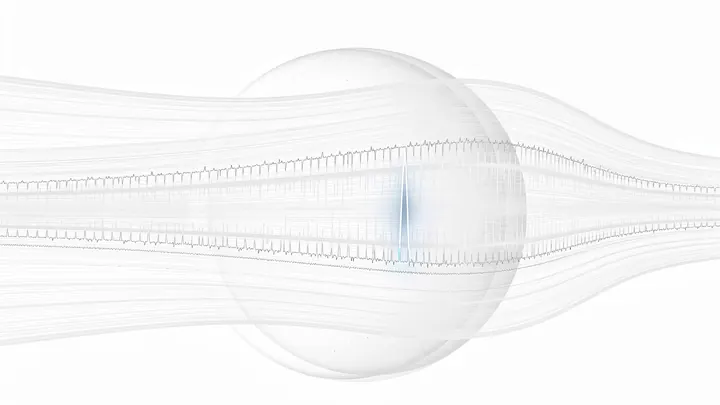
In the basement of the laboratory, an 8 tesla magnet hums. Inside it, like a bell in a bell tower, hangs a hollow copper cylinder tuned to a single note. If an axion, a dark matter particle, flies by, the cylinder responds with a faint ring. The trouble is that ordinary copper muffles this ring: at high frequencies, current flows only through a thin skin of the metal, and losses grow.
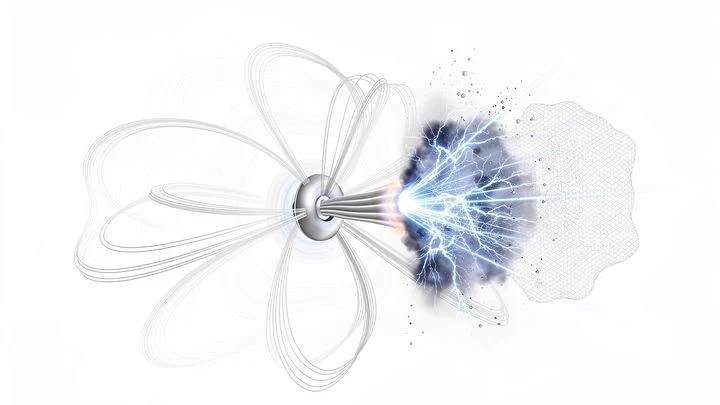
A storm in the upper atmosphere lasts a few millionths of a second. A cosmic ray, a proton or a helium nucleus, strikes air molecules, sending a swarm of particles downward. Most of them stay together, but occasionally one particle gains so much energy that it surges ahead.
The night sky in neutrino light resembles a canvas worked on by two hands. One holds a broad, soft brush: these are supernova remnants, the shells left behind after stellar explosions. The other grips a fine, hard pen — microquasars, binary systems where a black hole twists matter into narrow jets.
Pulsar PSR J1740+1000 is a city-sized star spinning faster than a kitchen blender. After a supernova explosion, it left behind a dense core that accelerates particles to near-light speeds. These particles fly into space, and previously it was thought they scatter in all directions, like splashes from a stone thrown into water.
A lamp is hidden behind a large aquarium filled with water. You see not one light source but several reflections and refractions — the water bends the path of the rays.
High in the mountains, where the air is clear and still, physicists are preparing to catch elusive visitors from space — neutrinos. These particles, like ghosts, pass straight through the Earth, leaving almost no trace. But occasionally a neutrino does slam into an atom, producing a shower of particles that can be seen.
The Universe is a giant concert hall, where instead of walls and balconies, invisible clouds of dark matter float. This architectural ensemble is not static: it refracts and scatters the 'music' rushing through it — gravitational waves from merging black holes.
The light of a distant star carries within it the silent hum of the atmospheres of planets orbiting it. For a long time, capturing it was like trying to make out a whisper over a roaring waterfall. But with the advent of the 39-meter Extremely Large Telescope (ELT) and the ANDES spectrograph with a resolution of 100,000, this task is no longer hopeless.
For a long time, astronomers searched for the 'factories' of the most energetic cosmic rays — particles that carry the macrocosm compressed to the size of an atomic nucleus. Colossal star-forming regions like Cygnus OB2, where winds from young giants collide, were prime suspects.
In the constellation Aquila, about 40,000 light-years away, one of the most powerful natural accelerators in the Galaxy is at work. It's the microquasar GRS 1915+105—a pair consisting of an ordinary star and a black hole.
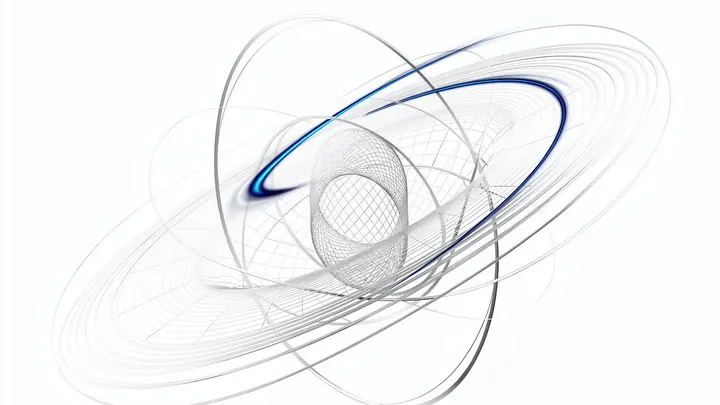
At the heart of the Galaxy, about 7 kiloparsecs away, lies a true natural particle accelerator. This is a rapidly spinning neutron star — the pulsar PSR J1849-0001, left behind by a supernova explosion.
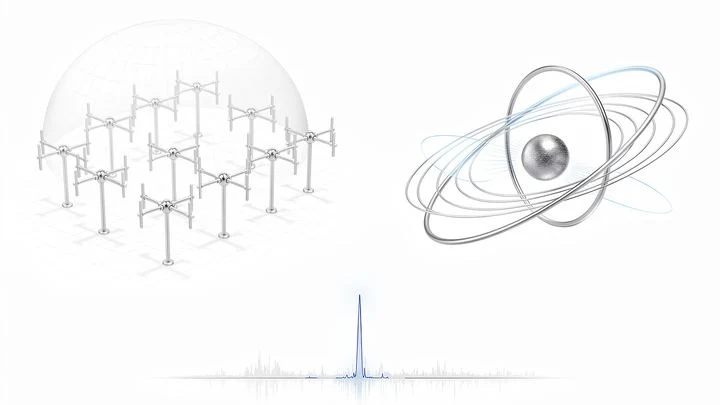
Listening to the cosmos requires patience and a finely tuned ear. Astronomers chose the most sensitive low-frequency instrument for this: the OVRO–LWA antenna array — 352 dipole antennas scattered across two and a half kilometers of California desert.
In the 1930s, Fritz Zwicky first noticed that galaxies in clusters were moving too fast — something invisible was holding them. Later, Vera Rubin measured the rotation of spiral galaxies, confirming that space is permeated by dark matter.
Nearly 12 billion years ago, when the Universe was experiencing the turbulent 'cosmic noon'—the era of record-breaking star formation — at the heart of one galaxy, the quasar WISSH13 was flaring up.
The aurora borealis is like a distant theater: the show may be on, but whether the audience sees it depends on the curtain. Here, the curtain is clouds and moonlight. Earlier forecasts tried to predict both the occurrence of auroras and viewing conditions at once, mixing everything together.
A magnifying glass focuses sunlight into a bright point. If the glass has a tiny flaw, the spot of light becomes distorted. Gravitational lensing works in a similar way: a massive galaxy bends light rays from a more distant source, creating an enlarged and sometimes distorted image.
On a dark night over the Uruguayan pampa, a dazzling fireball silently flares up. It streaks for a few seconds, scattering sparks, and fades beyond the horizon. This is a bolide — a large asteroid fragment slamming into the atmosphere. If it survives the fall, a meteorite will land on the ground.
Gamma-ray burst GRB 221009A flared so brightly that it was dubbed the 'brightest of all time.' The LHAASO observatory detected gamma rays from it with energies up to 13 TeV — thousands of times more energetic than particles in an X-ray machine.
Light from a distant galaxy traveled to us for 13.4 billion years. The James Webb Space Telescope caught it and split it into colors. The spectrum shows a bright hydrogen line, like a fingerprint saying that galaxy GS-z13-1-LA is actively forming stars.
Young hot stars inside the galaxy act like floodlights.
Gamma rays with energies above one hundred trillion electronvolts are like stones thrown with incredible force. For a long time, it was believed that only protons, heavy particles accelerated in cosmic accelerators, could launch such 'stones.' But new work shows that sometimes light electrons are enough.
Cosmic rays are not light but charged particles bombarding Earth from all directions. Most of them are protons (hydrogen nuclei), but heavier nuclei also show up: helium, nitrogen, iron.
Deep in the constellation Aquila lies a nebula that looks like an expanding bubble. It is inflated by a tiny star the size of a city — a pulsar that makes several rotations per second and loses rotational energy. Usually, such bubbles shine exactly as brightly as their pulsar is powerful.
A gamma-ray burst is like a shot from a cosmic cannon: a brief but dazzling flash that outshines an entire galaxy for a few seconds. But when observed in the hardest gamma-ray band (photons with energies above a gigaelectronvolt), the signal often gets lost in the noise, like a whisper in a noisy hall.
In October 2022, the cosmos put on a fireworks show that every detector on Earth noticed. The explosion, named GRB 221009A, was so bright that it was called the brightest ever observed. It's a gamma-ray burst — a short but incredibly powerful flash that releases as much energy in seconds as the Sun will produce in its entire lifetime.
Gravitational waves are ripples in the fabric of spacetime, spreading from sources like circles on water from a thrown stone. When a wave passes a galaxy, its path bends, like water ripples meeting an underwater boulder.
In a kitchen where you're simultaneously boiling soup, frying meat, and baking bread, everything happens in one pot. That's roughly what the central molecular zone (CMZ) looks like — a dense clump of gas at the very heart of the Milky Way.
Cosmic rays are charged particles that constantly bombard Earth from deep space. When one of these particles enters the atmosphere, it collides with air nuclei and spawns a whole cascade of secondary particles: electrons, muons, photons.
Deep in the Italian Apennines, under a thick layer of rock, sits a crystal that catches every decay of radioactive americium. Americium emits gamma rays with an energy of 59.5 kiloelectronvolts, like a very sharp bell that always sounds the same.
Galaxies, like giant whirlpools, sometimes collide and merge. In this chaos, gas compresses, new stars flare up, and a bright radio beacon is born at the very center. Its light — not visible to the eye, but radio waves — pierces through dust and gas like a siren through fog.
For three years straight, every night, telescopes have stared at one point in the sky. There lies the galaxy Mrk 421, whose core shoots a jet of particles aimed almost exactly at Earth. Such objects are called blazars. A black hole at the galaxy's center spins matter into a disk, and some of it is ejected outward in two narrow beams.
Dark matter is like an invisible glue that holds galaxies together. It emits no light, but if its particles collide, gamma rays can flash. Scientists hunted for such flashes in dwarf galaxies — small stellar clusters with lots of dark matter and almost no ordinary matter.
Cosmic particles with energies millions of times greater than anything our accelerators can produce slam into the atmosphere and create a shower of secondary particles. This shower emits radio waves that antennas on the ground pick up. But the signal is weak: it's swamped by the radio noise of our galaxy and the receivers' own noise.
At night, the sky is never completely black. Even far from cities, the upper atmosphere glows faintly: sunlight makes hydrogen atoms emit a reddish glow that astronomers call geocoronal emission. For a telescope, it's like a fogged-up window: it adds extra light and hinders seeing distant galaxies.
In the cold clouds between the stars, where new suns are born, invisible chemical work is underway. Simple molecules collide, swap atoms, and assemble into chains that may later become part of planets. One such chain is the NCCO+ ion, made of nitrogen, two carbons, and oxygen.
Two galaxies approach each other like a pair of dancers who drift apart and then are drawn back together. At the moment of a particularly close encounter, their gas compresses, and bright ultraviolet light bursts from within. This is exactly what happens in the Haro 11 system — the nearest pair of merging galaxies that lets such light escape.
The early universe was a hot soup of particles and light. In this soup, sound waves, fluctuations in density, spread outward from clumps of matter like ripples on a pond. When the universe cooled, these waves froze, leaving an imprint in the distribution of galaxies: they are slightly more abundant at a certain distance from each other.
To spot life on other planets, you don't necessarily need to search for oxygen in the air. Living beings paint the surfaces of their worlds: Earth's plants in green, bacteria in purple. The future HWO space telescope will capture these "paints of life" on exoplanets.
Neutrinos are ghost particles: predicted by the Standard Model, they barely interact with matter. Catching them is like trying to hear a whisper in the roar of a waterfall.