Mini

Speed Filter of the Skies: How Swift Visitors Elude Telescopes

Original: "Sky-Plane Velocity Distributions of Interstellar Objects and Implications for Their Detection"
arXiv:2606.05344v1 · 2026-06-03 · CC BY 4.0 · ⏱ 1 min · Exoplanets Galaxies Instrumentation
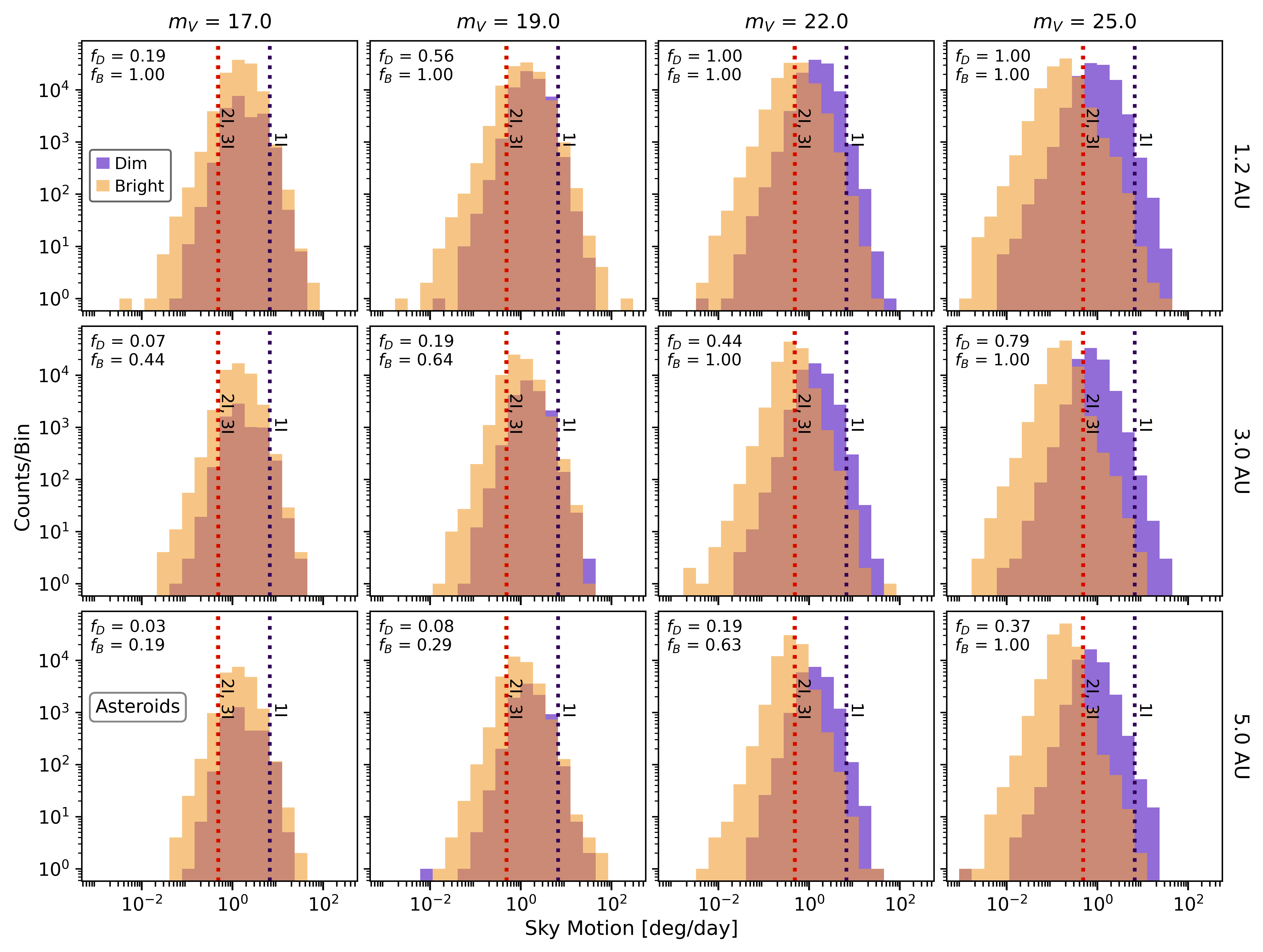
The angular velocity of interstellar objects is the main barrier hiding millions of galactic visitors from our telescopes.
Links in the knowledge graph 1

Oumuamua raced across the firmament at 24 lunar disks per day — telescopes couldn't hit the shutter in time. We only notice those wanderers that happen to slow down. But it's on the quiet outskirts, where angular speed freezes, that the archive of interstellar bodies lies hidden. New surveys will target-scan these slow waters, and then every faint object will become a parcel from a distant star, carrying the chemical signature of another nature.

🎯 1I/Oumuamua accelerated to 12.2 degrees per day — that's over 24 full lunar disks. At that speed, it could cross the entire sky in just a month.

🎬 It's reminiscent of Arthur C. Clarke's novel 'Rendezvous with Rama,' where a mysterious cylindrical object hurtles through the Solar System, leaving humanity perplexed. The modern problem of fast interstellar guests revives that same spirit of discovery and the need to hurry so as not to miss unique data.

\vec{v}_{\text{sky}} = \vec{v} - (\vec{v} \cdot \hat{d})\hat{d}
Sky motion speed is obtained by subtracting the radial component from the total orbital velocity.
\frac{d\theta}{dt} = \sqrt{\frac{GM}{|a(1-e^2)|}} \frac{r(1+e\cos f) - r_{\oplus}(\cos(f-f_{\oplus}) + e\cos f_{\oplus})}{r^2 - 2r r_{\oplus} \cos(f-f_{\oplus}) + r_{\oplus}^2}
Speed on the celestial sphere is expressed through orbital elements and Earth's position; the closer the alien trajectory is to us, the higher the rate.
Scientists
Christian DopplerD. B. McLaughlinDidier QuelozMichel MayorR. A. RossiterDavid Charbonneau
Tags
comet asteroid photometry Sun exoplanet carbon dioxide spectroscopy
Laws
Doppler effectKepler's third lawMaxwell's equationsPlanck's lawPlanck–Einstein relationWien's displacement law
Original: arXiv:2606.05344v1 · CC BY 4.0 · bridge42worlds