Speed Filter of the Skies: How Swift Visitors Elude Telescopes ✛ ✦
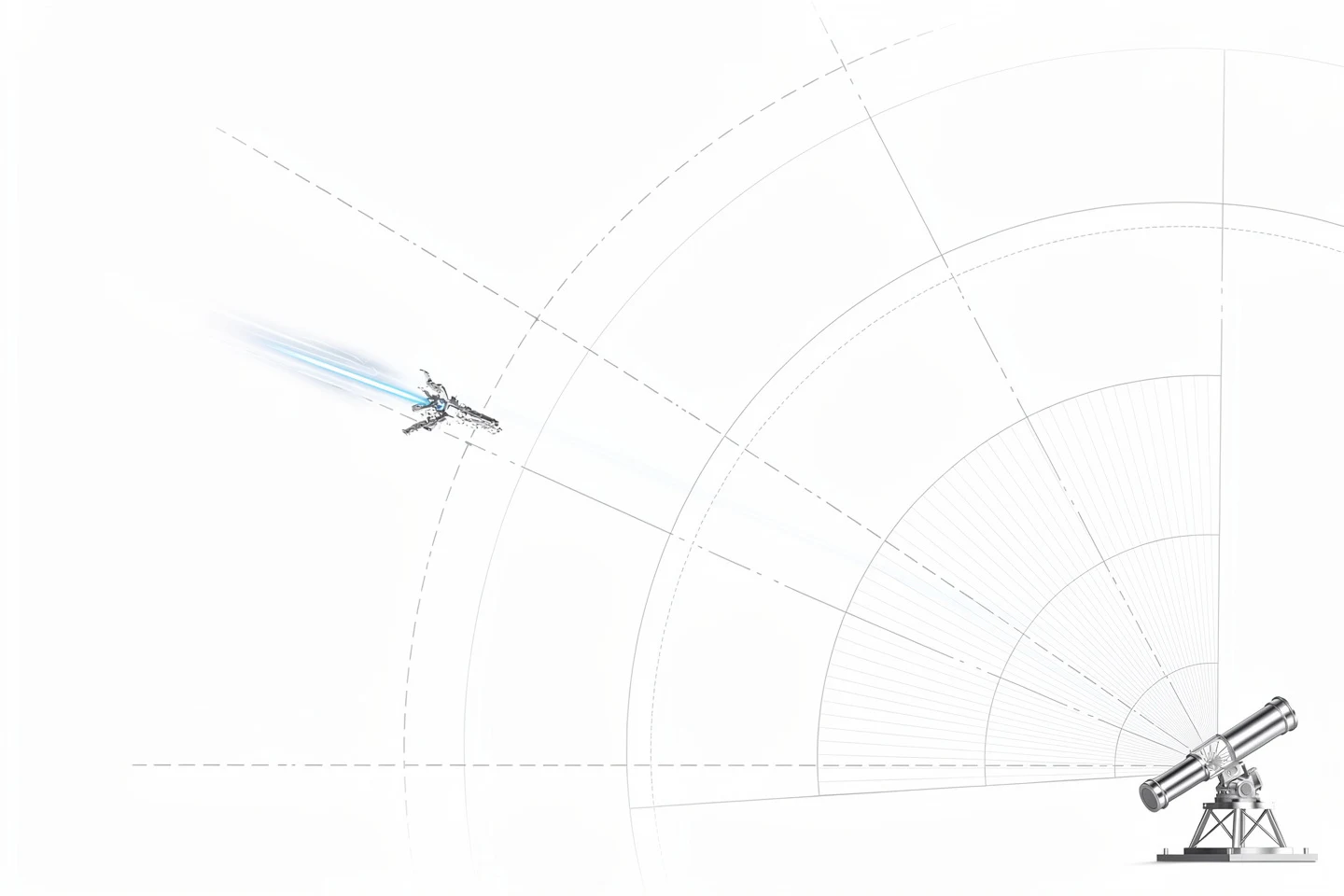
Interstellar space is not a cosmic desert, but a super-fast highway. Trillions of asteroids and comets from other systems race past us, yet camera-telescopes only catch a few. Imagine a night highway: the headlights of a distant car flash brightly, but if it zooms by too fast, the camera shutter can't click in time. That’s how interstellar wanderers behave: their angular velocity is often higher than what survey systems can 'digest'.
Astronomers derived an elegant analytical formula — instead of cumbersome simulations, it directly computes an object's angular speed. The secret lies in a geometric 'sight': \(\vec{v}_{\text{sky}} = \vec{v} - (\vec{v} \cdot \hat{d})\hat{d}\). Remove the component along the line of sight — and what's left is pure lateral shift. It's like filming a bird in flight: its approach toward you is almost unnoticeable, but movement across the frame makes it smear into a streak. Eccentricity and true anomaly of the orbit are essentially the steering wheel and gas pedal in this celestial race.
Simulations of hundreds of thousands of virtual objects confirmed the picture. Bodies like Oumuamua, as they approach Earth, accelerate across the sky to several degrees per day — and often exceed the critical threshold of 10 degrees per day set for the future LSST survey. Only 56% of such objects manage to reach 19th magnitude within 1.2 AU, and almost all of them at that moment streak like meteors. Imaging can't keep up — the image smears, the signal drowns in noise. It's the same trouble as hunting exoplanets via the transit method: if the camera blinks too rarely, quick events fall through the cracks.
But the traffic on the galactic highway is uneven. Beyond Neptune's orbit, where the Sun barely reaches with gravity, interstellar drifters move into the slow lane. Their angular speed drops to values accessible to leisurely photometric surveys. Perhaps the archives of nightly observations already hold their traces — like scraps of parchment with the coordinates of uninvited guests. By adapting the analytical method to specific search strategies, astronomers can bring these slow wanderers into sharp focus. And then each spectral fingerprint from spectroscopy will become a paragraph from the chemical chronicle of distant worlds.
An irony of fate: to see the most extraordinary, you need to look not feverishly, but with cold patience — exactly there, on the edge, where motion nearly freezes, the cosmos opens its archives.
1I/Oumuamua accelerated to 12.2 degrees per day — that's over 24 full lunar disks. At that speed, it could cross the entire sky in just a month.
It's reminiscent of Arthur C. Clarke's novel 'Rendezvous with Rama,' where a mysterious cylindrical object hurtles through the Solar System, leaving humanity perplexed. The modern problem of fast interstellar guests revives that same spirit of discovery and the need to hurry so as not to miss unique data.