Why It's So Hard to Spot Visitors from Other Stars ✛ ✦
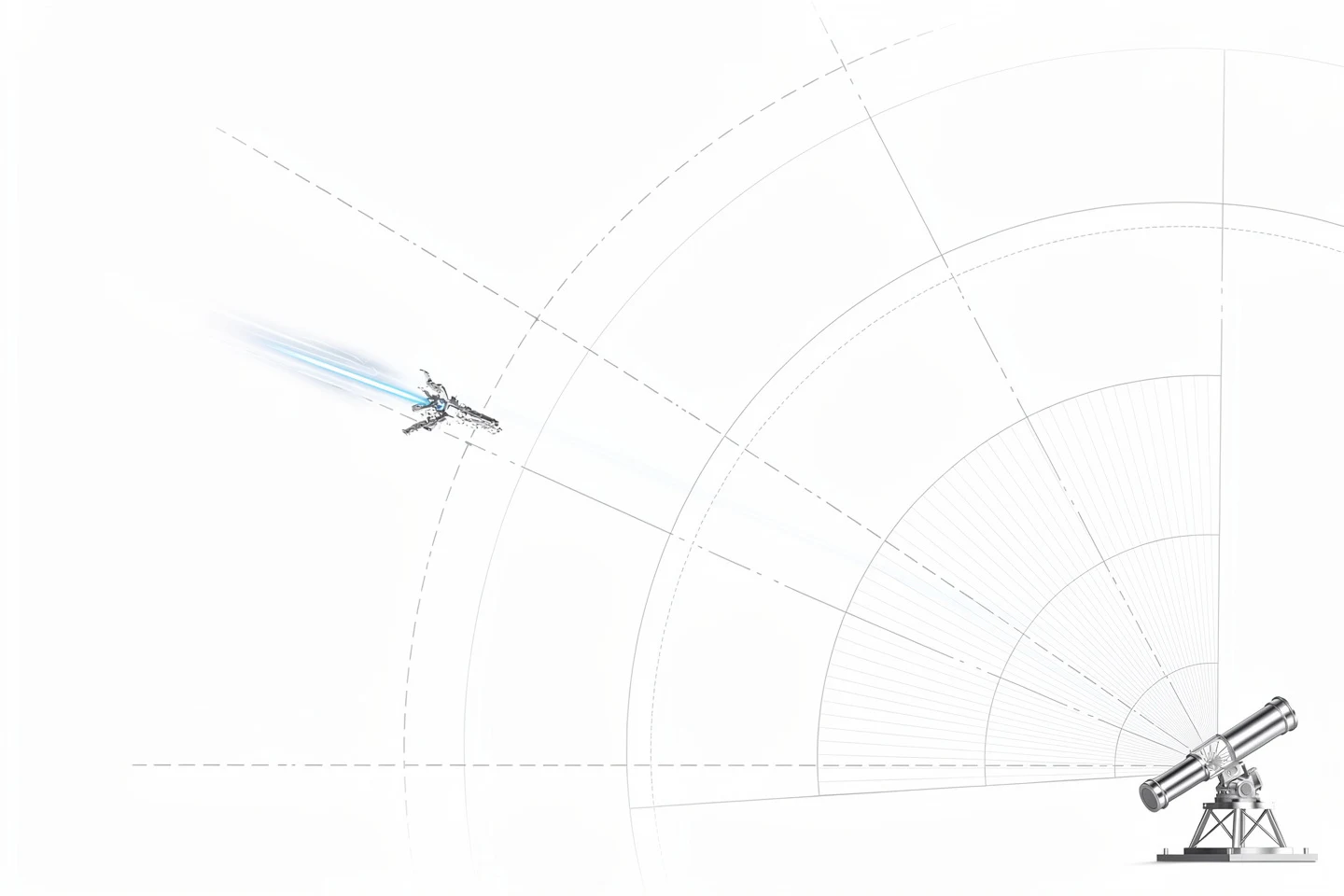
Photographing a car speeding by is an impossible task. From a distance it seems to barely crawl, but up close it turns into a blurry ghost. Astronomers face a similar puzzle trying to spot interstellar wanderers — comets and asteroids from alien stars. Since 2017, we’ve noticed only three, even though models predict millions.
It all comes down to their breakneck motion across the sky. Telescopes identify targets by changes in brightness (photometry — the art of light measurement), but if a dot moves too fast, its trail smears, and the instruments can’t keep up. Dark rocky chunks become visible only near Earth, when their motion is greatest. Bright comets in gas cocoons, on the other hand, shine from afar and creep along slowly.
The interstellar bodies closest to us most often slip from view: their speed across the sky is off the charts. Half of these dim wanderers move faster than 1.5 degrees per day: that’s beyond the capability of many telescopes. To catch them, scientists analyze light (spectroscopy)—encoded within it are signs of carbon dioxide and other substances that bubble away under the Sun's heat. The hunt is akin to searching for exoplanets: you need to fish out a fleeting signal from the noise.
ʻOumuamua, the fastest of the interstellar visitors, streaked across the sky at 12.2 degrees per day — equivalent to 24 lunar disks. We only spotted it as it was already racing away from the Sun.
In Arthur C. Clarke’s novel ‘Rendezvous with Rama,’ a giant cylinder arrives from interstellar space, remaining a mystery to humanity. Real objects are much smaller, but their appearance stirs a similar scientific thrill.