High-Speed Interstellar Visitors: How Motion Across the Sky Hampers Their Discovery ✛ ✦
Context
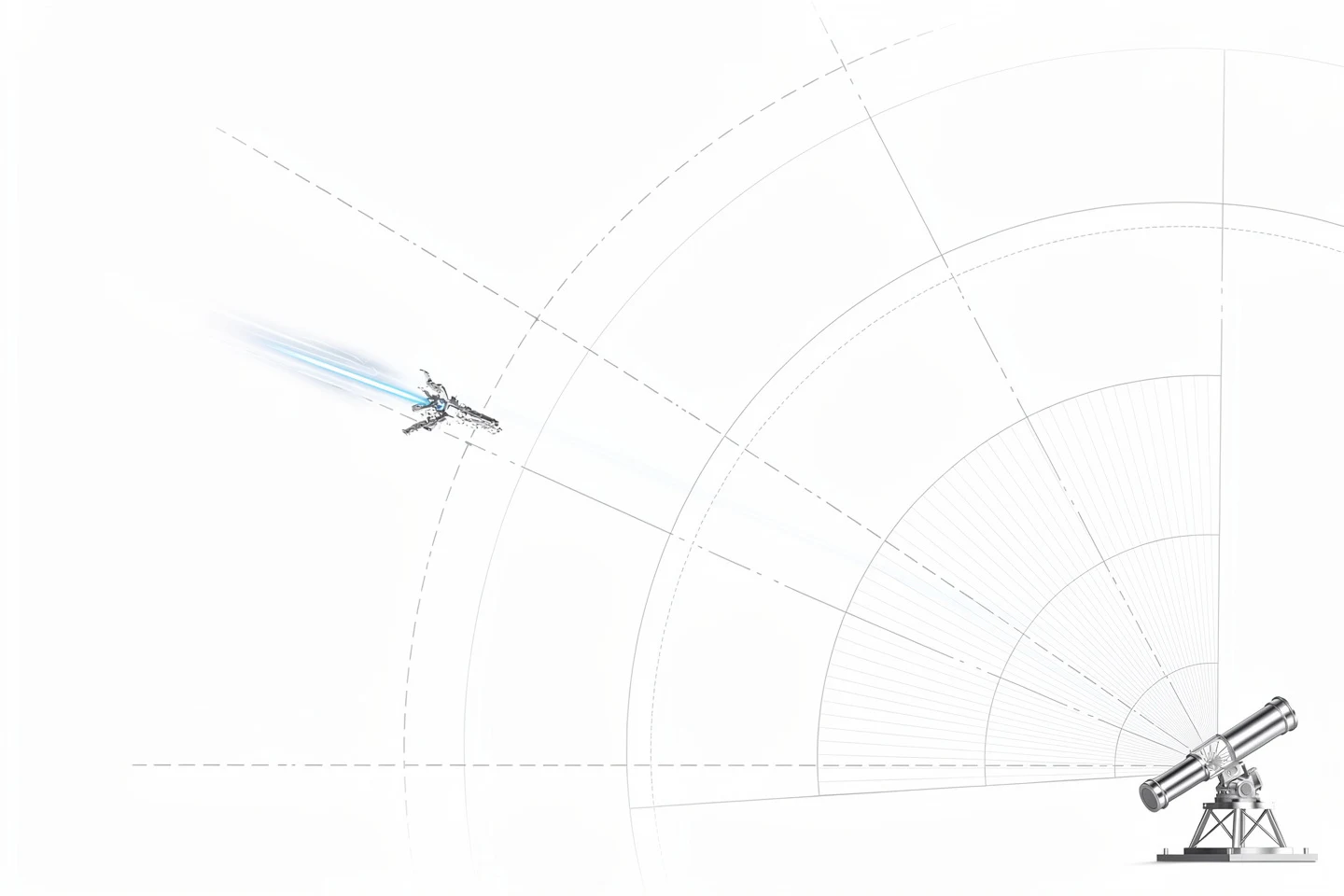
Interstellar objects — comets and asteroids arriving from beyond the Solar System — are unique probes for studying the composition and dynamics of other planetary systems. Their detection became possible thanks to modern survey telescopes like PanSTARRS and ATLAS, which use photometric methods to spot faint moving sources. Yet the meager haul—just three in a decade—raises the question: why aren’t we seeing more of them, when population estimates predict millions of objects?
Methods
To estimate the typical sky motion of interstellar bodies, astronomers developed an analytical solution that computes an object's angular speed from its hyperbolic orbit and Earth's position, without the need for heavy numerical integration. Unlike traditional approaches, this method is computationally light and applies to any moving object observed from Earth. Using a probabilistic model, the authors generated synthetic populations of about 100,000 interstellar objects within heliocentric spheres of radii 1.2, 3.0, and 5.0 AU (around the Sun), corresponding to Earth’s vicinity, the inner Solar System, and the distance of Jupiter. For each object, the apparent magnitude was calculated along its hyperbolic path, and then its angular speed was determined at the moment it reached a set brightness threshold. Active comets were modeled separately, accounting for brightening due to sublimation of volatiles like carbon dioxide.
Results
The results showed that the distribution of angular speeds strongly depends on the objects’ intrinsic brightness. Faint bodies like 1I/'Oumuamua (absolute magnitude $H_V$=22.08), when they reach detectable apparent brightness (say, 19th magnitude), have typical speeds of a few degrees per day, with a median of about 1.6 deg/day for objects within the 1.2 AU sphere. This is close to 'Oumuamua’s record speed at discovery (6.6 deg/day), but a large chunk of the population moves even faster. Conversely, bright objects such as 3I/ATLAS ($H_V$=17.1) are spotted at greater distances and thus have noticeably smaller angular speeds—median around 0.9–1.3 deg/day. Comets with active outgassing, modeled with brightness enhancement as they approach the Sun, show even lower speeds because they become visible far out. For example, for nuclei 100 meters and 1 kilometer across, typical speeds at a threshold magnitude of 19 are below 0.5 deg/day. Spectroscopic observations of known interstellar comets confirm their composition rich in hypervolatiles, which is what creates a bright gaseous coma.
Implications
These findings suggest that the rapid sky motions of interstellar objects might be a key factor limiting their detection by current surveys. This is especially true for faint asteroid-like objects that only brighten enough near Earth, where their angular speed peaks. Much like the challenge of detecting exoplanets with the transit method, which demands high time cadence, here we need fast track recognition and linkage. Moreover, LSST’s alert limit of 10 deg/day means many bodies akin to 'Oumuamua will be missed.
Future development
In the future, scientists plan to adapt this analytical method to simulate specific survey strategies, taking into account signal loss from trailing and objects’ positions relative to the Sun. This will help optimize automated detection algorithms and link the observed population to the true size and orbit distribution of interstellar bodies.
Impact
The results are important for planning future surveys like the Legacy Survey of Space and Time (LSST) and for mining archived data where missed objects may be lurking.
Next steps
The next step will be to incorporate realistic detection criteria into population models and to search for slow-moving interstellar objects in the outer Solar System, where their angular speeds are minimal.
Key open problems
The study connects the shortage of observed interstellar objects to the broader challenge of mapping small bodies within and beyond the Solar System, as well as to understanding the dynamical evolution of planetary systems.
The knowledge machine's view
This section is addressed to the author of the paper and their colleagues. Neighbouring works were found by meaning-based search across our archive, not by word overlap. We do not review: we show the field around the work.
What the work does
The study develops an analytical model for calculating the angular velocities of interstellar objects on hyperbolic orbits, generates synthetic populations of up to 100,000 objects within heliocentric spheres of radius 1.2–5.0 AU, and shows that the velocity distribution strongly depends on intrinsic brightness: faint objects move faster across the sky, while bright comets move slower because they are detected at greater distances.
Where its strength is
The strength lies in the analytical approach, which allows for quick and accurate estimates of angular velocities without numerical integration, and in the quantitative demonstration of how the detection threshold biases the observed population of interstellar objects.
Where it could go next
- It might be interesting to compare your results with a recent study of quasi-interstellar objects—bodies that temporarily leave the Solar System and return, mimicking an interstellar origin. Their angular velocities upon re-approaching the Sun may fall in the same range as those of faint interstellar visitors, and your model could help estimate how often such objects are misclassified as interstellar.based on: Quasi-interstellar objects: when the Solar System meets its own exiles arXiv:2607.04216v1
- A related work examines how an interstellar object passing through the Oort cloud perturbs comet orbits. One could extend your model to the outer regions of the Solar System and see how perturbations from interstellar bodies affect the influx of long-period comets, which are then observed with high angular velocities.based on: A Stellar Visitor Stirred Up the Comet Cloud arXiv:2606.25069
- It would be interesting to compare your findings with a study where an interstellar object exhibits rapid mass loss. If such objects fade faster than assumed, their detectability at large distances may be lower, further shifting the observed angular velocity distribution toward fast, faint bodies.based on: Interstellar Visitor Slims Down Before Our Eyes arXiv:2606.01377
Worth trying
- Apply your analytical formula to a sample of known fast-moving objects, such as hyperbolic comets, to test how well it predicts their observed angular velocities.
- Assess how future surveys with deeper magnitude limits (e.g., LSST) will change the median angular velocities of detectable interstellar objects, using your model.
- Consider jointly modeling angular velocities and light curves for active comets to refine how sublimation affects detectability at different distances.
Why this may matter
Understanding how sky motion affects the detection of interstellar objects is critical for planning future surveys and interpreting current statistics: without accounting for this effect, we risk underestimating the population of faint, fast-moving bodies, which may be the most common messengers from other planetary systems.
Nearby works in our archive
- Earth's Shadow Hunts for Alien Probessimilarity 0.65
- Return of the Galactic Ghosts: Our Own Among Strangerssimilarity 0.63
- Quasi-interstellar objects: when the Solar System meets its own exilessimilarity 0.63
- A Stellar Visitor Stirred Up the Comet Cloudsimilarity 0.62
- A Lunar Telescope Will Reveal the Shadows of Distant Black Holessimilarity 0.61
- How Spin and Hidden Companions Confuse Stellar Agessimilarity 0.61
- Interstellar Visitor Slims Down Before Our Eyessimilarity 0.61
The closest work in the archive sits at 0.65 by meaning — the usual level for our corpus.
Original abstract
as written by the authors arXiv:2606.05344v1
In the past decade, three macroscopic-scale interstellar objects have been discovered, implying that a larger galactic population exists. In this paper, we investigate the possibility that the rapid sky-plane velocities of interstellar objects may preclude their discovery. We provide an analytic solution for the apparent sky motion of an object on an arbitrary orbit observed at an arbitrary location which is more efficient and requires less overhead than the numerical approach. This formula is applied to evaluate the typical sky motion of an interstellar object as a function of its orbit and limiting magnitude/distance. We generate three synthetic populations of $$\sim10^5$$ interstellar objects within heliocentric spheres of radii 1.2, 3.0, and 5.0 AU, and calculate the sky motion for these objects when they reach a range of limiting magnitudes for multiple populations of interstellar asteroids and comets. The sky motions of the three known interstellar objects are broadly characteristic of populations with similar absolute magnitudes. Moreover, the intrinsically brighter objects reach detection magnitude thresholds at lower on-sky speeds than the dim objects, and active comets at even lower speeds for the same apparent magnitudes. The tails of these distributions extend to speeds faster than the discovery motion of 1I. Therefore, the potentially rapid sky motion of interstellar objects should be taken into account when attempting to link hyperbolic trajectories in survey data.
Interestingly, the fastest interstellar object, 1I/'Oumuamua, sped up to 12.2 deg/day — more than 24 full Moon diameters! At that rate, it could cross the entire sky in just a month.
The concept of interstellar wanderers echoes Arthur C. Clarke’s novel 'Rendezvous with Rama,' where a giant cylindrical object hurtles through the Solar System, remaining an enigma for humanity. While real objects are modest in size, their sudden appearance and unusual properties spark a similar scientific thrill.
Key numbers
- Speed of 1I/'Oumuamua at discovery: 6.6 deg/day
- Maximum speed of 1I: 12.2 deg/day
- Absolute magnitude of 1I: 22.08
- Median angular speed of faint objects (1.2 AU, m_V=19): 1.56 deg/day
- Fraction of faint objects reaching m_V=19 within 1.2 AU sphere: 56%