The Seven Faces of Disorder express
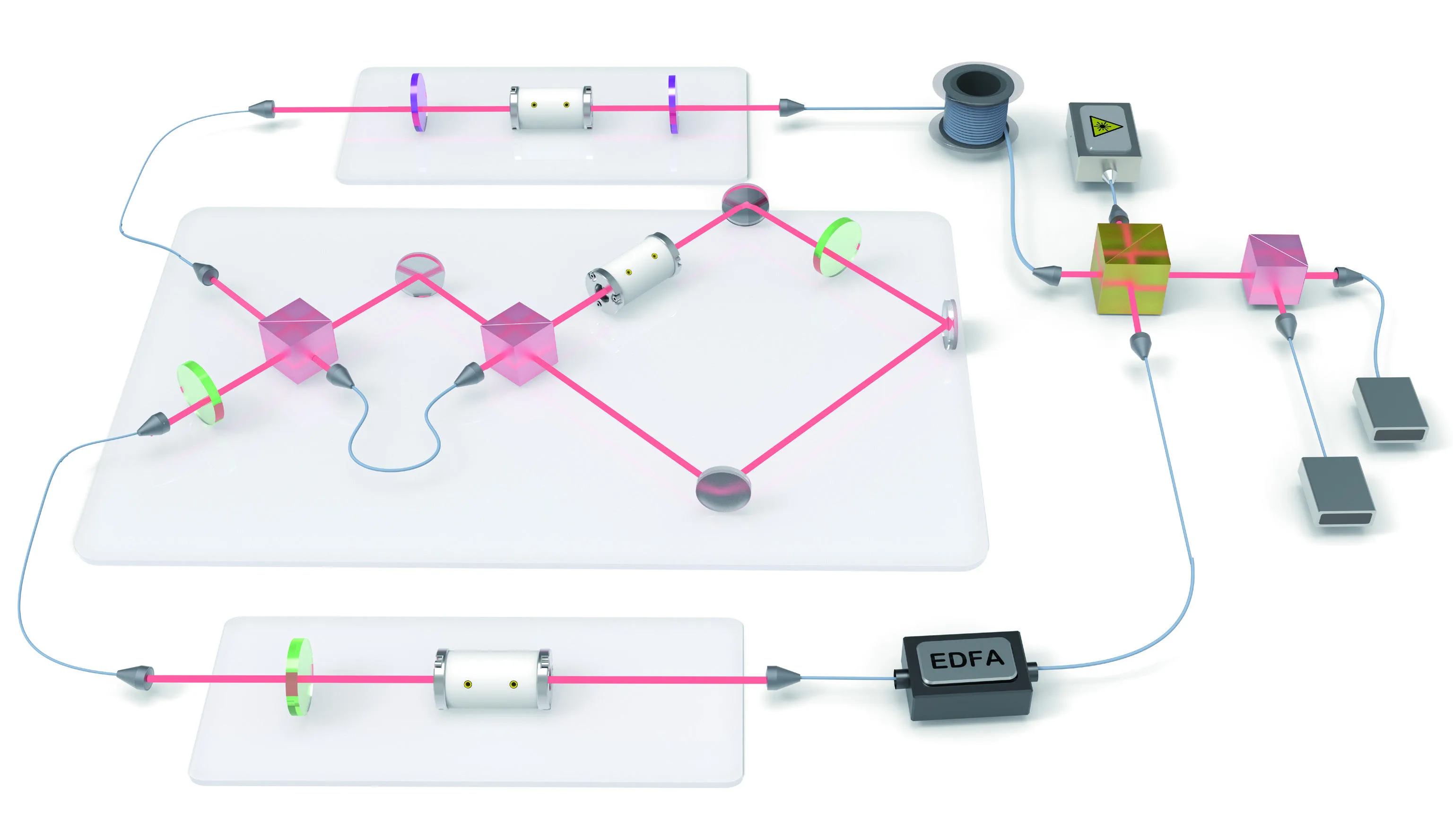
In 1958, Philip Anderson showed that strong disorder can stop a wave. Since then, physicists have discovered that between complete stoppage and free travel there are intermediate regimes. A particle can not only stand still or fly, but also jitter in place, pulse, or combine several types of motion at once. Theory predicted exactly seven such phases, but seeing them all in a single experiment had remained elusive.
An international team created a special medium for light — a photonic crystal with periodically varying couplings. Light in it behaves like an electron in a disordered metal, but with an important difference: the degree of disorder can be finely tuned. By varying the distances between waveguides, the authors obtained the entire spectrum of states — from ballistic escape to eternal localization.
The experimenters not only recorded the phases but also traced the transitions between them. It turned out that the boundaries are mobile: by changing just one parameter, one can smoothly shift the system from a fully conducting state to a fully insulating one, passing through all intermediate stops. This is like a landscape with valleys and passes, where each point corresponds to its own type of order.
Such a "seven-phase" crystal is not just a pretty demonstration. It provides a universal testing ground for ideas that until now lived only on paper — from multifractality to controlling coherent transfer. In the future, such structures could help create ultra-sensitive sensors and optical computers where a signal can be held or released at will.
Original abstract
as written by the authors arXiv:2606.14825
Anderson localization has evolved far beyond the conventional dichotomy between extended and localized states. Modern localization theory predicts a complete transport hierarchy comprising extended, critical, and localized phases together with all coexistence phases among them, forming a seven-phase Anderson-localization landscape. Despite its fundamental importance, this hierarchy has never been experimentally realized within a single system. Here we realize the complete seven-phase Anderson-localization landscape in a one-dimensional Floquet photonic lattice. By engineering quasiperiodic hopping profiles containing inhomogeneously distributed hopping zeros, we generate critical states and enable their coexistence with extended and localized sectors. The resulting transport regimes are directly resolved through their distinct spatiotemporal dynamics, including ballistic expansion, confined critical oscillations, and persistent localization. We observe all seven phases, including the elusive triply coexisting extended-critical-localized phase, and experimentally track the phase transitions connecting them. Our results establish the first complete experimental map of the Anderson-localization landscape and provide a unified platform for investigating mobility edges, multifractality, and programmable coherent transport.
The term "Anderson localization" emerged after Philip Anderson tried to explain why electrons sometimes get stuck in dirty metals, even though by all laws they should move. His 1958 paper began with the phrase: "We assume that with sufficient disorder, diffusion ceases." Today, this phenomenon is observed not only for electrons but also for sound, light, and even ultracold atoms.
In Greg Egan's novel "Distress," a civilization is described that has learned to alter the degree of quantum disorder in space, turning some regions into impenetrable walls and others into perfect conductors. The seven phases from the new work are almost a ready-made instruction manual for such a world.