Spacetime Bricks: How Tensor Networks Catch an Elusive Field Theory express
In quantum physics, there are theories where everything follows clear proportions, like a musical rhythm that always returns to the beginning of the bar. But there are also 'irrational' theories where the rhythm breaks and predicting the next beat is nearly impossible. One such theory is the compactified boson: a particle lives on a circle, and its behavior depends on the radius of that circle. If the radius is not a simple fraction, the theory becomes irrational, and calculating it is extremely difficult.
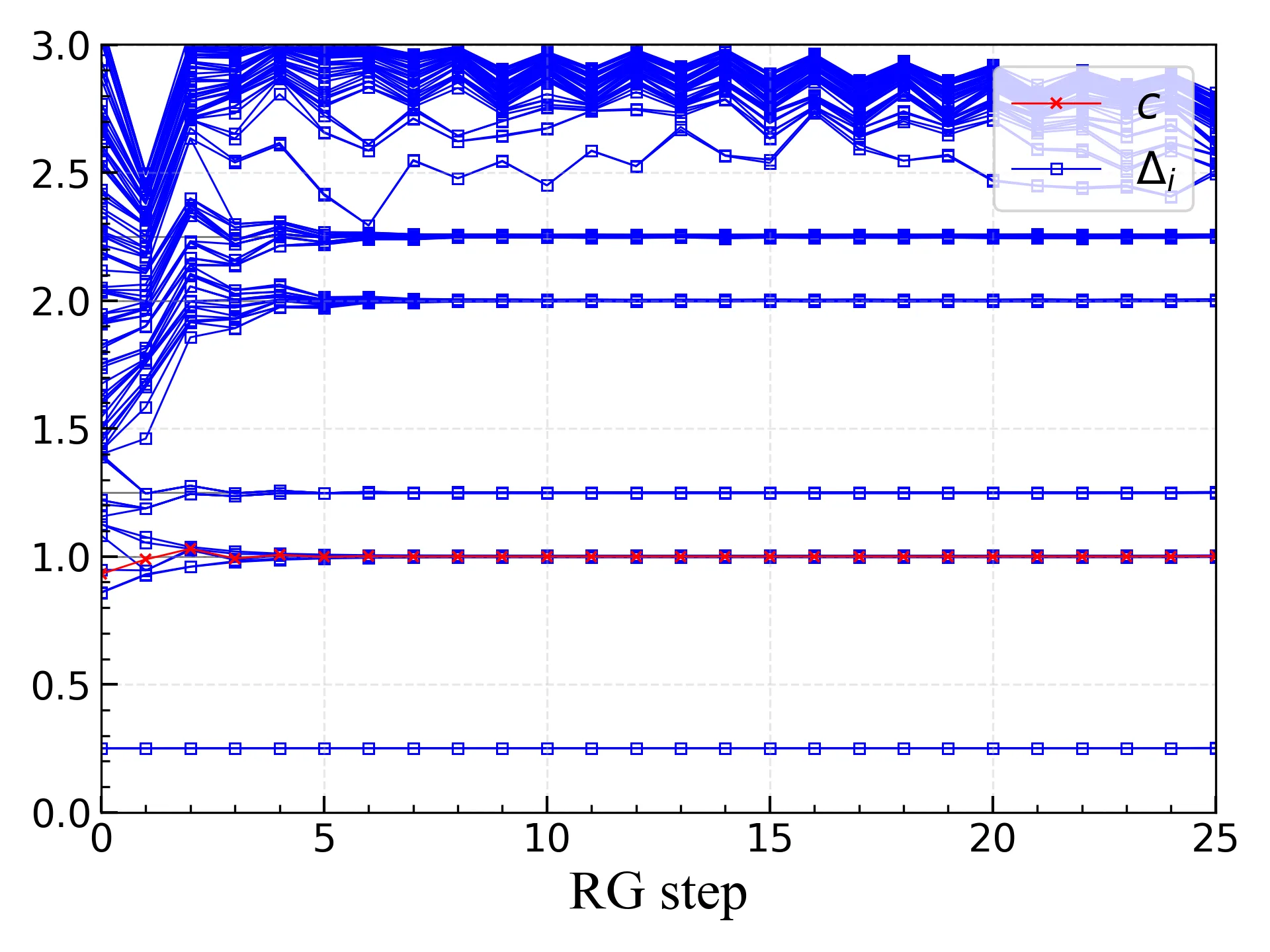
The authors of the new work figured out how to 'catch' this theory in a net of fixed points — tensor networks of spacetime curvature. Each point acts like a knot in a fishing net, but instead of fish, it holds a piece of reality. First, the scientists took boundary data, open strings that end at the edges of the world, and built the network. It reproduced the behavior of closed strings with an error of less than one percent.
But the real surprise was waiting inside one node. There, a 'tuning knob' was found: by adjusting it, one can smoothly transition from one irrational theory to another. This is like turning a volume knob that changes not the sound, but the very physics of the particles. It's as if you tweak one part of an engine, and a gasoline engine turns into a diesel one, without replacing the other parts.
This approach is a bridge between the discrete world of computation and the continuous fabric of reality. If networks of fixed points can handle irrational theories, they might also help in understanding quantum gravity. Spacetime itself may be made of tiny 'bricks'—and these networks show how they can be assembled.
Original abstract
as written by the authors arXiv:2607.03534
Fixed-point (FP) tensor networks provide a discrete spacetime representation of conformal field theories (CFTs), offering a new route toward understanding holographic duality, generalized symmetries, and even quantum gravity. In this work, we construct FP tensors for the 2D compactified boson theory at a generic compactification radius, an archetypal irrational CFT, using boundary (open-string) data with conformal boundary conditions. We show that the resulting tensors reproduce the closed-string spectrum with high accuracy and generate stable renormalization-group (RG) flows under the tensor complex renormalization algorithm. Moreover, we identify a controllable exactly marginal deformation at the level of a single tensor, enabling flows that move continuously along the $$c=1$$ moduli space. This framework establishes a concrete lattice-level route toward describing a broad class of 2D irrational CFTs.
Irrationality in physics is not a flaw but a property: such theories often arise when describing systems with an infinite number of states, and their spectrum never repeats, like the digits of π.
In Isaac Asimov's novel 'The End of Eternity', reality is changed by manually tweaking parameters — much like in this work, where one 'knob' in a tensor smoothly deforms an entire theory.