Tensor networks are a family of computational techniques that represent the quantum state of a many-body system as a network of interconnected tensors — multidimensional arrays of numbers. Instead of storing the full wavefunction, which grows exponentially with the number of particles, a tensor network compresses the information by exploiting the local structure of interactions. This makes it possible to simulate quantum systems that would otherwise be intractable on classical computers, such as chains of interacting spins, superconducting circuits, or the behavior of particles in a quantum fluid.
History
Tensor networks were introduced in the 1990s, with the Density MatrixRenormalizationGroup developed by Steven White in 1992 as a precursor. The formal framework of tensor networks, including Matrix Product States, was established in the early 2000s by Guifré Vidal and others.
How it works
The key idea is to decompose the huge wavefunction into smaller tensors connected by contracted indices, forming a graph. The geometry of this graph (e.g., a chain, a tree, or a more complex lattice) reflects the entanglement structure of the system. Algorithms like the Density MatrixRenormalizationGroup (DMRG) iteratively optimize the tensors to find the ground state or time evolution of the system. By adjusting the 'bond dimension' — the size of the connections between tensors — one can trade accuracy for computational cost, making the method flexible and powerful.
Quantum systems made of many particles are the basis of future computers and secure networks. But the more particles there are, the harder it is to understand how they are arranged: the number of possible states grows like an avalanche. The usual approach, measuring everything, takes an incredibly long time.
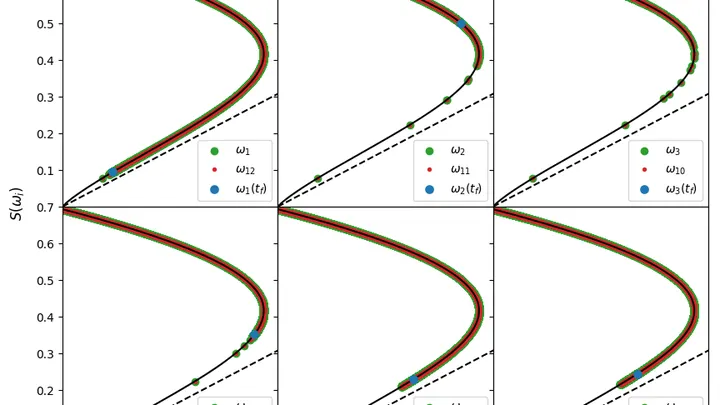
A quantum computer isn't just a bunch of qubits: it's a whole city, where each resident is one of the machine's possible states. Residents get to know each other through weak interactions between qubits: if one state can transition to another, a thread of acquaintance is drawn between them.
A drop of ink in a glass of water spreads in intricate swirls. Similarly, a quantum particle exchanging energy with its environment changes its state in a complex and entangled manner. Describing this dance between particle and environment has long baffled scientists.
An electrical grid stuffed with power electronics resembles a huge orchestra without a conductor. Each converter, each line adds its own note, and sometimes the instruments start playing out of tune.
Water from a faucet boils quickly, but in the last moment before the boiling point, everything seems to freeze — bubbles hesitate, the temperature stalls. So it is in quantum systems: when a material approaches a critical point, its internal clock stretches to infinity.
For a long time, identifying quantum phases was like interrogating a witness: you had to reach every corner of the system to uncover its secret. In the era of Landau, order was tied to symmetry breaking and a local parameter — everything plain as day.
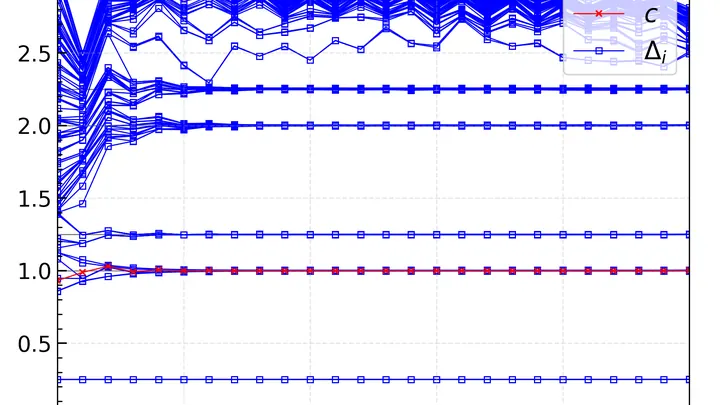
In quantum physics, there are theories where everything follows clear proportions, like a musical rhythm that always returns to the beginning of the bar. But there are also 'irrational' theories where the rhythm breaks and predicting the next beat is nearly impossible. One such theory is the compactified boson: a particle lives on a circle, and its behavior depends on the radius of that circle.
Three dancers move as one: each feels all the others, and the overall harmony cannot be reduced to individual interactions. This is roughly how three particles behave, born from an electron and positron collision at the speed of light. They are a top quark, its antiparticle, and a Z boson.
A thrown stone follows a smooth arc: its path is easy to predict. But if the stone skips across water, the trajectory becomes jagged and far more interesting. Quantum particles behave much the same way when their state is not a calm wave with fixed energy but a turbulent mix of several waves at once.
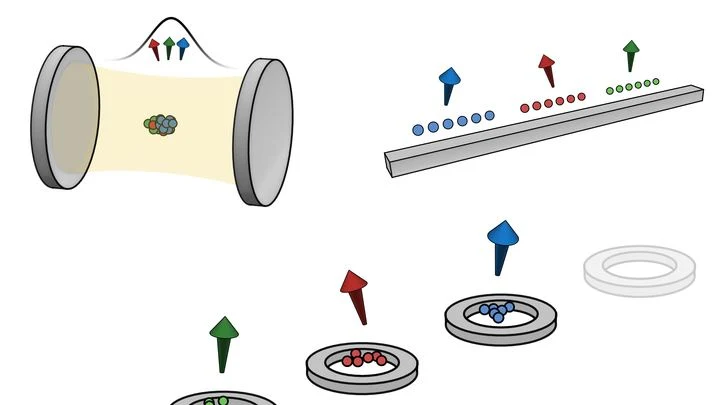
An invisible trap made of laser light held 11,000 atoms — a record for quantum engineering. Previously, physicists wrestled with a few dozen of these particles; now the count runs into the thousands. Each atom becomes a qubit — a quantum bit that is both zero and one at once, like a spinning coin balanced on its edge.
Neutrinos are nearly elusive particles that permeate everything around us. In a dense cloud, such as during a star explosion, they begin to collectively change their type, or 'flavor.' This process is like a crowd of people synchronously changing the color of their clothes, but not all at once — rather in waves.
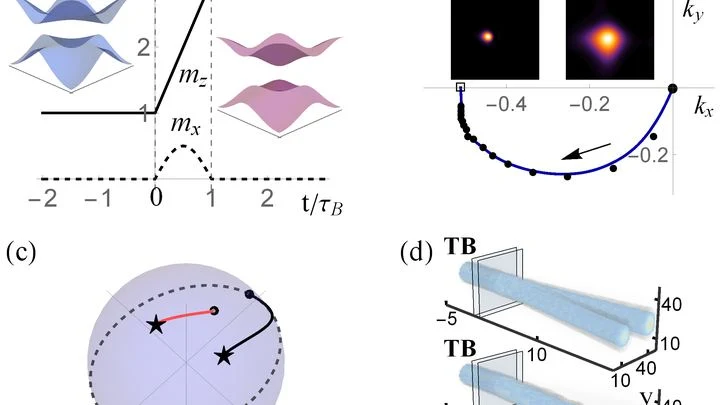
A stone falls into a pond, and ripples spread across the water. They reflect off the shore, overlap, and die out. All this motion unfolds in space. But what if the pond itself changed its depth or density for an instant — not at one point, but everywhere at once? A temporal boundary is exactly such a jump in properties over time, not space.
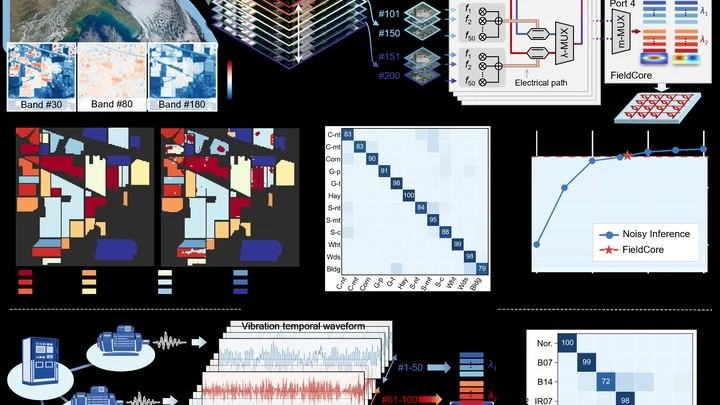
A typical computer shuttles electricity along copper traces, and every operation is a queue: first one thing, then another. Light works differently. In a single beam, you can mix dozens of signals without them interfering, like different voices in a choir, singing at once but each heard distinctly.
The new FieldCore chip uses five such "voices" at once.
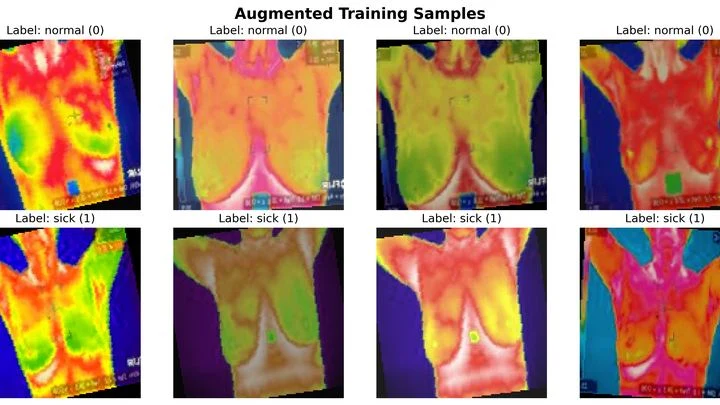
The hot air above asphalt shimmers, betraying the heated surface. Medical thermography works in a similar way: the skin over a tumor is often slightly warmer than healthy skin — by just fractions of a degree. Computer programs try to catch this difference and determine whether it's dangerous.
Inside an exploding star, neutrinos race so densely that they start to influence each other. Their quantum states become entangled, like threads in a tight ball where you can no longer tell which is which. Ordinary computers struggle with this task, as the number of possible states grows avalanche-like.
In a cold cloud of atoms chilled to near absolute zero, energies can behave like threads that weave into braids. These braids are not just a pretty image: their pattern is tied to topology, the branch of mathematics that studies properties preserved under continuous deformations.
An ice cube in tea melts without a trace. Similarly, quantum systems usually quickly forget their past. But under strong disorder, many-body localization emerges — particles seem to freeze, preserving memory.
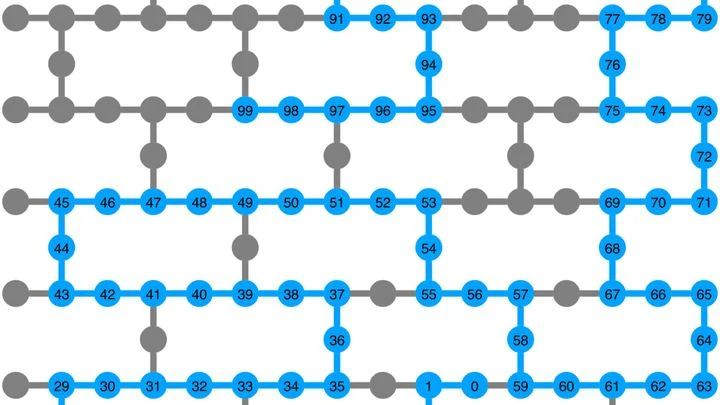
The experiment on IBM's 144-qubit processor lasted 5000 cycles.
A rope braided from a hundred short strands can be twisted to the right or to the left. Each strand individually doesn't know which way the whole rope is twisted, but try to unravel it, and the difference immediately shows. That's roughly how the states physicists call symmetry-protected are arranged: locally they are indistinguishable, but globally they are different.
A hundred fireflies in a jar blink out of sync, but once they synchronize, their flashes merge into a bright pulse. Quantum emitters, individual atoms or artificial particles that can emit photons, behave in much the same way. When there are many of them and they interact, calculating their collective behavior is no easy task.
On an ordinary optical table, amid lasers and mirrors, a cloud of a hundred strontium-87 atoms begins to live by the laws of curved spacetime. Half a second later, its quantum interference fades: gravitational time dilation destroys the superposition.