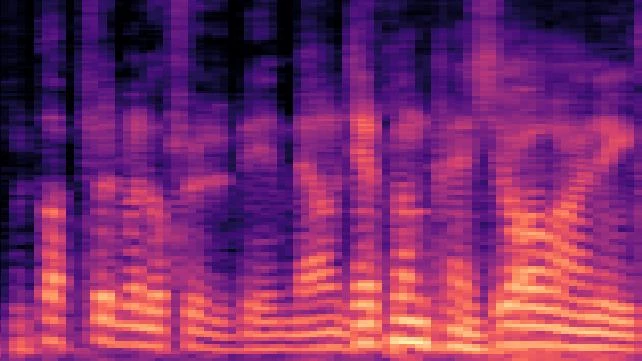
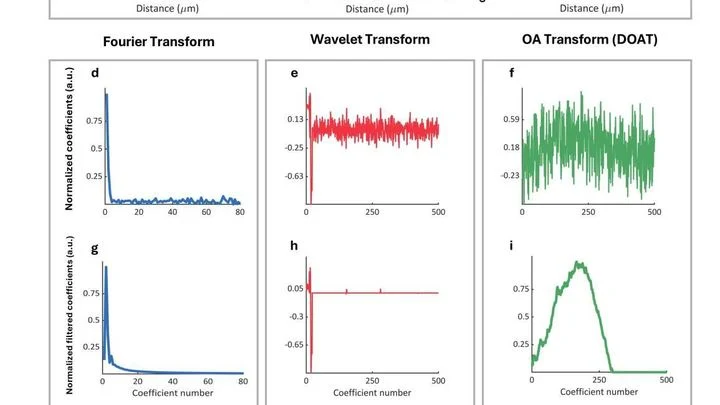
The Fourier transform is an integral transform that maps a function of a real variable (often time) to a function of a complex variable (frequency). It decomposes the signal into an orthogonal basis of harmonic oscillations. The result (spectrum) shows the amplitude and phase of each frequency component. The inverse transform allows reconstructing the original signal. Thanks to the Fast Fourier Transform (FFT), the algorithm works very quickly and is used everywhere in signal processing.
History
Jean-Baptiste Joseph Fourier in 1807 (published in 1822) in a memoir on heat propagation showed that an arbitrary function can be expanded into a trigonometric series. The idea met resistance from Lagrange and Laplace, who doubted the convergence of the series. Later, Dirichlet (1829) clarified the conditions. In the 20th century, Laurent Schwartz extended the transform to generalized functions (Dirac delta function). Today it is the basis of harmonic analysis.
How it works
Mathematically, the kernel e^{-iωt} acts as a 'probe': for each frequency ω, we compute the correlation of the signal with a harmonic oscillation of that frequency. The integral measures the 'similarity'. Thanks to the orthogonality of sinusoids, the decomposition is invertible without loss. The Fast Fourier Transform uses the symmetry of complex roots of unity, reducing the computation of a large matrix to a series of small ones. In quantum mechanics, the wave function in momentum representation is the Fourier transform of the coordinate wave function, and the relation Δx Δp ≥ ħ/2 follows directly from the properties of the FT.
In practice
Image compression (JPEG), noise filtering in audio, signal analysis in MRI and radar, digitization of music — everywhere where it is necessary to isolate frequencies or remove interference.
Fun fact
In quantum mechanics, the momentum representation of the wave function is the Fourier transform of its coordinate representation. The Heisenberg uncertainty principle arises from the properties of the Fourier transform: the narrower the signal in time, the wider its spectrum.
Imagine a simultaneous interpreter in a room where two people are speaking: they must keep up with both meaning and intonation, but if the speech is too fast, only a paraphrase remains. That's roughly how scientists feel as the stream of gravitational waves from black hole and neutron star mergers grows, while precise signal calculations lag behind.
An interpreter gets distracted by every rustle in the hall, and a one-hour meeting stretches into two. Similarly, molecular foundation models learn the language of molecules from vast corpora, but each new conversation requires fine-tuning. Monroe changes the rules: it doesn't learn a new language but instantly finds common meaning from a few examples.
Waves on the water's surface usually break against any obstacle — a rock, a piling, an island. But what if you arrange obstacles so cleverly that the wave barely notices them? In a new study, scientists assembled a pattern of many points on the water, arranged according to special mathematical rules, and sent waves through them.
Light escaping a massive body loses steam. Its frequency dips slightly, and its color shifts toward red. Physicists call this gravitational redshift. In classical theory, it's all clear, but the moment you bring quanta into the picture, trouble starts.
Previously, this shift was modeled as a kind of mode mixer — a device that entangles different states of light.
The quantum networks of the future resemble the Tower of Babel: each node speaks its own dialect. Some store information in the polarization of a photon — the direction of oscillation of the light wave. Others use time bins: that is, when exactly the pulse arrives.
A human effortlessly picks out the desired voice from the clamor of a party. For a computer, the same task is still at the edge of its abilities. Previous programs trained on sterile recordings, free of echo or the clinking of appliances.
Models that turn text into audio are good at recreating single sounds, but get confused when the script has several in a row. For example, the script might call for a ring, then footsteps, then a door slam. The generator might shuffle events, so the listener hears footsteps before the ring.
Learning a foreign language is like tuning a musical instrument. The new technology works like a smart tuner: it takes your recording and a native speaker's reference speech, stretches or compresses them in time (like adjusting a string) to align them precisely, and evaluates three key parameters: clarity of sounds, rhythmic precision, and intonation.
Data analysis on the internet or sensor systems has long resembled trying to conduct an orchestra where each musician is locked in their own booth, and the conductor cannot leave the podium.
In fast-moving vehicles, mobile internet slows down: the signal, traveling at the speed of light, blurs like the scenery outside the window. Engineers have found a way to pack data more densely without letting them mix up. It's like a multi-lane highway where packet-cars drive not with a safe interval, but almost bumper-to-bumper.
Traditional hearing aids resemble a chef who cooks from a recipe blindly. They analyze the sound chaos from the microphone and amplify speech based on it. In a noisy café, this approach often errs. The new system behaves like an experienced cook: first processes the signal, then samples the result.
Human hearing is wired so that the brain prioritizes familiar patterns — a friend's voice, the patter of rain, a car horn. But a new system works on a different principle: it registers any sound burst, even one never encountered before.
Tomographs don't produce ready-made pictures. They collect numerous 'shadows' — projections of innards from different angles or using various signals — and mathematically reconstruct a 3D picture from them.
A neural network that generates sounds from text is like a kitchen where dozens of chefs prepare each 'dish.' Many just get in the way — sending false signals and wasting resources.
Cleaning speech from noise is like tuning an old TV: twist the contrast knob too far, and faces become unnatural. Researchers separately adjusted the 'volume' and 'time shift' for each frequency of sound, as if splitting it into a rainbow — a method known as spectroscopy. It turned out the key knob is volume, not phase synchronization.
The standard way of digitizing speech: taking volume readings thousands of times per second. It's like tasting broth with a teaspoon: each sip is watery, with almost no detail. The data stream swells, though the substance is minuscule.
Scientists proposed first "simmering down" the audio signal.
A protein in a cell is not a frozen sculpture. It is constantly in motion: bending, breathing, jittering. This motion, its dynamics, determines how the protein works. But peering directly into the dance is hard, and computer simulations often demand enormous computing power.
A new approach, named DynaMode, views protein motion as a musical piece.
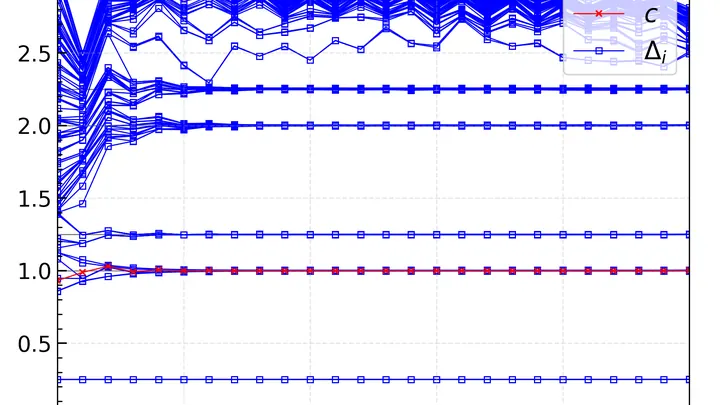
In quantum physics, there are theories where everything follows clear proportions, like a musical rhythm that always returns to the beginning of the bar. But there are also 'irrational' theories where the rhythm breaks and predicting the next beat is nearly impossible. One such theory is the compactified boson: a particle lives on a circle, and its behavior depends on the radius of that circle.
Imagine an interpreter sitting in a meeting room, translating every word. But then they notice their translation could improve if they learned from their mistakes. They start noting which phrases caused confusion and adjust them. Within an hour, their translation is more accurate and the meeting runs smoother.
A quantum memory node is a tiny diamond with a defect that can store and emit single photons. But its light has a wavelength of 637 nanometers, the same red as a ruby, and is almost completely absorbed after just a few meters of standard optical fiber.
Each vowel sound is a distinct shape of the mouth, tongue, and throat. When you say 'ah,' 'ee,' or 'oo,' not only does the air inside your head change, but so does the way radio waves pass through it. Researchers peered into this process using MRI scans taken right during speech and built a precise computer model of the head — from bones to soft tissues.
Training an accurate aerodynamic model is like culinary art: first, a chef masters hundreds of recipes to grasp the general principles, then easily perfects a specific dish. Engineers created AeroTransformer and fed it 30,000 different wing shapes — a whole galaxy of culinary ideas galaxy.
A quantum computer is like an orchestra where every musician must come in at exactly the right moment. Previously, to play a complex piece, you had to constantly move the instruments around — slow and noisy. The new scheme, called "parity architecture," keeps everyone in place, and the conductor simply changes the notes.
The quantum Fourier transform is like a musical instrument that breaks a signal into pure notes. If the instrument is slightly out of tune, the melody sounds wrong. Scientists are checking whether you can spot the detuning by listening to just a few random notes.
Previously, it was thought that if the instrument plays well on average, it would also work for complex pieces.
A beam of light passing through a transparent plate usually keeps its color. But if you stack the plate from thin alternating layers, it becomes a grating that reflects and transmits waves selectively. This has long been used in lasers and optical filters. Now such gratings have been made to vibrate, and light started changing color.
Light passing through ripples on a water surface paints dancing patterns on the bottom of a pool. Engineers have used a similar idea to make light compute. They fabricated a tiny plate with a wavy relief: each ridge and groove deflects rays in its own way. When an image falls on such a surface, the light transmitted through it converges at different points behind it.
A laser beam hits the skin, and tissues respond with a barely audible ultrasonic echo. From that echo, doctors can see blood vessels and tumors without making a single incision. But before the picture appears on the screen, the signal has to be cleaned of noise, just as a cook skims the foam off a broth to make the soup clear.
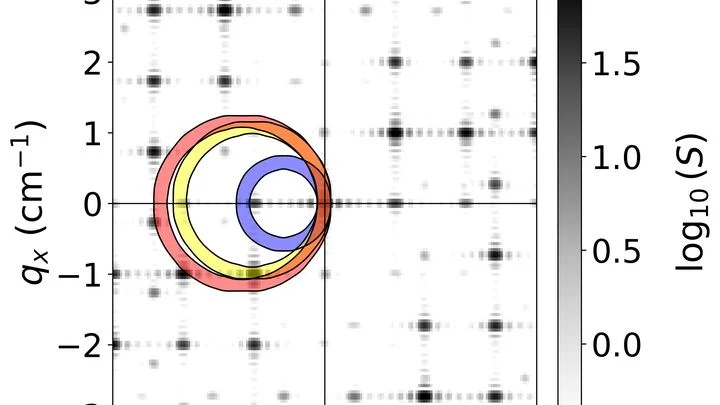
When an X-ray beam reflects off a crystal, it paints a pattern of spots and streaks on a detector. If the crystal is perfect, the pattern is simple. But inside a real material, atoms are often shifted — compressed in some places, stretched in others. The pattern then looks like ripples from a stone thrown into water, and deciphering it by hand is nearly impossible.
An ornithologist in the jungle hears a trill, but the bird is hidden in the foliage. It would be great to get its portrait right away — at least from a photo database. Usually, that requires thousands of pairs of “song recording + photo of the same bird,” and collecting them is expensive and time-consuming.
The authors took a detour: they used two ready-made models.
Old weather records hold surprises: the thermometer suddenly jumps by half a degree, not because of the weather, but because the station switched instruments. Such abrupt shifts in data are called changepoints, and separating them from genuine climate signals is a challenge statisticians grapple with.
Inside a tiny crystal, sound is trapped like light in a mirrored room. It bounces off the walls and forms standing waves — a multitude of harmonic oscillations, each with its own frequency. Physicists have learned to use these oscillations as qubits — the basic units of quantum information.
A beam of visible light enters a cloud of billions of rubidium atoms cooled to near absolute zero, and emerges on the other side already in the telecom range.
A translator at negotiations picks up not only the words but also the tone in which they are spoken. If they focus only on vocabulary, they might miss sarcasm or fatigue in the voice. If only on intonation, they could mistranslate the details of the contract.