A topological quantum computer is a theoretical approach to quantum computing that uses topological states of matter, such as Majorana fermions, to encode and process quantum information. The key advantage is that the quantum information is stored in global properties of the system, making it inherently protected from local perturbations and noise, which are the main obstacles to building practical quantum computers. This approach promises to reduce the need for extensive error correction.
History
The concept was proposed by Alexei Kitaev in 1997 and later developed by others, including Michael Freedman and Chetan Nayak. The search for Majorana fermions in solid-state systems has been ongoing, with promising but debated experimental evidence in recent years.
How it works
The idea is to use quasiparticles called non-abelian anyons, such as Majorana zero modes, which can be braided around each other in two-dimensional space. The quantum information is encoded in the topological state of the system, which depends only on the braiding history, not on local details. When the anyons are moved and exchanged, they perform quantum operations. Because the information is stored non-locally, local noise cannot easily destroy it, providing a natural form of error protection.
In practice
If realized, topological quantum computers could be used for any quantum computing application, such as simulating quantum systems, factoring large numbers, and solving optimization problems, but with significantly reduced error correction overhead.
Fun fact
The name 'Majorana fermion' comes from the Italian physicist Ettore Majorana, who predicted in 1937 that some particles could be their own antiparticles, a property that is key to their use in topological quantum computing.
An empty resonator isn't truly empty. Even in an absolute vacuum, where not a single photon exists, quantum fluctuations persist. They resemble ripples on water in a dead calm: the surface appears smooth, but molecules keep jittering. Physicists have learned to turn this jitter into real waves.
The quantum world is tricky: sometimes particles confined to a flat layer and pierced by a strong magnetic field start behaving like a liquid made not of whole electrons but of their fractions — fractional charges. This is the fractional quantum Hall effect.
For a long time, identifying quantum phases was like interrogating a witness: you had to reach every corner of the system to uncover its secret. In the era of Landau, order was tied to symmetry breaking and a local parameter — everything plain as day.
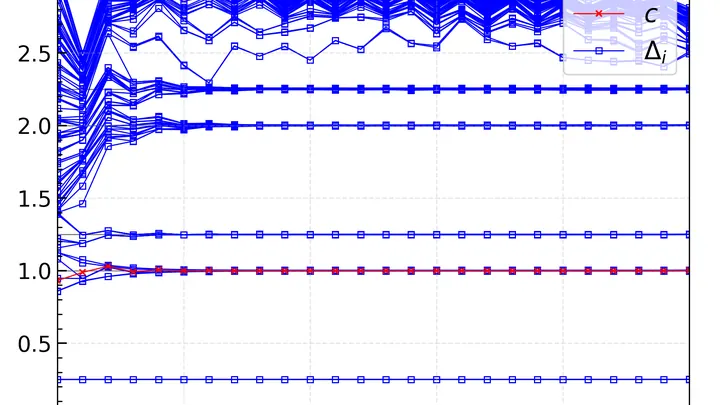
In quantum physics, there are theories where everything follows clear proportions, like a musical rhythm that always returns to the beginning of the bar. But there are also 'irrational' theories where the rhythm breaks and predicting the next beat is nearly impossible. One such theory is the compactified boson: a particle lives on a circle, and its behavior depends on the radius of that circle.
Two pendulums hang from the same crossbar. A push, and they start swinging, gradually falling into and out of sync. In a topological qubit, Majorana particles, special excitations that can store quantum information, play the role of these pendulums.
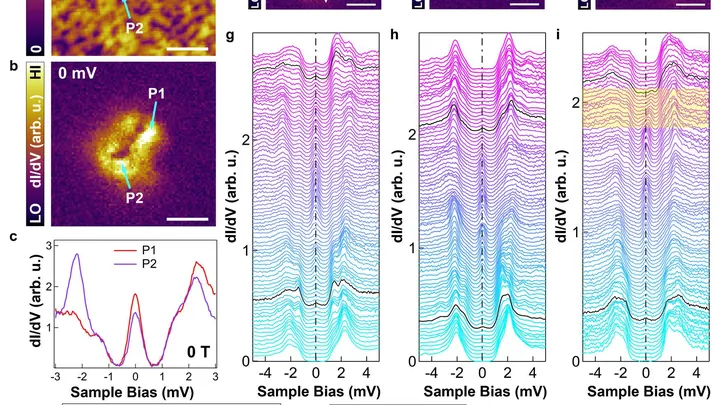
You're looking for a quiet room for an important conversation. You step into a space, and hear silence. But upon closer inspection, you find that in one corner the ventilation is simply broken, and in another there's a hole in the floor that absorbs sound.
A cloud of rubidium atoms falls into a trap made of light. Lasers and magnetic fields arrange it like a crystal lattice, but the cells here are not fractions of a millimeter: they are fractions of a micrometer.
Conventional neural networks learn from thousands of examples, burning hours and gigawatts. Physicists have found a quantum workaround. As early as Max Planck showed the discreteness of energy, today this allows generation without training.
A driver turns the steering wheel to make the car turn. The quantum world also has its own "steering wheels"—external parameters that are slowly varied to shuttle particles from one place to another.
A pot of water boils, and molecules break into a chaotic dance. You cannot stop that moment or freeze the dance, but in the quantum world there is a workaround: you can create a 'double' of the system that stores all the information about its thermal state.
A drop of ink falls into a glass of water, and within a minute you can't tell where it landed. In the quantum world, it's even more dramatic: information about a local event spreads across the entire system so quickly that any point-like sensor soon stops feeling anything. This is called delocalization, and for quantum sensors, it sounds like a death sentence.
Among magnets, there are quiet masters of disguise. An ordinary magnet attracts paperclips and has two poles — north and south. But there are materials that are internally arranged like a magnetic chessboard: their atoms are aligned in a strict order, yet externally the material behaves neutrally, as if no magnet exists at all. Such substances are called altermagnets.
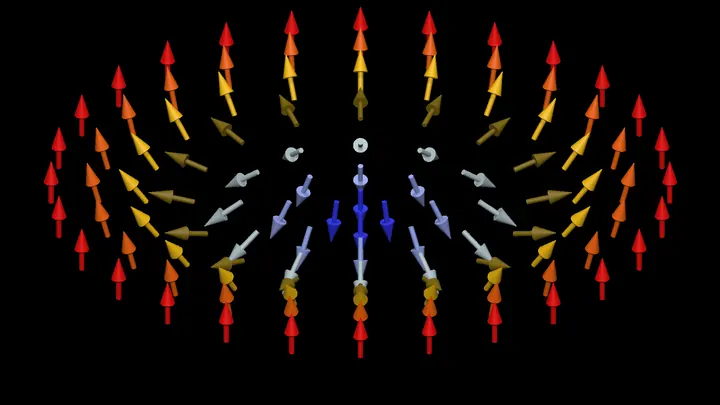
In a field trap, scientists assembled a crystal — 150 ions at ultra-low temperature. Each ion behaves like a tiny magnet, capable of rotating in any direction. By controlling forces that depend on this rotation, physicists made all the magnets swirl into a common vortex called a skyrmion.
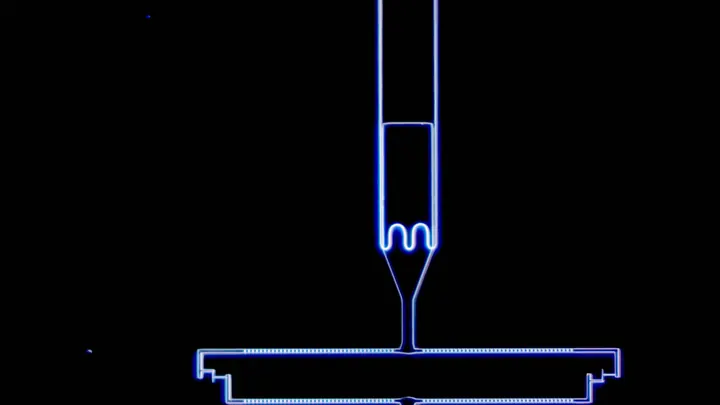
An ordinary superconducting qubit is like a swing that any gust of wind can set rocking. The slightest change in electric charge nearby, and the quantum state is already spoiled.
A rope braided from a hundred short strands can be twisted to the right or to the left. Each strand individually doesn't know which way the whole rope is twisted, but try to unravel it, and the difference immediately shows. That's roughly how the states physicists call symmetry-protected are arranged: locally they are indistinguishable, but globally they are different.
Inside every cell, chemical reactions are constantly underway, like a tiny kitchen where protein chefs whip up essential compounds. But seeing exactly how a chef prepares a dish is tricky when you're surrounded by a crowd of other molecules.
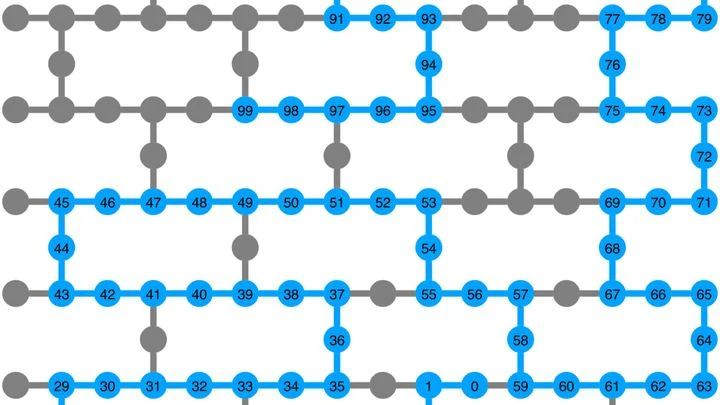
A quantum computer is like a pot of boiling water: particles are jostling around chaotically, and you need to calm them down to get a useful answer. In a new study, physicists have devised a way to cool a chain of 19 quantum spins (tiny magnets) right on a real device.
All matter, from stars to humans, is built from particles that in the Standard Model are divided into two families. But there's a third, rare kind — particles that, when swapped, don't just exchange places but tie themselves into a knot, remembering the intertwining rather than the path.
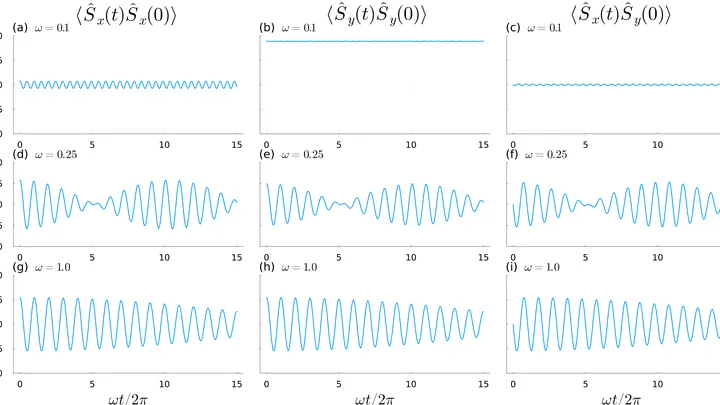
In the quantum world, noise usually destroys orderly behavior, like random jolts damping a pendulum. But on IBM quantum processors, physicists discovered the opposite: structured noise can prolong and even create rhythmic oscillations. It's like a pendulum that swings harder from seemingly chaotic yet internally synchronized pushes.