Who Spreads, Who Suffers: The Hidden Life of an Epidemic express
The orchestra plays without a conductor. We know the overall volume: that's the basic reproduction number R0, the spectral radius of the epidemic. But the score itself, the contact matrix between people of different ages, holds the melody: who spreads the infection and who takes the main blow.
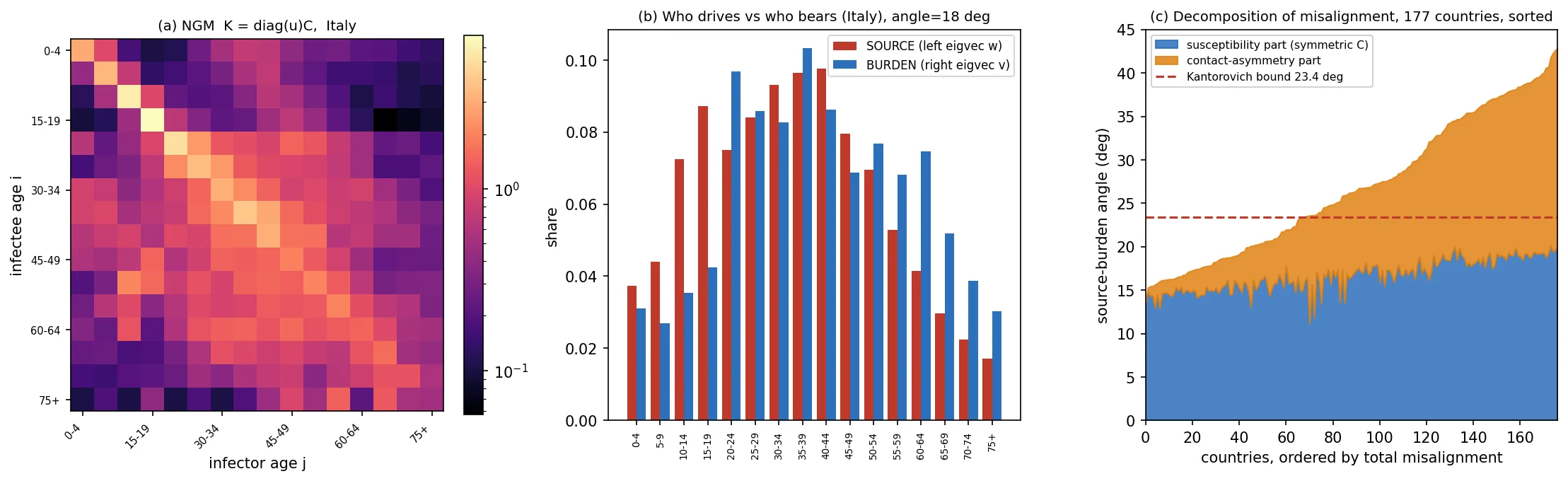
Researchers analyzed contact data from 177 countries, collected in the work by Prem et al., and saw a curious picture. In an ideal world, the 'sources' and 'victims' of an epidemic coincide: those who infect the most are themselves the ones who get sick. But in reality, these groups have diverged. On average worldwide, the angle between them was 26°, and in some countries more than 40°. It's like firefighters who put out the fire while remaining unharmed, while the flames rage in the next block.
The authors proved a theorem: when contacts are reciprocal (as many times as I meet you, so many times you meet me), this gap is bounded by the simple ratio of the highest susceptibility to the lowest. But in reality, contacts are not reciprocal, and the gap becomes even larger. Most troubling, a strategy aimed solely at reducing R0 sometimes misses the mark: it protects those who spread the disease, not those who die from it. As a result, the average mortality from the infection can even increase.
In some countries, the difference between those who spread the infection and those who suffer from it exceeds 40 degrees, as if a compass needle pointed not north but northeast.