Gregor Mendel, an Augustinian monk from Brno, spent eight years in the mid-19th century growing peas in the monastery garden and counting — by hand, grain by grain — thousands of plants. He noticed that if you cross two pure varieties (yellow and green), the entire first generation will be yellow. But when these yellow hybrids were crossed with each other, green peas suddenly reappeared in the second generation — exactly one quarter of the total. Mendel realized: hereditary factors do not blend like paints, but behave like discrete particles, which we today call genes. Each trait is determined by a pair of such particles, and when sex cells form, they segregate so that each gamete receives only one. The dominant variant masks the recessive one but does not destroy it — it can reappear in the next generation. Thus, genetics was born.
History
Gregor Mendel formulated the law in 1865 based on experiments with peas (Pisum sativum), published in 1866 in the journal of the Brno Natural History Society. He selected seven pairs of contrasting traits and traced their inheritance over several generations. The work remained unnoticed until 1900, when it was independently rediscovered by Hugo de Vries, Carl Correns, and Erich von Tschermak. Later, the law was confirmed cytologically: Walter Sutton and Theodor Boveri in 1902–1903 linked chromosome behavior in meiosis to Mendelian segregation, laying the foundations of the chromosomal theory of inheritance.
How it works
The law applies to monogenic traits with complete dominance. It underlies the prediction of the probability of recessive hereditary diseases in carrier families, is used in plant and animal breeding to fix desired alleles, and in genetic counseling. Limitations: the law holds only for genes located on different chromosomes or far apart on the same chromosome (no linkage), and provided that alleles do not affect gamete or zygote viability.
In practice
Breeders use this law to predict how many plants in the offspring will inherit a desired trait — for example, drought resistance or fruit sweetness. Without it, developing new wheat varieties or dog breeds would be impossible.
Fun fact
Mendel sent his work to Charles Darwin, but Darwin apparently never read it — the pages of the book remained uncut. Had Darwin known about Mendel's laws, he might have solved the main puzzle of his theory — how exactly traits are inherited.
A tightly stretched membrane, squeezed into a narrow case, decides on its own where to burst. So does a cell: when it is cramped, the point of division shifts from the middle, and the two halves come out unequal. Previously, it was thought that such asymmetry is predetermined by chemical labels, but the new work shows that mechanics alone is enough.
Life begins with a bubble. In a warm puddle on ancient Earth, fat molecules could gather into tiny spheres — prototypes of cells. Inside such a sphere, a polymer happened to be present that accelerated the uptake of new fats from the surrounding water. The bubble grew, divided, and passed its composition to offspring.
Two daughter cells receiving equal shares from the mother: that's the familiar picture of division. But what if one gets almost everything and the other just crumbs? Stochastic modeling shows that sometimes unequal division is more advantageous.
Each cell stores a protective reserve that helps it weather hardships. During division, this reserve is distributed between daughters.
Imagine a cookbook that gets rewritten from generation to generation. One day, the borscht recipe receives a secret ingredient from a pastry chef, and from that moment, the taste remembers not only ancestors but also a neighbor. In the Standard Model of evolution, genes behave the same way.
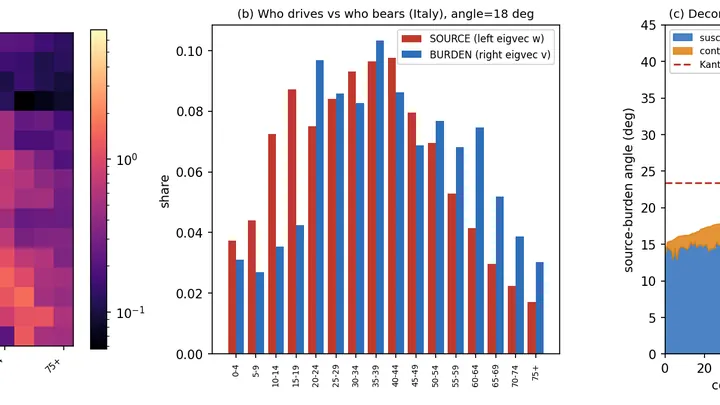
The orchestra plays without a conductor. We know the overall volume: that's the basic reproduction number R0, the spectral radius of the epidemic. But the score itself, the contact matrix between people of different ages, holds the melody: who spreads the infection and who takes the main blow.
Inside every cell, a complex network of genes determines what it will become — a nerve cell, a muscle cell, or part of the skin. This choice often resembles flipping a toggle switch: two stable positions, and the cell decides which way to tip. But cells have a feature rarely considered in such models: they divide.
A neuron in the brain is like a person handing out business cards at a crowded conference. At first, making acquaintances is easy, but as the address book fills up, each new contact requires more effort: there's little room left. The authors based their model on this 'crowding' rule: the more incoming connections a neuron already has, the harder it is to form another one.
In every cell lives a tireless scribe — an enzyme that copies the long thread of DNA. It moves along it like a read head over a tape, building a new strand alongside. It picks letters by strict rule: opposite A it always places T, opposite G it places C. But sometimes, very rarely, its hand trembles, and a different letter slips in.