How to Ignite the Big Bang express
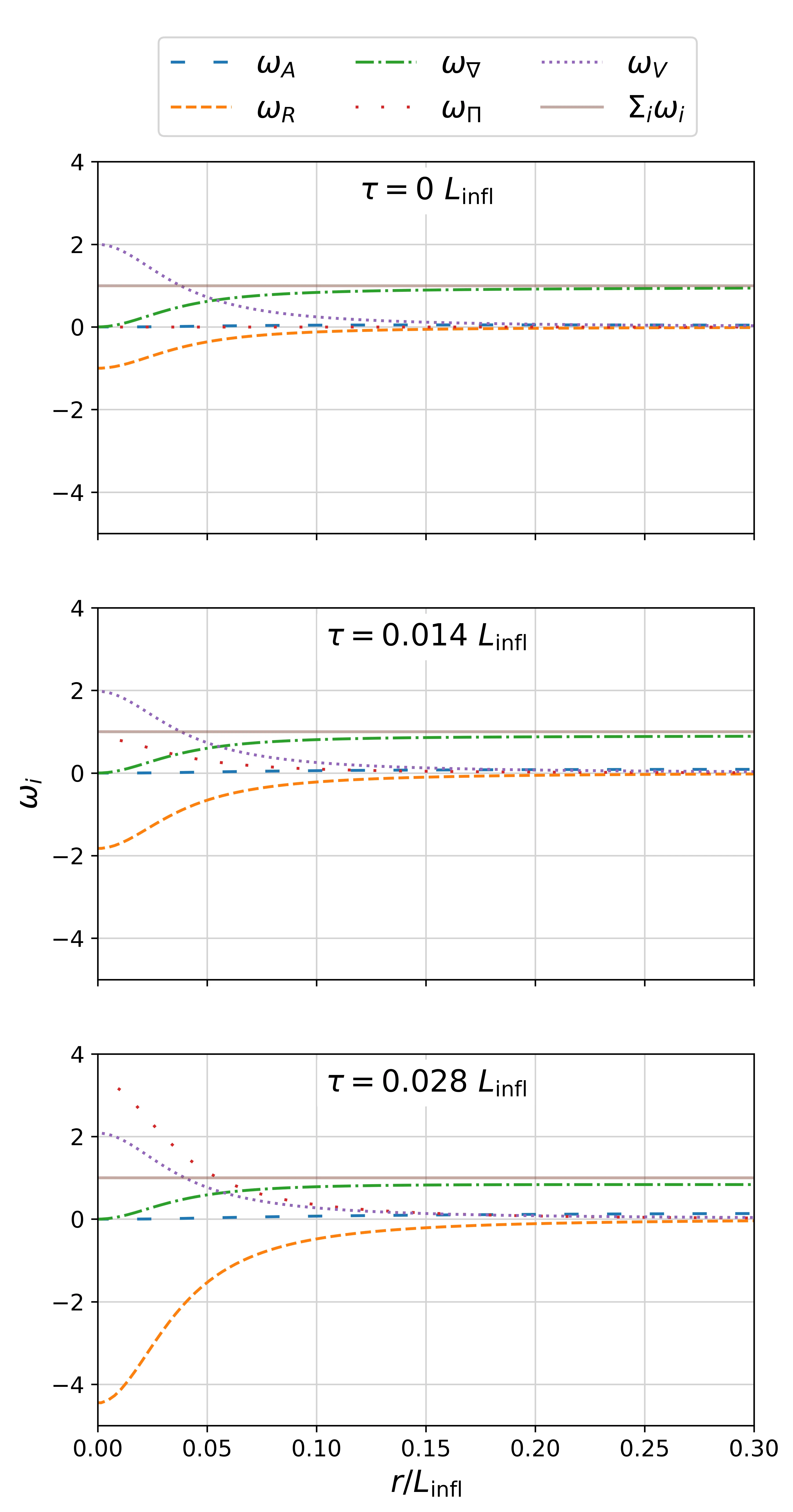
In the first moments after the Big Bang, the universe expanded at a terrifying rate. This process is called inflation, and it smoothed out all the wrinkles, making the cosmos homogeneous. But what started inflation itself? Physicists suspect that a single random fluctuation in the inflaton field, the special field that drove the expansion, might have been enough.
For a long time, simulations of inflation were run under artificial conditions: the universe was placed in a periodic box, like a torus with glued edges. This imposed unnatural curvature constraints. Stephen Hawking and others suspected the real picture might be different. The authors of the new work have for the first time modeled the birth of inflation in asymptotically flat space — one that is nearly uncurved at large distances. This approach is closer to what we see around us: a local bubble, not a closed geometry.
The result confirmed the old hunch: for inflation to start, the initial fluctuation must be several times larger than the characteristic inflationary scale (roughly 10⁻²⁷ cm). If the patch is smaller, it simply collapses into a black hole or dissipates without inflating the universe. It's like trying to blow up a balloon by breathing on it from a meter away: you need to put your lips right up to it so the air actually gets inside. Same here — only a sufficiently large "seed" triggers the cascade of expansion.
The constraints previously imposed on initial conditions could have distorted the picture. A periodic box of fixed size inadvertently tuned fluctuations to the right scale. Now it's clear: nature doesn't have to be periodic, and the start of inflation is a rarer, more demanding event than it seemed. But if it does happen, it triggers a chain reaction that gives rise to all the diversity of galaxies and stars.
Original abstract
as written by the authors arXiv:2607.06441
A key question in early universe cosmology is whether inflation can be successfully seeded by a generic, localised fluctuation in the inflaton field that probes the inflationary part of the potential. Past simulations have mainly considered periodic spacetimes representing either a closed universe of a specific size or a typical patch of a larger one, and as a result have needed to impose restrictive conditions on the extrinsic and intrinsic curvatures, which are arguably not generic. In this work we consider initial fluctuations in asymptotically flat spacetimes, allowing more general profiles of the intrinsic and extrinsic curvature. Our findings confirm and generalise the result of Goldwirth and Piran that a fluctuation with proper size several times the inflationary scale $$(G\rho_{\rm infl})^{-1/2}$$ is required for successful inflation. We also discuss inherent restrictions on the initial data, and how imposing a periodic length close to the inflationary scale may bias results.
Inflation lasted a mere 10⁻³² seconds, but in that time the universe expanded by at least 10²⁶ times, like a grain of sand becoming the size of the observable cosmos.