In the early universe, just after the Big Bang, the cosmos was a hot, dense soup of particles and radiation. Although the universe is now remarkably smooth on large scales, it was not perfectly uniform then. There were tiny variations in temperature from one region to another—fluctuations on the order of one part in 100,000. These temperature fluctuations are the seeds of all cosmic structure: the slight overdensities they represent eventually grew through gravity into galaxies and clusters of galaxies.
History
The existence of temperature fluctuations in the cosmic microwave background (CMB) was first detected by the COBE satellite in 1992, a discovery that earned the Nobel Prize in Physics for George Smoot and John Mather. The detailed statistical properties of these fluctuations were later mapped with great precision by the WMAP and Planck missions.
How it works
These fluctuations are thought to originate from quantum mechanical jitters during a period of rapid expansion called inflation. During inflation, quantum fluctuations in the field driving the expansion were stretched to macroscopic scales, imprinting a nearly scale-invariant pattern of density variations. After inflation, these variations became temperature differences in the primordial plasma. In the context of axion production, these temperature fluctuations act as periodic 'pushes'—spatial and temporal variations in energy density that can resonantly amplify the production of axions, a hypothetical dark matter candidate, through a process analogous to parametric resonance.
In practice
Temperature fluctuations in the CMB are a primary source of cosmological data. By analyzing their statistical distribution, cosmologists can determine the composition, geometry, and expansion history of the universe, and constrain models of inflation and dark matter, including axions.
Fun fact
The temperature fluctuations in the CMB are so small that they correspond to a difference of only about 0.00003 degrees Kelvin, yet they are the blueprint for every galaxy cluster in the observable universe.
The orchestra plays, though no one sees the conductor. The musicians are charged particles in the pulsar's magnetosphere, and the score is the electric and magnetic fields generated by the spinning superdense star.
An accountant tallies up all the factories, warehouses, and shops, but the balance doesn't add up — half the inventory seems to have evaporated. That's roughly how astronomers have spent decades searching for ordinary matter in the present-day Universe.
The early Universe resembles a boiling cauldron, where particles and antiparticles are born and die in equal numbers. But today, all around us is only matter — stars, planets, ourselves. How did a tiny excess of one part in a billion emerge from the initial equality? One answer hides in the oscillations of a heavy field, like a rock that the tide alternately submerges and exposes.
In the first fraction of a second after the Big Bang, the universe expanded at an unimaginable rate. The engine behind this expansion could have been a field that behaves like a slowly rolling ball — the axion. What makes the axion special is that, like a conductor, it can drive electromagnetic waves, creating them literally out of nothing.
In the first fractions of a second after the Big Bang, the universe was a stage of rapid change. A stretched rubber sheet that cools quickly becomes covered with microscopic cracks. A similar process on a cosmic scale could have given rise to cosmic strings — ultra-thin but super-dense threads of energy stretching across the entire universe.
These strings are not just defects in space.
The early universe underwent rapid expansion — inflation. According to one theory, the driving force of this process (the inflaton) behaved like an axion — a particle interacting with a gauge field through a special coupling (an analog of the Chern–Simons effect).
In the first fractions of a second after the Big Bang, the Universe underwent inflation — a monstrously rapid expansion that smoothed out all irregularities. But amid this cosmic smoothness, one "wrong" note could have been hidden: quantum fluctuations of the axion field.
Light from quasar J0744+2052 traveled to us for almost 12 billion years. Along the way, it bumped into hydrogen clouds that snatched individual lines from the spectrum — like a comb sifting through delicate frequencies. Astronomers call this pattern the Lyman-alpha forest in spectroscopy.
Boiling water in a pot is a good place to start. Bubbles of steam rise, pop, and the surface settles down. Something similar might have happened in the first moments of the universe's life with a special field filling space: bubbles of a new phase inflated and collided, like islands of steam in liquid.
In the first moments after the Big Bang, the universe expanded at a terrifying rate. This process is called inflation, and it smoothed out all the wrinkles, making the cosmos homogeneous. But what started inflation itself?
In the first moments after the Big Bang, the universe inflated at an unimaginable rate. This inflation left behind ripples — tiny overdensities in the hot radiation and plasma.
In the first instants after birth, the universe might have been multidimensional, like a sheet of paper that suddenly gained thickness. This "thickness"—the extra dimensions — began to inflate rapidly. Such superfast growth is called inflation.
In the early Universe, tiny black holes could have been born — mountain-mass but atomic-nucleus-sized. Today they could serve as factories for dark matter. There are two mechanisms: the familiar evaporation (Hawking radiation) and the lesser-known superradiance.
The oven slowly cools. While it's hot, the dough rises vigorously, but once the temperature drops, the process stalls. That's roughly how dark matter was born in the 'freeze-out' model: in the hot early cosmos, particles collided and abounded, but as the universe expanded and cooled, their number froze, like baked goods set in place.
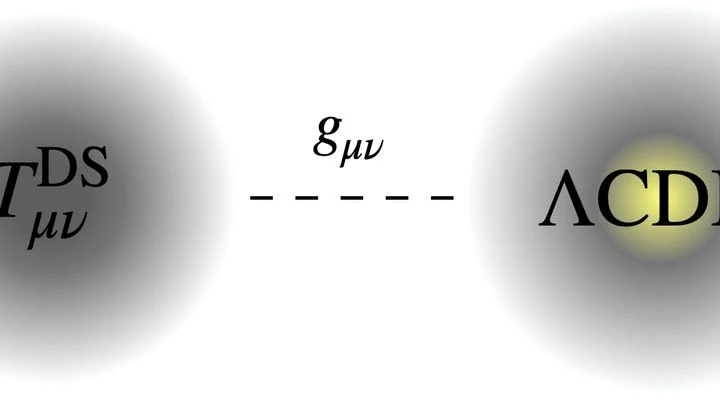
The origin of the hot Big Bang is one of the greatest mysteries. The familiar picture: after inflation, the inflaton field transfers energy to ordinary particles, reheating the Universe. Yet dark matter and dark energy hint that nature has hidden sectors.
Ancient light, traveling 14 billion years, reaches us from all directions. At first glance, it looks perfectly smooth, but if you look closely, tiny fluctuations appear, like ripples on a still pond. Those ripples aren't random noise; they're an encoded history of the universe.
A magnet with only one pole — north, but no south. Split it in half, and instead of two ordinary magnets, you get two more one-pole magnets. In our world, no such particle has been found, although many theories predict their existence. These hypothetical objects are called magnetic monopoles.
The authors of the study noticed a curious connection.
It all started with a tiny clump that grew faster than light could cross it. Inside this inflating bubble, our future Universe, reigned unimaginable heat. But one field, called the inflaton (the engine of inflation), behaved like a conductor: it controlled both the expansion and how other particles behaved.
The classic story of the Universe’s birth from a blazing point called the Big Bang raises uncomfortable questions: why is the cosmos so homogeneous, and what was before the singularity?
In the first moments after the Big Bang, the universe was a boiling soup of elementary particles. Even the light neutrinos were actively colliding with everything around. But the rapid expansion cooled this soup, and the neutrinos broke free, becoming almost indifferent to the surrounding world.
A tiny black hole zips through a gas cloud. Instead of swallowing the gas, it heats it up, like an iron left on a damp cloth. Radiation streams from the black hole, creating a hot spot — a region where the temperature is hundreds of times higher than in the surrounding space.
The mystery of the missing antimatter has haunted physics since the mid-20th century. The Big Bang should have created equal amounts of matter and antimatter, yet today's world is almost entirely matter. The Standard Model is powerless to explain this baryon asymmetry — we need new particles and mechanisms beyond it.
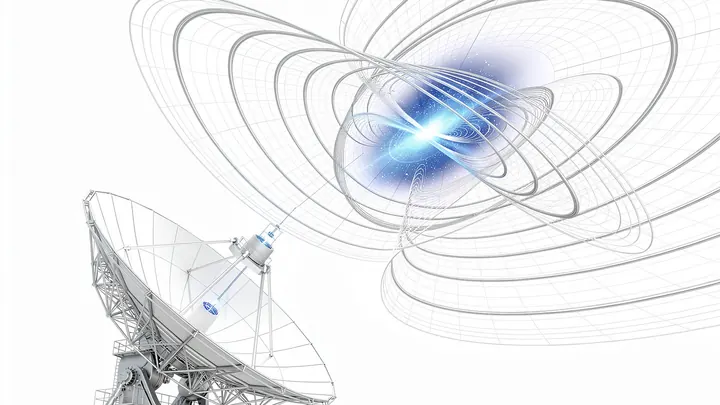
A pond with ripples spreading from a fallen stone. So it is on cosmic scales: a sudden burst of energy in the dark sector, an invisible substance that emits no light, creates ripples in the fabric of space. These ripples alter the path of light particles traveling to us from the very birth of the cosmos.
The authors of the new study built a mathematical framework to describe these distortions.
A huge orchestra is tuning up before a concert. Each instrument makes its own noise, and in the general hubbub it's hard to pick out individual sounds. But if the conductor gives a special flick of the baton for a second, all the violins will simultaneously hit one high note, and that pure tone will cut through the cacophony.
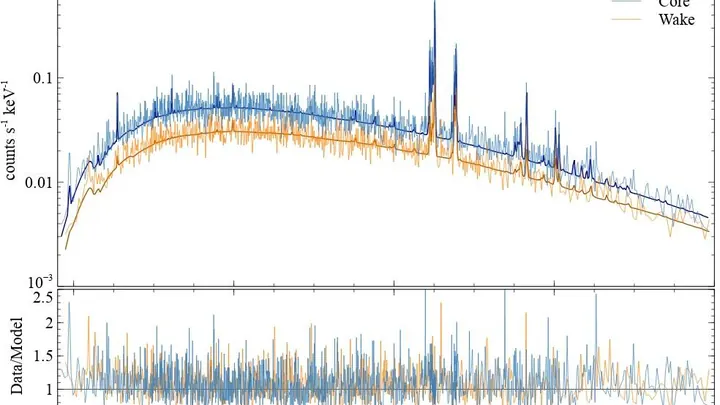
At the heart of the Ophiuchus galaxy cluster floats a bubble of hot plasma the size of several galaxies. It rises like a giant hot-air balloon in the atmosphere, leaving a wake behind it — a region where gas is set in motion.
Drop two identical pebbles from a mountain peak: one lands a centimeter to the left, and a minute later they end up in different valleys. A galaxy is the same mountain, only with billions of pebbles and a slope that stretches over millions of years. The authors of a new study simulated a disk of 40 million point-like stars and tested how quickly it forgets where it started.
A laser strikes the crystal, and it responds with flashes of light, like a bell ringing after a blow. But if the bell is warm, its sound wavers and fades. Same here: the crystal's atoms constantly jitter from heat, and this jitter disrupts the electrons' smooth flight, making the light dim and blurry.
In the first moments after the Big Bang, the universe was not empty and quiet but filled with hot plasma, particles, and magnetic fields. Among the particles, there may have been axions — light, nearly elusive dark matter candidates.
After the Big Bang, the Universe simmered as a fiery 'soup' of fundamental particles. Expanding and cooling, the soup gradually 'solidified' into protons and neutrons — much like crystallization. Had the solidifying been instantaneous, like a lake cracking in a deep freeze, the fabric of spacetime would have convulsed.
Ice slips away from under a skate blade like a bar of soap in wet hands. For a hundred years, scientists argued about where this slipperiness comes from. Some said there is already a thin layer of water on top: it acts as a lubricant. Others countered that water only appears when you start moving, due to friction.
The assembly of a virus shell is like fastening a button: protein blocks must interlock in the correct order, and thermal fluctuations act like trembling fingers. With weak binding, the trembling helps find the right position — the shell closes faster.
Ten microseconds after the Big Bang, the Universe resembled a pot of boiling broth. Floating in it were quarks and gluons — the particles that would later assemble into protons and neutrons. As the broth cooled, at some point the quarks clumped together into lumps — the very protons and neutrons that make up all visible matter.
Hot Jupiters, exoplanets giants snuggled up to their stars, are mysteriously puffed up. Their radii often exceed standard models by 50–100%. New models, based on transiting data (transit method), flip our understanding: heat doesn't come from the interior but from the upper atmosphere.
In the dense swarm of old stars known as the globular cluster M15, astronomers have spotted not just stars but layers of time. Some stars were born earlier, others later, and their chemical composition reveals their origin with the precision of an archaeologist reading the strata of an ancient settlement.
The ARCADE2 radiometer on a high-altitude balloon detected an excess radio emission, while the ground-based EDGES experiment found an anomalously deep trough in the hydrogen spectrum at 21 cm. Both signals do not fit the standard cosmological model and point to an unknown source of soft photons.