A chain reaction is a self-sustaining sequence of events where each step produces the trigger for the next. In physics and chemistry, the most famous example is nuclear fission, where a neutron splits an atom, releasing more neutrons that split more atoms. But the concept applies broadly: from chemical reactions like combustion to biological processes like the spread of neural signals. Chain reactions are characterized by a multiplication factor — if each step produces more than one trigger, the reaction accelerates; if less, it dies out.
History
The concept of a nuclear chain reaction was first proposed by Leó Szilárd in 1933, who later patented the idea. The first controlled self-sustaining chain reaction was achieved by Enrico Fermi's team in 1942.
How it works
The mechanism requires three elements: a starting trigger, a step that produces new triggers, and a medium that allows the triggers to propagate. In nuclear fission, a neutron is absorbed by a fissile nucleus, which splits and emits 2-3 new neutrons. If the material is dense enough and large enough (critical mass), these neutrons cause further fissions, sustaining the reaction. Control rods or moderators can absorb neutrons to keep the multiplication factor at exactly 1, achieving a steady state.
In practice
Chain reactions power nuclear reactors and are the basis of nuclear weapons; they also explain the propagation of flames and the amplification of signals in photomultiplier tubes.
Fun fact
The first artificial self-sustaining chain reaction was achieved in a squash court at the University of Chicago, under the football stadium's bleachers.
Write down a recipe, then check it an hour later: if the proportions are off by even a gram, the taste is gone. Chemical reactions in open systems behave much the same way: the slightest difference in initial concentrations grows over time into completely different states.
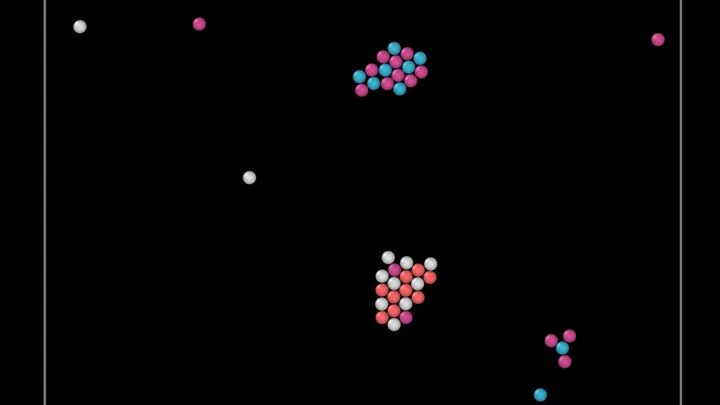
A drop of water on glass trembles and shimmers: it seems to have a life of its own. Similar behavior can now be observed in the world of colloids: tiny particles suspended in a liquid. Researchers simulated particles that emit chemical signals. These signals, like scents in the air, spread around and cause neighbors to either draw closer or move apart.
One hundred milliseconds. In that time, after a lightning strike or a short circuit, the power system either returns to normal operation or loses stability. A new-generation Neural Network Oscillations learns to sense this moment, like an experienced tightrope walker anticipating a gust of wind.
A quantum chain is like a string of lights, where the bulbs are the spins of particles. Ideally, all bulbs glow in sync, following a common rhythm: that's symmetry. But if you cut off a piece of the string, the rhythm can get out of step: within that segment, symmetry is broken.
Physicists study a chain of strongly interacting particles (the XYZ model).
A cloud of atoms cooled to near absolute zero suddenly starts behaving like a brain. One excited atom triggers a chain reaction — neighbors light up in turn, and an avalanche of activity sweeps through the gas. Physicists call this Rydberg facilitation: atoms are easier to excite when an excited one is nearby.
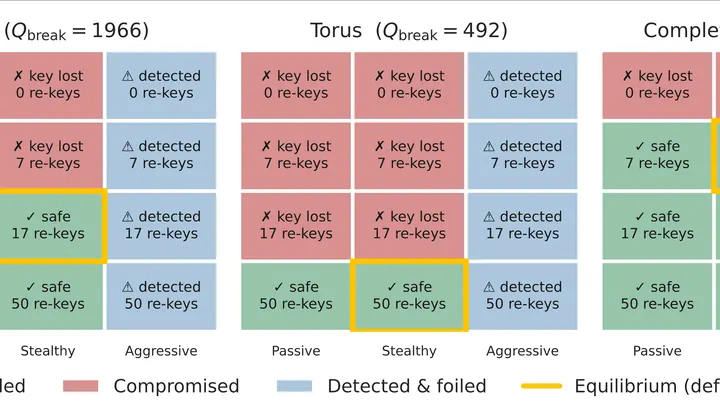
A cloud service dishes out commands to a drone swarm without any knowledge of their movements. The signals are encrypted, but each maneuver leaves a barely visible trace in the cipher, like ink bleeding through paper from the pressure of a pen. Over time, these ink stains coalesce into a pattern, and the hidden data is no longer a secret.
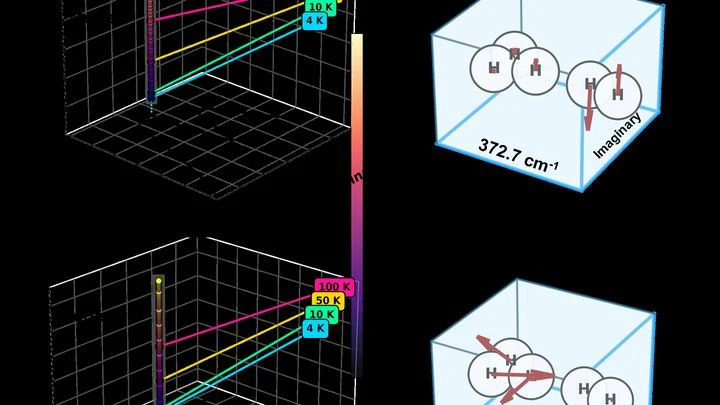
A chemical reaction resembles passing through a turnstile: a crowd creates chaos and gets stuck, while an orderly line moves. In the quantum world, however, when the jostling subsides, the barrier can become ghostly — a particle passes through it as if the turnstile has vanished.
A colony of cells is like a city that grows from its outskirts: new houses appear where there's more space. Inside, it's crowded, and construction stalls. Similarly, cells divide more often at the edge, where neighbors squeeze them less. Scientists modeled this without any chemical commands — only mechanics.
In the model, each cell is a ball that presses on others.
A drop of ink in a glass of water spreads out on its own. But if the ink were made of tiny motors, they wouldn't just spread: they'd crawl, jostle, and cluster into swarms. Such self-propelled particles are called active. You can assemble them into molecules like beads on a bracelet. And here's the surprise: the order of beads on the bracelet changes everything.
When chemists see how concentrations of substances change, they need to figure out which reactions are behind those changes. It's like trying to reconstruct a recipe from photos of plates at different stages of a meal. Previously, this often involved derivatives — instantaneous rates of concentration change.
A rubber band is stretched, and suddenly snaps. In the atomic world, a similar picture emerges: the string binding particles can break. In a new study, physicists took a chain of Rydberg atoms and tracked how such a string breaks.
Under weak tension, the string breaks completely, and the system splits into several independent pieces, as if a rubber band shattered into segments.
In the superconducting circuits that make up quantum computers, extra particles, quasiparticles, are born from time to time. They are like random passersby who barge into the processor's work and spoil the calculations.