The perturbation spectrum describes the initial distribution of density fluctuations in the early universe, typically characterized by a spectral index that quantifies how the amplitude of fluctuations varies with scale. This spectrum is the seed for all cosmic structure — galaxies, clusters, and the cosmic microwave background (CMB) anisotropies. Its shape encodes the physics of cosmic inflation and any additional processes, like dark matter interactions or modified gravity, that operated in the first moments.
History
The concept was developed in the 1980s with inflationary theory, notably by Guth, Starobinsky, and others. The spectral index was first measured precisely by the WMAP satellite in 2003, confirming inflation's prediction of a nearly scale-invariant spectrum.
How it works
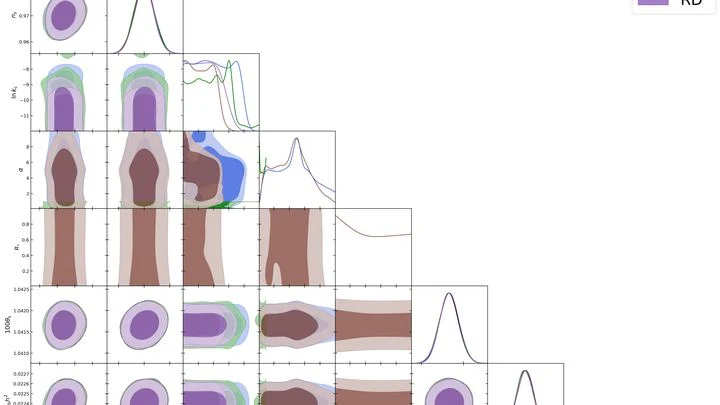
During inflation, quantum fluctuations were stretched to cosmic scales, creating a nearly scale-invariant spectrum of perturbations. The spectral index n_s measures the deviation from perfect scale invariance: n_s = 1 means equal amplitude on all scales, while n_s < 1 (as observed) means slightly more power on large scales. Measurements of the CMB and galaxy surveys constrain n_s and its running, testing models of inflation and beyond.
A tiny correction to the standard inflationary model, such as a small running of the spectral index, can explain the observed low power at large angular scales in the CMB.
Light from the very beginning of the cosmos has been traveling toward us for 13.8 billion years. During that time, its polarization, the direction of its oscillations, might have been twisted, like a compass needle that someone quietly nudged. Physicists call this phenomenon cosmic birefringence.
In the first fractions of a second after the Big Bang, the universe was a stage of rapid change. A stretched rubber sheet that cools quickly becomes covered with microscopic cracks. A similar process on a cosmic scale could have given rise to cosmic strings — ultra-thin but super-dense threads of energy stretching across the entire universe.
These strings are not just defects in space.
The universe is a vast, dark ocean. We see only the glowing foam on its surface — stars and galaxies. But hidden in the depths are two invisible forces: dark matter, which with its gravity keeps galaxies from flying apart, and dark energy, which, on the contrary, pushes space itself apart, making the universe expand faster and faster.
In the first fractions of a second after the Big Bang, the Universe underwent inflation — a monstrously rapid expansion that smoothed out all irregularities. But amid this cosmic smoothness, one "wrong" note could have been hidden: quantum fluctuations of the axion field.
At the dawn of time, the universe experienced a brief moment of frantic expansion — inflation. Tiny quantum jitters of spacetime stretched to cosmic scales. These jitters, primordial fluctuations, became the seeds from which galaxies and stars later grew.
2.1 × 10⁻⁹ — that's the temperature variation across the sky, about the same as measuring ripples a fraction of a millimeter high on the ocean surface. This microscopic non-uniformity is imprinted in the cosmic microwave background and tells the story of the very beginning of time.
Picture the early Universe as an unimaginably large bell. Inflation — the era of rapid expansion, dreamed up by Alan Guth, strikes it, sending a wave rippling across the fabric of spacetime.
In the first moments after the Big Bang, the universe expanded at a terrifying rate. This process is called inflation, and it smoothed out all the wrinkles, making the cosmos homogeneous. But what started inflation itself?
The cosmic microwave background is the petrified light of the first moments. Shortly after the Big Bang, microscopic quantum fluctuations were stretched by inflation to the scales of galactic superclusters.
The hot broth of the early universe cooled unevenly. At some point, bubbles of a new phase began to pop within it, like steam bubbles in boiling water. But these bubbles weren't made of steam; they were made of a new state of matter in which particles of the dark sector clumped into larger lumps. That's how dark matter could have been born.
The very first moments of the Universe's life resemble tuning a complex musical instrument. Quantum fluctuations, stretched by rapid inflation, became the 'notes' from which galaxies later formed. In the new work, physicists considered an unusual opening chord — a superoscillating state.
The early universe underwent a rapid expansion — inflation. In a tiny fraction of a second, minuscule quantum jitters were stretched to galactic scales and became the seeds of all large-scale structure.
Quantum noise, like the hiss of an untuned radio, filled the infant Universe. Alan Guth showed that superfast expansion (inflation) caused this ripple to freeze, giving rise to clumps of matter — the seeds of galaxies.
A new method extends this picture to any theory of gravity.
A giant drum has just taken a hit. Its membrane is still trembling, but besides the main boom, a fine ripple spreads across it — someone ran a finger over the taut skin. In much the same way, in the first moments after the Big Bang, spacetime vibrated not only with the "roar" of expansion but also with the tension of suddenly emerging magnetic fields.
Ancient light, traveling 14 billion years, reaches us from all directions. At first glance, it looks perfectly smooth, but if you look closely, tiny fluctuations appear, like ripples on a still pond. Those ripples aren't random noise; they're an encoded history of the universe.
The birth of the universe resembles not an explosion, but a traffic jam. At first, a tiny fraction of a second after the Big Bang, space expanded sluggishly, like cars stuck in gridlock. Then came a sharp surge — accelerated expansion, which cosmologists call inflation.
The mystery of dark matter, first glimpsed in the stellar whirlpools by Vera Rubin, has been tormenting physics for nearly a century. One of the boldest hypotheses: primordial black holes, born in the scalding broth of the early universe.
A pond with ripples spreading from a fallen stone. So it is on cosmic scales: a sudden burst of energy in the dark sector, an invisible substance that emits no light, creates ripples in the fabric of space. These ripples alter the path of light particles traveling to us from the very birth of the cosmos.
The authors of the new study built a mathematical framework to describe these distortions.
The Universe performs a symphony in two contrasting tempos. The first explosive accelerando (inflation, conceived by Alan Guth) sent spacetime soaring in the first trillionth of a second. The second acceleration, slow but relentless, began five billion years ago.
Imagine a vast lake at night, perfectly still. You can't see waves, but you hear them lapping evenly on the shore from all sides. That's what astronomers call the gravitational-wave background — a constant hum from distant black hole mergers. But what if the splashing were slightly louder on one side?
In the first moments after the Big Bang, the cosmos resembled a giant cooling pond. Just as water, when freezing, becomes covered with a network of cracks, so the cooling universe could have cracked — not into ice, but into the thinnest filaments of pure energy. These filaments are called cosmic strings.
If space is a canvas, then brushstrokes cannot be infinitely thin. There's a tiniest segment, shorter than which there's no point in measuring. This quantum 'graininess' alters the geometry itself: the motion of galaxies and the growth of large-scale structures bear its mark.
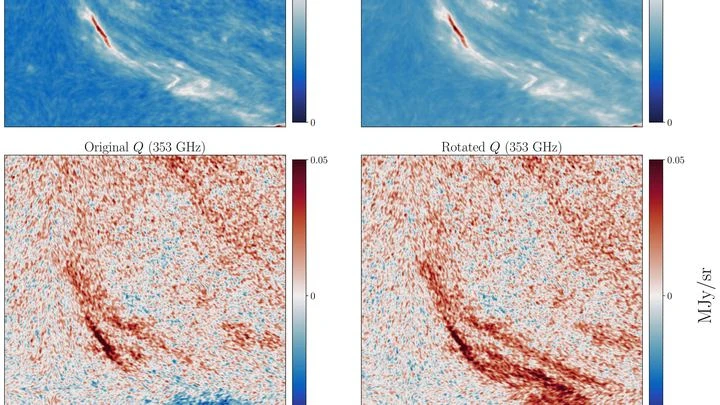
Light that has traveled to us for nearly 14 billion years is like an old photograph whose details emerge with careful processing. The cosmic microwave background (the afterglow of the Big Bang) holds the imprint of the universe's first moments, but its signal is faint and distorted.
The universe is like an ocean, where waves of different lengths roll onto the shore. The longest waves are the giant fluctuations in the distribution of matter that we see in the cosmic microwave background. Standard theory says such waves should exist on all scales.
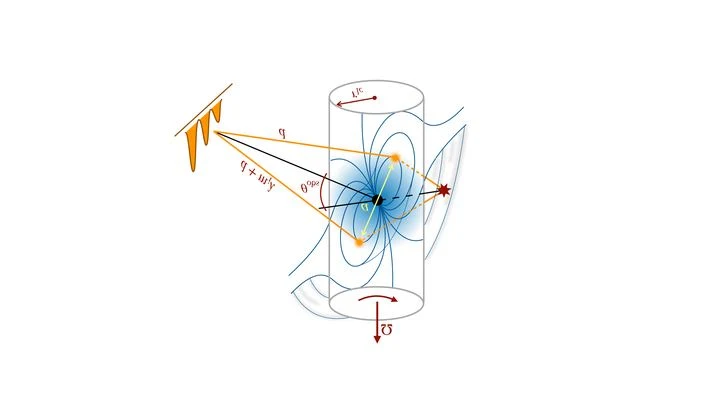
A radio telescope picks up a signal from the Crab Nebula, and instead of a smooth line, the screen shows bright and dark bands, like on a zebra's hide. This is the emission from the pulsar, a rapidly spinning neutron star left over from a supernova explosion.
The cosmic microwave background is a faint glow left over from the Big Bang, like the cooling embers of a campfire. It encodes gravitational waves that may have arisen in the first fractions of a second, when the universe inflated faster than light.
According to the Big Bang theory, developed by Georges Lemaître, the Universe began from a hot dense point and then rapidly expanded — an inflation proposed by Alan Guth. Echoes of that time reach us as a faint glow — the ancient light.
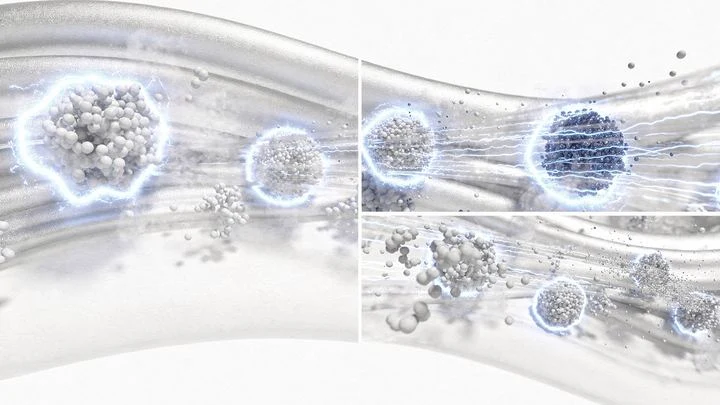
Cosmic rays are atomic nuclei accelerated to near-light speeds. They arrive at Earth from all directions, and their composition tells us what's happening in the far reaches of the Galaxy.