Quantumfluctuations in the vacuum are the tiny, random energy variations that occur even in perfectly empty space, as dictated by the Heisenberg uncertainty principle. During cosmic inflation — the brief, exponential expansion of the universe in its first fraction of a second — these microscopic jitters were stretched to macroscopic scales, seeding the initial density variations that later grew into galaxies, clusters, and the large-scale structure we observe today. This mechanism connects the quantum world to the cosmos, explaining why the universe is not perfectly uniform but instead contains the seeds of all structure.
History
The idea that quantumfluctuations during inflation seed cosmic structure was developed in the early 1980s by physicists including Alexei Starobinsky, Alan Guth, and Viatcheslav Mukhanov, building on the inflationary paradigm proposed by Guth in 1981.
How it works
Inflation amplifies quantum vacuum fluctuations by rapidly expanding space, freezing these perturbations as classical density variations. After inflation ends, these variations act as gravitational wells, attracting matter and eventually collapsing into galaxies and stars. The process is analogous to freezing ripples on a pond: the ripples (quantum fluctuations) are stretched and frozen into the fabric of space, leaving a permanent imprint on the distribution of matter.
In practice
This concept underpins predictions for the cosmic microwave background radiation's temperature anisotropies, which are measured by satellites like Planck and used to constrain cosmological parameters.
Fun fact
The quantumfluctuations that seeded galaxy formation are the same phenomenon that causes the Casimir effect, where two uncharged metal plates attract each other due to vacuum energy.
In the first instants after the Big Bang, the universe expanded faster than light could cross it. Like an inflating balloon, but instead of rubber, it was space itself. On this balloon, ripples inevitably formed — tiny compressions and rarefactions from which all galaxies and stars later grew.
A courtroom interpreter is distracted by every rustle: the creak of a chair, a cough in the back row, the rustle of papers. By the end of the day, they are translating not what the witness said, but what they heard through the noise. Rare translation errors are not the result of a single loud shout, but of the accumulation of many small disturbances.
It all started with stretching. In the first fractions of a second, the universe ballooned — physicists call this inflation. Then the rapid expansion gave way to a phase where the field's energy converted into ordinary particles.
In the first moments after the Big Bang, the universe underwent a rapid expansion — inflation. Space stretched faster than light, and quantum jitters of the vacuum turned into real particles. This is how dark matter, the invisible substance that holds galaxies together, could have been born.
In the first 10⁻³⁵ seconds after the big bang, the most rapid part unfolded. Space expanded faster than light — that's expansion of the universe (inflation). Almost the entire score was performed by a single field, the inflaton, conducting the tempo and key.
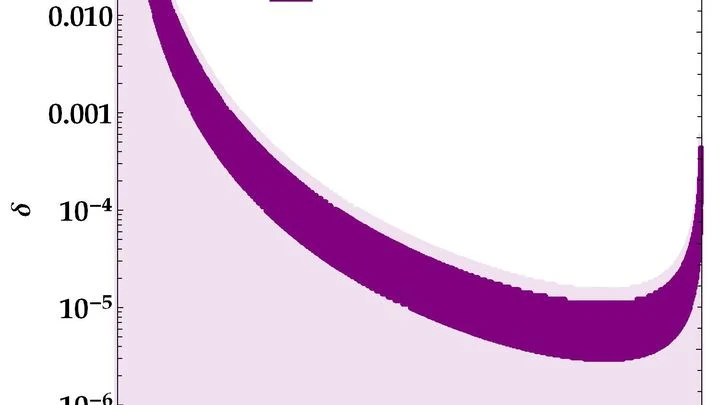
0.965—a number that split cosmologists into 'before' and 'after'. That's the value of the spectral index ns measured by the ACT telescope as it stared into the cosmic microwave background — the cooled light of the Big Bang.
The early universe grew at a terrifying speed — inflating to gigantic proportions in a tiny fraction of a second. Physicists describe this burst with a single number: the exponent in a formula that resembles the steepness of a hill. The steeper the hill, the faster the ball rolls down: that is, the more rapidly space expanded.
At the dawn of time, the universe experienced a brief moment of frantic expansion — inflation. Tiny quantum jitters of spacetime stretched to cosmic scales. These jitters, primordial fluctuations, became the seeds from which galaxies and stars later grew.
In the first moments after the Big Bang, the universe expanded at a terrifying rate. This process is called inflation, and it smoothed out all the wrinkles, making the cosmos homogeneous. But what started inflation itself?
Imagine a ball in an unfamiliar hall: two guests start from opposite corners. Their movements are not a smooth waltz but chaotic improvisation in search of rare treasures. Contrary to intuition, the outcome hinges not on tempo but on the geometry of the floor.
Inflation is the rapid expansion of the newborn Universe, when quantum fluctuations were stretched to cosmic scales. The cosmic microwave background is the fossilized light of that epoch, shadows on the wall of our cosmic cave.
In the first moments, the universe expanded at an unimaginable rate — a phase called inflation. It is thought that particles of dark matter, the invisible substance that holds galaxies together, could have been born from the vacuum during this time. But what determines exactly how many are produced?
The authors considered a model with two fields.
The early universe expanded at an unimaginable rate — faster than light could cross it. In this boiling cauldron, any region of space resembled an open can of paint: its boundaries continuously captured new 'vapor' from outside, while some of its own contents irrevocably escaped.
In the first moments after the Big Bang, space behaved like an elastic film. It underwent an explosive expansion — inflation (the theory of Alan Guth and Andrei Linde).
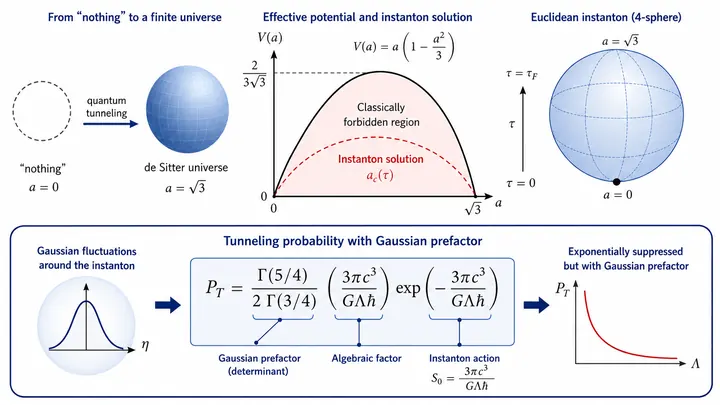
Quantum nothingness resembles water in a pot just before boiling. From time to time, a bubble spontaneously swells up — but not of steam, but of an entire universe. Such a bubble doesn't collapse; instead, it inflates into spacetime, triggering its own Big Bang. The only question is how often this happens.
It all started with a tiny clump that grew faster than light could cross it. Inside this inflating bubble, our future Universe, reigned unimaginable heat. But one field, called the inflaton (the engine of inflation), behaved like a conductor: it controlled both the expansion and how other particles behaved.
The mystery of the missing antimatter has haunted physics since the mid-20th century. The Big Bang should have created equal amounts of matter and antimatter, yet today's world is almost entirely matter. The Standard Model is powerless to explain this baryon asymmetry — we need new particles and mechanisms beyond it.
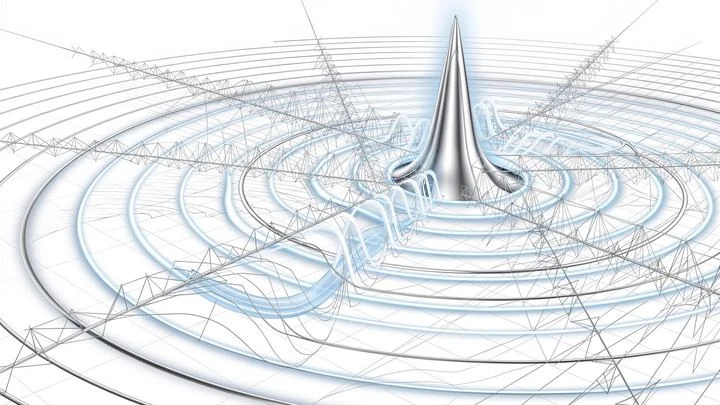
A pond with ripples spreading from a fallen stone. So it is on cosmic scales: a sudden burst of energy in the dark sector, an invisible substance that emits no light, creates ripples in the fabric of space. These ripples alter the path of light particles traveling to us from the very birth of the cosmos.
The authors of the new study built a mathematical framework to describe these distortions.
The idea of inflation, the superfast expansion of space just after its birth, was proposed by Alan Guth in 1980. It explained why our world is so uniform. But fresh snapshots of the Big Bang from the ACT telescope showed a pattern that slightly didn't match the predictions of two leading models.
The Universe performs a symphony in two contrasting tempos. The first explosive accelerando (inflation, conceived by Alan Guth) sent spacetime soaring in the first trillionth of a second. The second acceleration, slow but relentless, began five billion years ago.
An ultracold cloud of atoms trapped in laser light can 'breathe': it rhythmically contracts and expands, much like lungs. Physicists have long been able to observe this breathing, but only now have they realized that its amplitude is not just a pretty picture: it is a precise measure of hidden energy jitters inside the cloud.
After the Big Bang, the Universe simmered as a fiery 'soup' of fundamental particles. Expanding and cooling, the soup gradually 'solidified' into protons and neutrons — much like crystallization. Had the solidifying been instantaneous, like a lake cracking in a deep freeze, the fabric of spacetime would have convulsed.
A snowdrift grows by strict rules: falling snowflakes form bumps, those attract more snow, and the bumps amplify. The same mathematics describes city growth, patterns on bark, ripples on water, and clusters of cosmic dust. Physicists call this uniformity universality.
The assembly of a virus shell is like fastening a button: protein blocks must interlock in the correct order, and thermal fluctuations act like trembling fingers. With weak binding, the trembling helps find the right position — the shell closes faster.
In the first instants after the Big Bang, the Universe expanded faster than light could cross it. This rapid growth, inflation, stretched tiny quantum jitters to the size of entire galaxies. But from what state did these jitters begin?
In the first moments after the Big Bang, the Universe underwent rapid expansion: inflation. But perhaps it was contracting before that, and then bounced. Both scenarios leave nearly identical imprints on the cosmic microwave background, and cosmologists have debated for decades which one is correct.