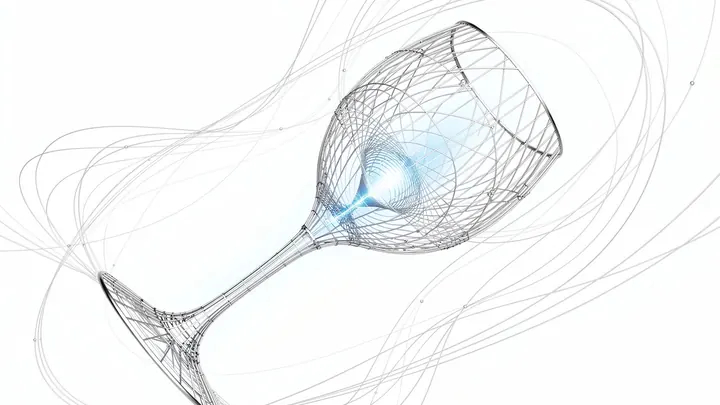
Spacetime foam is a hypothetical property of spacetime at the smallest imaginable scales, around the Planck length (about 10^-35 meters). At this scale, quantumfluctuations of gravity would be so strong that the smooth, continuous fabric of spacetime would break down into a frothy, bubbling mess. Instead of a fixed geometry, points in space and time would be constantly shifting, with tiny wormholes and quantum black holes popping in and out of existence. This concept challenges our classical intuition and suggests that the very notions of distance and time may be approximate, emerging only at larger scales.
History
The term 'spacetime foam' was introduced by John Archibald Wheeler in the mid-1950s as part of his exploration of quantum gravity, and it has since become a central concept in quantum gravity research, particularly in loop quantum gravity and string theory.
How it works
In quantum mechanics, the Heisenberg uncertainty principle allows energy to fluctuate wildly over very short times. When gravity is included, these energy fluctuations are so intense that they warp spacetime itself, creating a chaotic, foam-like structure. The 'foam' is not made of any physical substance but is a manifestation of the quantum nature of geometry. The scale of these fluctuations is set by the Planck length, where the gravitational force becomes as strong as the other fundamental forces, and the effects of quantum gravity cannot be ignored. Observations of distant astrophysical phenomena, such as gamma-ray bursts, can in principle probe this foam by looking for slight delays in the arrival times of photons of different energies.
In practice
Spacetime foam is studied in the context of ultra-high-energy cosmic rays and gamma-ray bursts, where quantum gravitational effects might cause tiny energy-dependent variations in the speed of light, which could be detected with future telescopes.
Fun fact
If spacetime foam exists, the speed of light might not be exactly constant: high-energy photons could travel slightly slower or faster than low-energy ones, a tiny effect that could accumulate over cosmic distances.
Electrons in an ultra-clean gallium arsenide film behave like a crowd at a crossroads, where the tilt of the magnetic field sets the direction. At zero tilt, they form a compressible liquid of composite fermions, particles made of an electron and a pair of vortices.
Space construction today is a costly hassle with prefabricated parts: every panel has to be lifted from Earth, then assembled in zero gravity, like building a model kit while wearing thick gloves. Engineers from a new study propose a different path: not hauling or printing, but letting the liquid itself sculpt the structure.
Space is not a void but a mosaic of tiny cells. In loop quantum gravity, spacetime curvature is transferred from a smooth sheet to a network of 'atoms' of volume — spin networks. Each node of such a network is a quantum of space, and the links between them are quanta of area.
But how does this mosaic change over time?
In the first moments after the Big Bang, cosmic symmetry breaking divided the hot plasma into regions with different vacuums — the lowest energy states of a field.
Inside a supercomputer, fifteen stable wave clumps — solitons — collide to form a halo of dark matter. These waves obey an equation that Erwin Schrödinger derived for electrons at the beginning of the 20th century, but now they paint a portrait of a giant galactic cocoon.
It is commonly believed that a black hole is a merciless cosmic vacuum cleaner, sucking in everything indiscriminately. But new research flips the picture: right at the horizon, curvature transforms from a trap into a trampoline.
For a long time, the event horizon behaved like a cosmic dictator: everything that crossed its boundary vanished irretrievably from our Universe. But quantum mechanics, like a dissident's voice, whispered: information cannot simply disappear.
In the first moments after the Big Bang, the universe expanded at a terrifying rate. This process is called inflation, and it smoothed out all the wrinkles, making the cosmos homogeneous. But what started inflation itself?
In the conventional Heisenberg picture, spins at low temperatures are supposed to line up in a strict pattern. But there are crystals — like pyrochlore — where geometry has its own way. Each ion sits at a vertex of a tetrahedron, and the main interaction enforces a rule: two spins point inward, two outward.
A black hole horizon is like a soap film stretched over an abyss. From a distance it looks perfectly smooth, but up close it trembles. This ripple arises from quantum fluctuations — the continuous birth and death of particles in the vacuum.
The black hole paradox has haunted physicists for decades. If a hole evaporates, where does its contents go? Discoveries by Stephen Hawking and Jacob Bekenstein showed that saving the laws of nature requires an unconventional move.
Imagine the universe as a woven blanket of invisible threads.
An empty glass on the table seems reliable. But if there's a microcrack in the bottom, one day it will break — not with a crash, but quietly, spreading in a web of lines. So too with the vacuum: it may not be the true vacuum but a false one — temporarily stable, yet ready to transition to a deeper, real state.
Immediately after the Big Bang, space may have vibrated like a string from quantum effects. As these oscillations faded, they would have left a mark on the expansion of galaxies — a memory effect. The search for this echo in telescope data turned up nothing.
Cosmology has long sought a loophole behind the Big Bang. Inflation, proposed by Alan Guth, stretches and smooths out primordial inhomogeneities, but what lit the fuse itself?
The mystery of dark energy is a chasm. Quantum field theory predicts a density 10¹²⁰ times larger than observed. In the string landscape, this abyss takes shape — myriads of vacua with different energies, and we are nestled in one of them.
Spacetime resembles a giant crystal. Gravitational waves, born from collisions of black holes, not only make it tremble — they leave indelible defects: edge ones, as if an extra plane of atoms was inserted into the crystal, and screw ones, where the layers twist.
A drop of cream falls into a cup of coffee, and within a minute, the entire drink turns beige. This mixing process can be quantified: how much "stirring" is needed to transform one distribution of particles into another? In mathematics, this approach is called optimal transport, and the measure of effort is the Wasserstein distance.
The authors applied this idea to quantum systems.
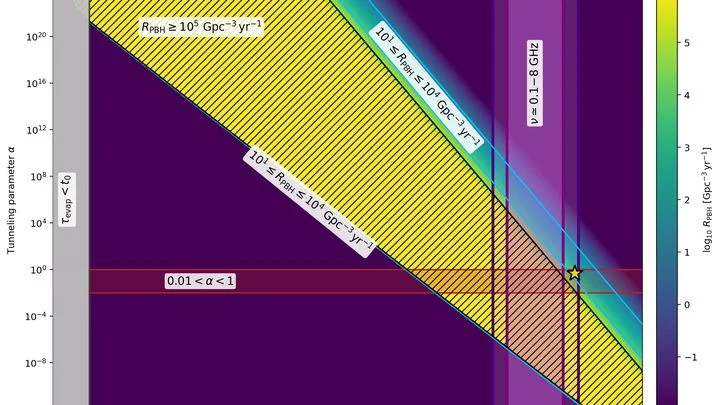
Some black holes are remnants from the Big Bang. Usually they fade via a slow radiation leak — predicted by Stephen Hawking. But a quantum switch could invert them into white holes, explosively releasing all energy like popcorn kernels that suddenly pop.
A snowdrift grows by strict rules: falling snowflakes form bumps, those attract more snow, and the bumps amplify. The same mathematics describes city growth, patterns on bark, ripples on water, and clusters of cosmic dust. Physicists call this uniformity universality.
In the first instants after the Big Bang, the Universe expanded faster than light could cross it. This rapid growth, inflation, stretched tiny quantum jitters to the size of entire galaxies. But from what state did these jitters begin?
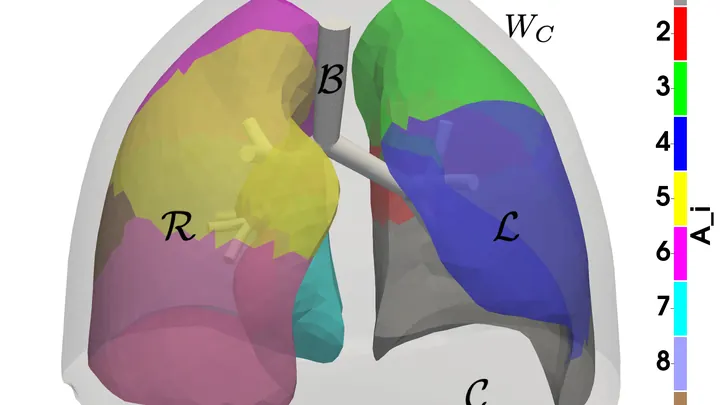
A lung scan reveals a tree: the trunk is the trachea, branches are the bronchi, and leaves are the alveoli. But how does air spread through these branches? Scientists built a computer model that replicates the lung's shape from images obtained via computed tomography.
Time is like a highway: from afar it looks flawlessly paved, but zoom in and every pothole appears. These bumps are the quantum fluctuations of the vacuum, making it impossible to measure the journey exactly. Physicists built a clock model whose operation relies on spontaneous particle creation from the void.
In the familiar world, we have three spatial dimensions. However, theoretical physics allows for additional, hidden directions — compactified, that is, curled up to microscopic sizes.
A waterfall doesn't ask if you're ready to jump. Its flow accelerates, and at some point even light can't escape back. A McVittie black hole is such a waterfall, but not in an ordinary river; it's in an expanding universe: the water here is space itself, which continuously stretches, carrying galaxies apart from each other.