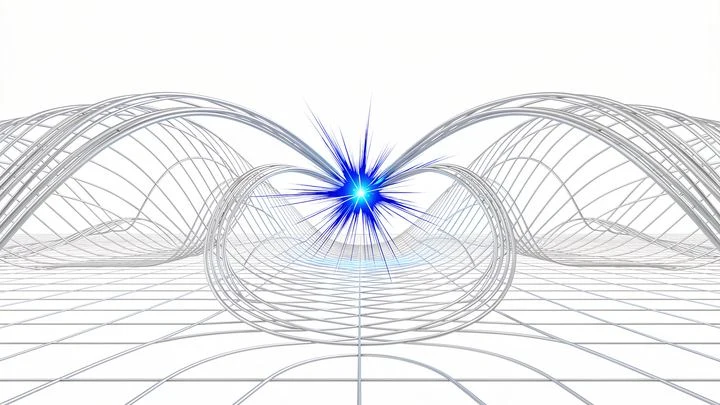
Primordial cosmic fluctuations are tiny density variations in the early universe, imprinted about 380,000 years after the Big Bang. These quantum-scale ripples were stretched to cosmic sizes during inflation and later amplified by gravity, providing the seeds for all structure we see today—galaxies, clusters, and superclusters. Without them, the universe would be perfectly smooth and featureless, with no stars or planets. They are observed as temperature anisotropies in the cosmic microwave background (CMB) and as the distribution of galaxies in large-scale surveys.
History
The prediction of primordial fluctuations was formalized in the 1980s with inflationary theory, and their statistical properties were confirmed by the COBE satellite in 1992 and refined by WMAP and Planck.
How it works
In the first moments after the Big Bang, quantum fluctuations in the inflaton field created slight overdensities and underdensities in matter and radiation. As the universe expanded and cooled, these regions evolved: denser areas attracted more matter via gravity, while radiation pressure resisted collapse, creating acoustic oscillations. These oscillations froze into the CMB as hot and cold spots, and later the overdensities collapsed into dark matter halos, which then gathered gas to form galaxies.
The largest fluctuations are only about one part in 100,000, meaning the early universe was remarkably smooth—yet those tiny variations gave rise to every galaxy in the cosmos.
A filament of the cosmic web stretches through the young universe, and strung along it like beads on a necklace are galaxies. In the core of the SSA22 protocluster, which in a few billion years will become the center of a massive cluster, these beads are still hot and dusty: stars are being born inside them, and cold gas serves as fuel.
The early Universe was not just a hot soup of particles. In the first fractions of a second, mirror symmetry could have been broken: the world and its reflection would not be quite identical. If so, the large-scale cosmic web of galaxies would retain a barely noticeable 'curl'—as if all matter were slightly twisted in one direction.
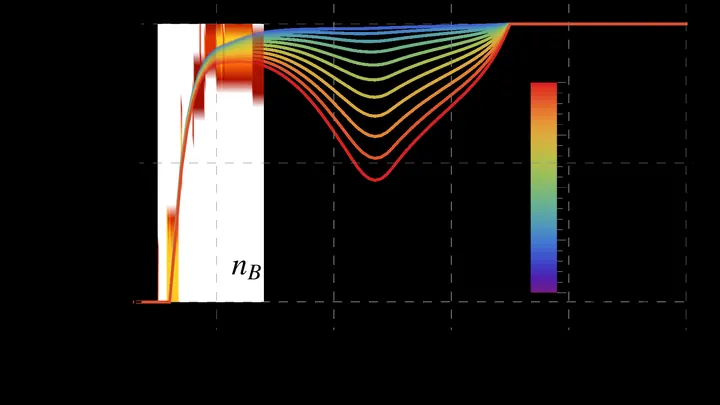
The first moments after the big bang: space expands rapidly — physicists call this period inflation. Inside this swelling fabric, like soap bubbles in a stream of air, regions of new vacuum begin to form — a first-order phase transition. Most bubbles pop or merge as soon as they appear.
The universe rang piercingly in its first moments. During the inflation epoch, when space expanded faster than light, energies were monstrous — trillions of times higher than in the Large Hadron Collider.
At the dawn of time, the universe experienced a brief moment of frantic expansion — inflation. Tiny quantum jitters of spacetime stretched to cosmic scales. These jitters, primordial fluctuations, became the seeds from which galaxies and stars later grew.
The first three minutes after the birth of the world are a cosmic kitchen where nature cooked the lightest atomic nuclei. The recipe is set by gravity: it controls the cooling rate of the hot 'broth' of particles. If gravity worked differently than we are used to, the dish would have turned out different — with different amounts of helium and deuterium.
In the first moments after the Big Bang, the Universe underwent a rapid expansion, inflation, blowing up quantum fluctuations to scales visible today in the cosmic microwave background.
In the first moments after the Big Bang, the universe expanded at a terrifying rate. This process is called inflation, and it smoothed out all the wrinkles, making the cosmos homogeneous. But what started inflation itself?
In the first moments of the universe's life, there was not even a hint of dark energy — the very force that today pushes galaxies apart ever faster. But if you look deeper, down to the Planck scale (billions upon billions of times smaller than an atomic nucleus), spacetime ceases to be smooth.
In the first moments after the Big Bang, the universe inflated at an unimaginable rate. This inflation left behind ripples — tiny overdensities in the hot radiation and plasma.
The very first moments of the Universe's life resemble tuning a complex musical instrument. Quantum fluctuations, stretched by rapid inflation, became the 'notes' from which galaxies later formed. In the new work, physicists considered an unusual opening chord — a superoscillating state.
In the first instants after birth, the universe might have been multidimensional, like a sheet of paper that suddenly gained thickness. This "thickness"—the extra dimensions — began to inflate rapidly. Such superfast growth is called inflation.
The early universe underwent a rapid expansion — inflation. In a tiny fraction of a second, minuscule quantum jitters were stretched to galactic scales and became the seeds of all large-scale structure.
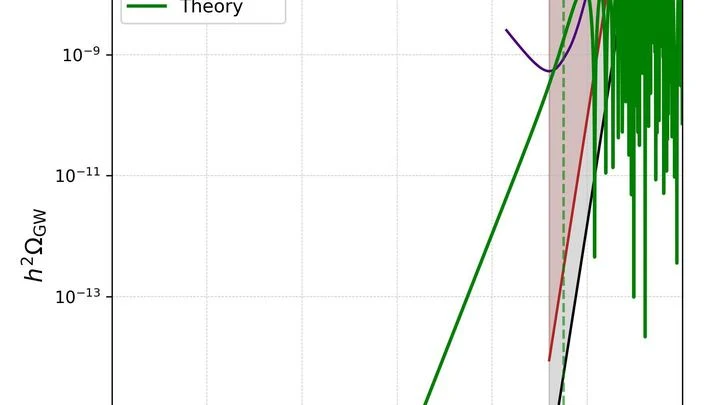
Light passes through a crumpled film — and comes out slightly altered. In much the same way, gravitational waves born in the early universe feel the lumpy distribution of galaxies and dark matter.
Using the James Webb telescope, astronomers peered into an ancient quasar — the dazzling heart of a galaxy where a giant black hole sucks in matter. It turns out it doesn't just destroy, but also creates: its powerful outflows and shock waves act like a true cosmic mill.
Hot tea in a freezer doesn't freeze all at once. First, tiny ice needles dart around — forming and melting until the temperature drops enough for the ice to set solid. The early universe behaved similarly as it cooled and changed its internal structure.
Ancient light, traveling 14 billion years, reaches us from all directions. At first glance, it looks perfectly smooth, but if you look closely, tiny fluctuations appear, like ripples on a still pond. Those ripples aren't random noise; they're an encoded history of the universe.
In the first moments after the Big Bang, the universe was a boiling soup of elementary particles. Even the light neutrinos were actively colliding with everything around. But the rapid expansion cooled this soup, and the neutrinos broke free, becoming almost indifferent to the surrounding world.
A tiny black hole zips through a gas cloud. Instead of swallowing the gas, it heats it up, like an iron left on a damp cloth. Radiation streams from the black hole, creating a hot spot — a region where the temperature is hundreds of times higher than in the surrounding space.
Right after the Big Bang, space rippled with gravitational waves, like those from a thrown stone. These tremors in the very fabric of the cosmos, predicted by Alan Guth, stretched across the entire universe. The ripples slightly compressed primordial matter in some places and thinned it out in others.
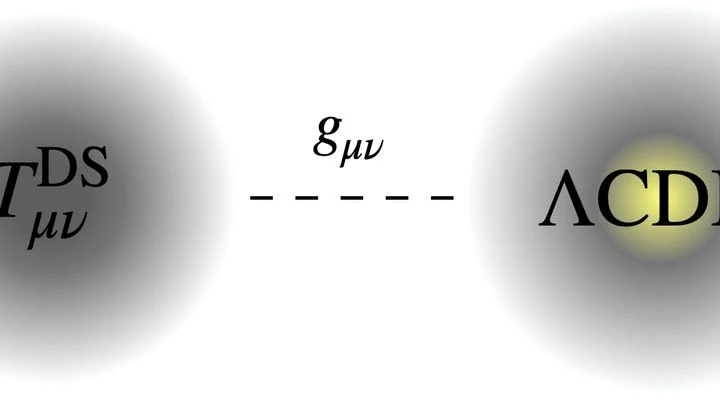
A pond with ripples spreading from a fallen stone. So it is on cosmic scales: a sudden burst of energy in the dark sector, an invisible substance that emits no light, creates ripples in the fabric of space. These ripples alter the path of light particles traveling to us from the very birth of the cosmos.
The authors of the new study built a mathematical framework to describe these distortions.
A huge orchestra is tuning up before a concert. Each instrument makes its own noise, and in the general hubbub it's hard to pick out individual sounds. But if the conductor gives a special flick of the baton for a second, all the violins will simultaneously hit one high note, and that pure tone will cut through the cacophony.
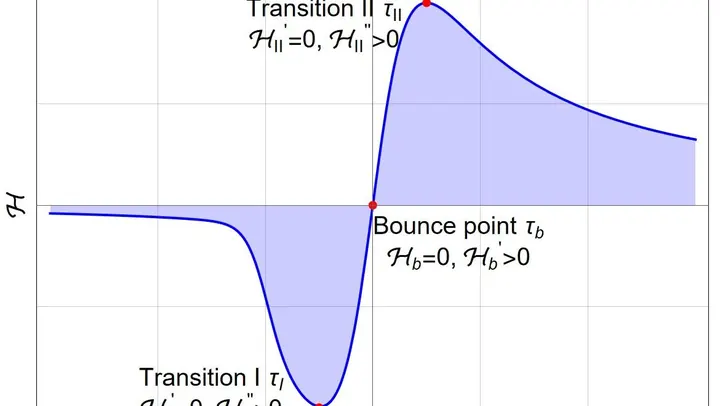
Usually, the story of the universe goes like this: there was nothing, then a bang, and ever since everything has been flying apart. But what if there was no 'nothing'? A group of physicists has shown that the universe could have existed forever: it just sometimes contracts and then expands again, like a spring.
A vast, dark cloud of gas stretched across the young universe. Inside it, like invisible fingers, magnetic field lines left over from the very birth of the cosmos threaded through. These fields act on charged particles, pushing them together, like a gentle breeze gathering fallen leaves into piles.
Imagine a vast lake at night, perfectly still. You can't see waves, but you hear them lapping evenly on the shore from all sides. That's what astronomers call the gravitational-wave background — a constant hum from distant black hole mergers. But what if the splashing were slightly louder on one side?
For 800,000 years, ice ages have occurred every 100,000 years. The rhythm matches the elongation of Earth's orbit. But the orbit changes the flow of solar heat so subtly — as if the conductor barely moved the baton, yet the orchestra thundered. It remained a mystery how this weak signal controls the ice sheets.
In the first few hundred million years after the Big Bang, the cosmos was like a noisy teen club: galaxies flared up, collided, and churned out stars by the hundreds.
The standard cosmological model describes the birth of the universe as an explosion from a singularity — a point of infinite density and spacetime curvature.
The young star PDS 66 is surrounded by a flat disk of gas and dust — the cradle of future planets. In the cold outer regions of such a disk, silicon and sulfur are usually hidden inside dust grains, but astronomers spotted a bright patch of gas at about 60 astronomical units from the star.
The dust around the young star CVSO 1942 flared up like a light bulb switched to full power. In 2024, the James Webb Space Telescope (JWST) peered into a transitional disk, a ring of gas and dust where planets are still being built, and saw that in mid-infrared light (wavelengths shorter than 10…
In the first moments after the Big Bang, the universe was nearly uniform, like smooth dough. But within a billion years, in some places the dough began to rise faster: clumps of hundreds of galaxies emerged, which astronomers call protoclusters. These are the seeds of future giant clusters, the most massive bound structures in the universe.
According to the Big Bang theory, developed by Georges Lemaître, the Universe began from a hot dense point and then rapidly expanded — an inflation proposed by Alan Guth. Echoes of that time reach us as a faint glow — the ancient light.
A black hole merger gives birth to a gravitational wave. Sometimes the wave’s path is blocked by a galaxy or a clump of dark matter, predicted by Zwicky and discovered by Rubin.
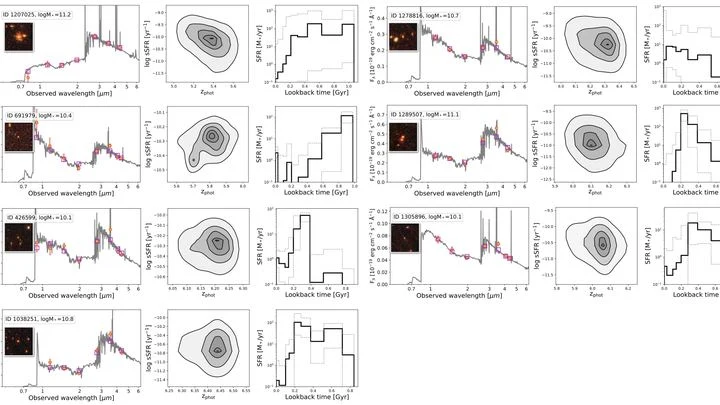
The James Webb Space Telescope looked back to a time when the universe, just after the Big Bang, was only a billion years old, and found the 'Sleepy' galaxy. Unlike its neighbors, which shone with young stars, it looked tired and dim.
On a high-speed highway, a steady flow of cars sometimes clumps into a traffic jam because of random slowdowns. In the young Universe, the overall expansion of galaxies after the Big Bang resembled this orderly movement. But each galaxy also performed its own maneuvers — braking or accelerating under the pull of neighboring galaxies.
The night of March 4, 2024. The MeerKAT radio telescope in South Africa catches a millisecond pulse: a fast radio burst coming from a depth of 17.4 gigaparsecs. This is light that traveled 10.5 billion years to reach Earth.