Reheating in cosmology refers to the process after cosmic inflation where the universetransitions from a cold, nearly empty state dominated by the inflaton field to a hot, dense plasma of particles. This process is crucial because it sets the initial conditions for the standard Big Bang cosmology, including the temperature and composition of the early universe. Without reheating, the universe would remain cold and empty, with no matter or radiation to form stars and galaxies.
History
The concept was introduced in the early 1980s alongside inflationarytheory, with key contributions from Andrei Linde, Paul Steinhardt, and others who developed the detailed mechanisms of particle production during reheating.
How it works
During inflation, the universe expands exponentially, cooling dramatically. The inflaton field, which drives inflation, then decays into standard model particles through a process akin to a field oscillating around its potential minimum. This decay produces a hot bath of particles, reheating the universe to temperatures high enough for nucleosynthesis and later structure formation.
In practice
Reheating is a theoretical cornerstone for understanding the early universe's particle content and is used in models predicting cosmic microwave background anisotropies and dark matterabundance.
Fun fact
The temperature of the universe after reheating is estimated to have been around 10^27 Kelvin, a trillion times hotter than the core of the Sun.
In a pot of boiling soup, light fat droplets rise to the top, while heavy vegetable chunks sink to the bottom. Particles in the tenuous hot gas around the Sun and other stars behave much the same way — except instead of broth, there's a mixture of charged particles: electrons, protons, and alpha particles.
In the first moments after the Big Bang, the universe resembled a boiling cauldron. According to one hypothesis, dark matter, the invisible substance that holds galaxies together, could have been born there.
It all started with stretching. In the first fractions of a second, the universe ballooned — physicists call this inflation. Then the rapid expansion gave way to a phase where the field's energy converted into ordinary particles.
The early universe resembled an overheated cauldron, seething with quantum fluctuations (random bursts of energy). In this chaos, like steam over boiling water, a special field, the scalar field, condensed. It became the 'engine' that made space expand at an incredible rate. This process is called inflation.
In the first moments after the Big Bang, the universe underwent a rapid expansion — inflation. Space stretched faster than light, and quantum jitters of the vacuum turned into real particles. This is how dark matter, the invisible substance that holds galaxies together, could have been born.
The early Universe was like a tightly coiled spring. In the first moments, it expanded at an unimaginable rate — a phase called inflation. Usually, this is attributed to a special field, but there's another idea: spacetime itself twists like a spring, and this twisting (in physics, torsion) becomes the engine of expansion.
0.965—a number that split cosmologists into 'before' and 'after'. That's the value of the spectral index ns measured by the ACT telescope as it stared into the cosmic microwave background — the cooled light of the Big Bang.
Boiling water in a pot is a good place to start. Bubbles of steam rise, pop, and the surface settles down. Something similar might have happened in the first moments of the universe's life with a special field filling space: bubbles of a new phase inflated and collided, like islands of steam in liquid.
Three invisible strings oscillate in the intergalactic void. This is not poetry, but a hypothesis about the nature of dark matter — an ultralight quantum field with spin 1, carrying three polarizations.
The universe cooled like a giant bathtub after a hot start. At 400 000 years after the Big Bang, hydrogen was ready to recombine — protons capturing electrons to become neutral atoms. But somewhere in this dark water, a tap kept dripping.
10⁻¹²⁰. That's not just a small number: it's a chasm. That's the ratio of dark energy density to the Planck density, the natural scale of quantum gravity. The colossal difference of 120 orders of magnitude has long seemed an unsolvable puzzle. But the answer might lie in a drama played out at the dawn of time.
The mystery of the radius valley — a sharp drop in the number of exoplanets with radii ~1.8 Earth — haunts astronomers. JWST, transit surveys like Kepler and TESS draw a clear gap: rocky super-Earths and gaseous sub-Neptunes are separated by almost a chasm.
The world around us is three-dimensional, but perhaps that's just an illusion. Some theories allow for extra dimensions of space, curled up or stretched in special ways. One such model depicts a five-dimensional universe with a "diluted" dimension (called a linear dilaton).
In the first moments after the Big Bang, the universe expanded at a terrifying rate. This process is called inflation, and it smoothed out all the wrinkles, making the cosmos homogeneous. But what started inflation itself?
In the first moments after the Big Bang, the universe inflated at an unimaginable rate. This inflation left behind ripples — tiny overdensities in the hot radiation and plasma.
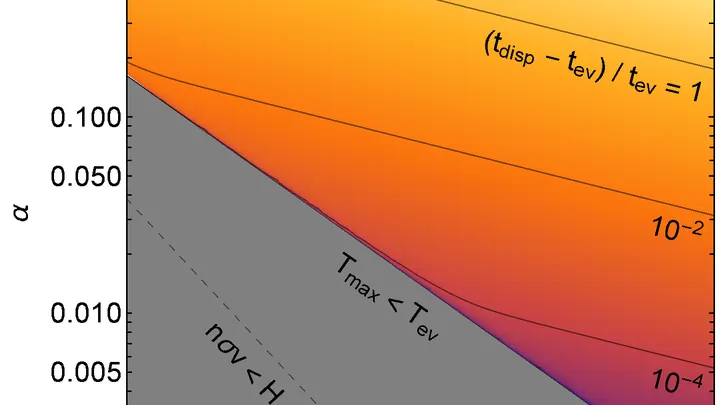
Dark matter is the invisible scaffold that holds galaxies together. But how did it come to be? The standard answer: particles of dark matter once stopped colliding and "froze out" in the amount we see today. However, there's a trickier path — UFO, or ultra-fast freeze-out.
Here, everything is like coffee that cools down and then heats up again as you carry it through a cold corridor.
In the first instants after birth, the universe might have been multidimensional, like a sheet of paper that suddenly gained thickness. This "thickness"—the extra dimensions — began to inflate rapidly. Such superfast growth is called inflation.
The early universe underwent a rapid expansion — inflation. In a tiny fraction of a second, minuscule quantum jitters were stretched to galactic scales and became the seeds of all large-scale structure.
The oven slowly cools. While it's hot, the dough rises vigorously, but once the temperature drops, the process stalls. That's roughly how dark matter was born in the 'freeze-out' model: in the hot early cosmos, particles collided and abounded, but as the universe expanded and cooled, their number froze, like baked goods set in place.
Inflation is the ultra-fast expansion of the universe in its first moments. It was driven by a field resembling a ball rolling down a hill. But there could have been a second, almost imperceptible ball nearby. The authors of this work considered exactly that scenario: a light spectator field (the axion), frozen at the top of its potential.
The origin of the hot Big Bang is one of the greatest mysteries. The familiar picture: after inflation, the inflaton field transfers energy to ordinary particles, reheating the Universe. Yet dark matter and dark energy hint that nature has hidden sectors.
The cosmic vacuum is not emptiness but a living ocean: its energy swells and subsides, echoing the expansion. Like a lunar tide, vacuum density sensitively responds to Hubble’s tempo — the conductor’s baton of the universe.
For almost a century, cosmologists have been grappling with the mystery: what makes the Universe expand ever faster? The standard answer — dark energy — creates a monstrous discrepancy between the theoretical vacuum density and observations. But there's another path, one that turns causality on its head.
In the first moments after the Big Bang, matter and antimatter should have been created in equal amounts. But today we see only matter — stars, planets, ourselves. Where did the antimatter go? One clue hides in nearly elusive particles: right-handed neutrinos. The usual story is that their decays create a slight bias in favor of matter.
A sponge thrown into a bucket of water eagerly soaks up moisture and swells before your eyes. But if you keep adding water and squeeze and release the sponge, absorption becomes harder and takes longer. That's roughly how tiny black holes behaved at the very beginning of the universe.
The birth of the universe resembles not an explosion, but a traffic jam. At first, a tiny fraction of a second after the Big Bang, space expanded sluggishly, like cars stuck in gridlock. Then came a sharp surge — accelerated expansion, which cosmologists call inflation.
A magnet with only one pole — north, but no south. Split it in half, and instead of two ordinary magnets, you get two more one-pole magnets. In our world, no such particle has been found, although many theories predict their existence. These hypothetical objects are called magnetic monopoles.
The authors of the study noticed a curious connection.
A tiny black hole the size of an atomic nucleus but with the mass of a mountain emerged in the first moments after the Big Bang, when random clumps of energy collapsed into such objects.
Cosmology is going through strange times. On one hand, the standard model with dark matter and dark energy beautifully describes the large-scale structure. On the other, it's cracking at the seams.
It all started with a tiny clump that grew faster than light could cross it. Inside this inflating bubble, our future Universe, reigned unimaginable heat. But one field, called the inflaton (the engine of inflation), behaved like a conductor: it controlled both the expansion and how other particles behaved.
The classic story of the Universe’s birth from a blazing point called the Big Bang raises uncomfortable questions: why is the cosmos so homogeneous, and what was before the singularity?
A pendulum chooses how to swing on its own. If you give it a strong push, it quickly returns to a smooth rhythm. If you hold it at its extreme position, it will stay there, but as soon as you let go, it resumes its usual motion.
In the seething cauldron of the early universe, the vacuum, like a supercooled liquid, could boil with bubbles of a new phase. For a long time, physicists pinned their hopes on these bubbles as a source of primordial black holes (PBHs)—ideal candidates for dark matter.
A tiny black hole zips through a gas cloud. Instead of swallowing the gas, it heats it up, like an iron left on a damp cloth. Radiation streams from the black hole, creating a hot spot — a region where the temperature is hundreds of times higher than in the surrounding space.
Usually, the story of the universe goes like this: there was nothing, then a bang, and ever since everything has been flying apart. But what if there was no 'nothing'? A group of physicists has shown that the universe could have existed forever: it just sometimes contracts and then expands again, like a spring.
Immediately after the Big Bang, the Universe underwent ultra-fast expansion, an idea proposed by Alan Guth and developed by Andrei Linde. When the expansion stopped, the field-energy began to oscillate like a giant swing.
About 380,000 years after the Big Bang, the universe cooled enough for electrons and protons to finally combine into neutral hydrogen. Although this event is called recombination, it was actually their first meeting — the heat had kept them from sticking together until then.
After the Big Bang, the Universe simmered as a fiery 'soup' of fundamental particles. Expanding and cooling, the soup gradually 'solidified' into protons and neutrons — much like crystallization. Had the solidifying been instantaneous, like a lake cracking in a deep freeze, the fabric of spacetime would have convulsed.
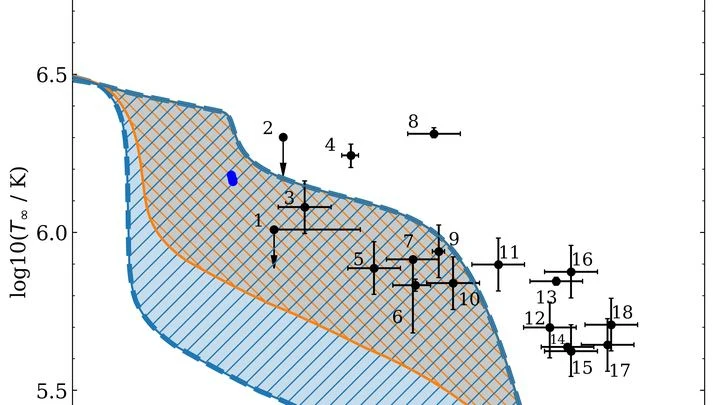
A neutron star is the remnant of an exploded star, compressed to the size of a city. In its core, matter is packed so densely that a teaspoon of such material would weigh as much as a mountain. At such densities, as predicted by the theory of strong interactions, particles acquire 'twins'—parity partners.