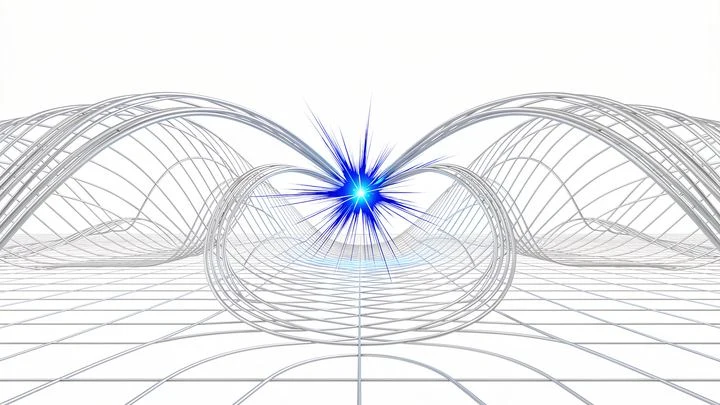
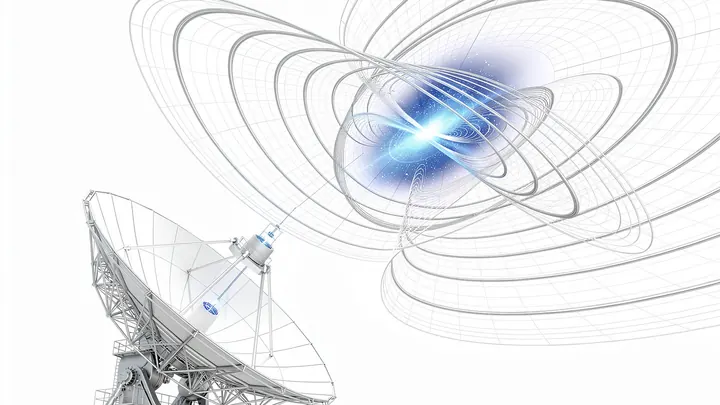
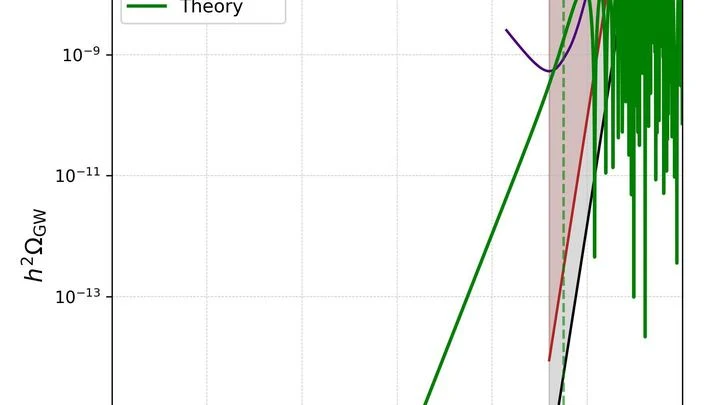
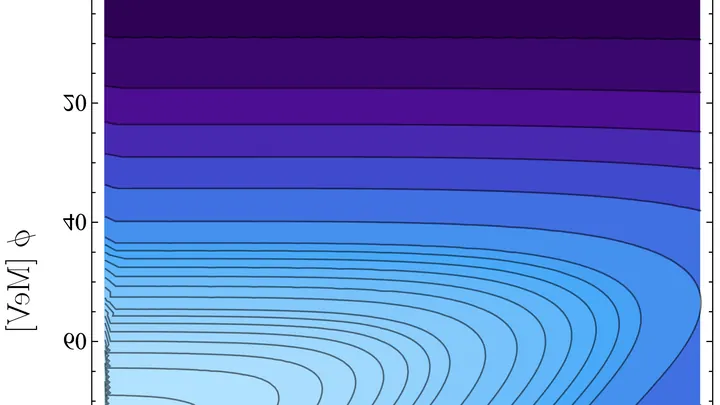
The cosmological collider is a theoretical framework that turns the early universe into a particle physics laboratory. During cosmic inflation—the exponential expansion that occurred a fraction of a second after the Big Bang—quantum fluctuations were stretched to astronomical scales, seeding the structure of the cosmos. The cosmological collider idea is that if heavy new particles existed during inflation, they would have left subtle imprints on the statistical correlations of these fluctuations, known as inflationary correlators. By measuring these correlations in the cosmic microwave background or the distribution of galaxies, physicists can infer the existence and properties of particles that are far too heavy to be produced in any terrestrial collider.
History
The term 'cosmological collider' was coined by Nima Arkani-Hamed and Juan Maldacena in a 2015 paper, building on earlier work by Xingang Chen and Yi Wang on 'inflationary non-Gaussianities' from massive fields.
How it works
During inflation, the inflaton field (the field driving expansion) fluctuates quantum mechanically. If there are other heavy fields coupled to the inflaton, they can be temporarily excited by these fluctuations, even if their mass is much larger than the Hubble scale. These excited particles then decay back into inflaton fluctuations, creating non-Gaussian signatures in the primordial density perturbations. These signatures appear as specific shapes in the three-point or four-point correlation functions of the perturbations, which can be calculated using quantum field theory on a de Sitter background. Observing these shapes would reveal the mass, spin, and interactions of the heavy particles.
In practice
This framework guides the analysis of data from cosmic microwave background experiments (like Planck, CMB-S4) and large-scale structure surveys (like DESI, Euclid) to search for signs of new physics, complementing searches at particle colliders like the LHC.
Fun fact
The cosmological collider can probe particles with masses up to a million times heavier than anything the Large Hadron Collider could ever produce, because inflation's energy scale was so much higher.
In the first instants after the Big Bang, the universe expanded faster than light could cross it. Like an inflating balloon, but instead of rubber, it was space itself. On this balloon, ripples inevitably formed — tiny compressions and rarefactions from which all galaxies and stars later grew.
A courtroom interpreter is distracted by every rustle: the creak of a chair, a cough in the back row, the rustle of papers. By the end of the day, they are translating not what the witness said, but what they heard through the noise. Rare translation errors are not the result of a single loud shout, but of the accumulation of many small disturbances.
It all started with stretching. In the first fractions of a second, the universe ballooned — physicists call this inflation. Then the rapid expansion gave way to a phase where the field's energy converted into ordinary particles.
The early universe resembled an overheated cauldron, seething with quantum fluctuations (random bursts of energy). In this chaos, like steam over boiling water, a special field, the scalar field, condensed. It became the 'engine' that made space expand at an incredible rate. This process is called inflation.
In the first moments, the Universe expanded at an enormous rate. This process is called inflation, and its driving force is the inflaton field. Its energy pushed space apart, like yeast raising dough. But physicists suspect that the dough might have left 'bubbles'—superheavy particles born from the expansion itself.
$$10^{-35}$$ seconds. A tiny instant during which the Universe manages to expand by a factor of $$10^{26}$$. Immediately after, it goes through thousands of rapid transformations — like a ball bouncing along a chain of tunnels. This cascade is the essence of chain inflation, first proposed by Alan Guth.
Clocks in the Universe are tricky things. Usually, in calculations of the birth of the world, a special scalar field plays the role of a clock — something like an invisible fluid filling all of space. It ticks, and physicists watch how the world changes relative to that ticking. But these clocks are man-made, introduced for convenience.
The authors of the new work took a different path.
The first moments after the big bang: space expands rapidly — physicists call this period inflation. Inside this swelling fabric, like soap bubbles in a stream of air, regions of new vacuum begin to form — a first-order phase transition. Most bubbles pop or merge as soon as they appear.
The universe rang piercingly in its first moments. During the inflation epoch, when space expanded faster than light, energies were monstrous — trillions of times higher than in the Large Hadron Collider.
0.965—a number that split cosmologists into 'before' and 'after'. That's the value of the spectral index ns measured by the ACT telescope as it stared into the cosmic microwave background — the cooled light of the Big Bang.
Gravity is a remarkably weak force. A small magnet holds a paperclip against the pull of an entire planet. Physicists have long sought the reason for this weakness, and one guess leads us into hidden dimensions. Perhaps gravity 'leaks' into them, losing strength in our three-dimensional world.
At the dawn of time, the universe experienced a brief moment of frantic expansion — inflation. Tiny quantum jitters of spacetime stretched to cosmic scales. These jitters, primordial fluctuations, became the seeds from which galaxies and stars later grew.
In the first moments after its birth, the universe expanded faster than a match lights. This process is called inflation. It explains why today's cosmos is so homogeneous and flat. But what happened before it? Perhaps the laws of quantum gravity were at work then, and their traces can be found in the data.
2.1 × 10⁻⁹ — that's the temperature variation across the sky, about the same as measuring ripples a fraction of a millimeter high on the ocean surface. This microscopic non-uniformity is imprinted in the cosmic microwave background and tells the story of the very beginning of time.
In the first moments after the Big Bang, the Universe underwent a rapid expansion, inflation, blowing up quantum fluctuations to scales visible today in the cosmic microwave background.
The early universe expanded at a breakneck pace: this phase is called inflation. But how exactly did it do it? Some models describe the expansion as a steep exponential surge, others as a more gentle power-law motion.
In the first moments after the Big Bang, the universe expanded at a terrifying rate. This process is called inflation, and it smoothed out all the wrinkles, making the cosmos homogeneous. But what started inflation itself?
In the first moments after the Big Bang, the universe inflated at an unimaginable rate. This inflation left behind ripples — tiny overdensities in the hot radiation and plasma.
The cosmic microwave background is the petrified light of the first moments. Shortly after the Big Bang, microscopic quantum fluctuations were stretched by inflation to the scales of galactic superclusters.
In the late 1990s, the night sky delivered a surprise: Saul Perlmutter and Adam Riess found that the expansion of the Universe is accelerating. Ever since, the greatest riddle has been dark energy — a substance making up nearly 70% of the cosmos, yet evading laboratory study.
In the first moments, the universe expanded at an unimaginable rate — a phase called inflation. It is thought that particles of dark matter, the invisible substance that holds galaxies together, could have been born from the vacuum during this time. But what determines exactly how many are produced?
The authors considered a model with two fields.
The very first moments of the Universe's life resemble tuning a complex musical instrument. Quantum fluctuations, stretched by rapid inflation, became the 'notes' from which galaxies later formed. In the new work, physicists considered an unusual opening chord — a superoscillating state.
In the first instants after birth, the universe might have been multidimensional, like a sheet of paper that suddenly gained thickness. This "thickness"—the extra dimensions — began to inflate rapidly. Such superfast growth is called inflation.
Inflation is the ultra-fast expansion of the universe in its first moments. It was driven by a field resembling a ball rolling down a hill. But there could have been a second, almost imperceptible ball nearby. The authors of this work considered exactly that scenario: a light spectator field (the axion), frozen at the top of its potential.
The early universe expanded at an unimaginable rate — faster than light could cross it. In this boiling cauldron, any region of space resembled an open can of paint: its boundaries continuously captured new 'vapor' from outside, while some of its own contents irrevocably escaped.
Quantum noise, like the hiss of an untuned radio, filled the infant Universe. Alan Guth showed that superfast expansion (inflation) caused this ripple to freeze, giving rise to clumps of matter — the seeds of galaxies.
A new method extends this picture to any theory of gravity.
Astronomers build maps of galaxies and listen to the radio whisper of neutral hydrogen. The signal is so faint that even a working TV would drown it out, but sensitive antennas pick it up from the depths of the Universe.
Imagine the early Universe as a giant balloon, instantly inflated to incredible size. The tiny bumps on its surface are frozen quantum ripples that later became galaxy clusters. This rapid inflation left behind an ancient glow — a map of the sky that astronomers study.
Ancient light, traveling 14 billion years, reaches us from all directions. At first glance, it looks perfectly smooth, but if you look closely, tiny fluctuations appear, like ripples on a still pond. Those ripples aren't random noise; they're an encoded history of the universe.
The birth of the universe resembles not an explosion, but a traffic jam. At first, a tiny fraction of a second after the Big Bang, space expanded sluggishly, like cars stuck in gridlock. Then came a sharp surge — accelerated expansion, which cosmologists call inflation.
It all started with a tiny clump that grew faster than light could cross it. Inside this inflating bubble, our future Universe, reigned unimaginable heat. But one field, called the inflaton (the engine of inflation), behaved like a conductor: it controlled both the expansion and how other particles behaved.
The classic story of the Universe’s birth from a blazing point called the Big Bang raises uncomfortable questions: why is the cosmos so homogeneous, and what was before the singularity?
Cosmology has long sought a loophole behind the Big Bang. Inflation, proposed by Alan Guth, stretches and smooths out primordial inhomogeneities, but what lit the fuse itself?
A pendulum chooses how to swing on its own. If you give it a strong push, it quickly returns to a smooth rhythm. If you hold it at its extreme position, it will stay there, but as soon as you let go, it resumes its usual motion.
The mystery of the missing antimatter has haunted physics since the mid-20th century. The Big Bang should have created equal amounts of matter and antimatter, yet today's world is almost entirely matter. The Standard Model is powerless to explain this baryon asymmetry — we need new particles and mechanisms beyond it.
A huge orchestra is tuning up before a concert. Each instrument makes its own noise, and in the general hubbub it's hard to pick out individual sounds. But if the conductor gives a special flick of the baton for a second, all the violins will simultaneously hit one high note, and that pure tone will cut through the cacophony.
Tuning a radio is a delicate business: one knob turns easily, another resists. In the physics of the early Universe, there are also 'knobs'—parameters that determine what we see today. One of them is the strength of the coupling between a special field (the one that drove the rapid expansion of the Universe) and the geometry of space.
In the first moments of the universe's existence, space was filled with hot plasma, where particles emerged and disappeared like bubbles in a boiling pot. The traces of these processes, stretched to gigantic sizes by expansion, are preserved in the cosmic microwave background — ancient light that has reached us across billions of years.
After the Big Bang, the Universe simmered as a fiery 'soup' of fundamental particles. Expanding and cooling, the soup gradually 'solidified' into protons and neutrons — much like crystallization. Had the solidifying been instantaneous, like a lake cracking in a deep freeze, the fabric of spacetime would have convulsed.
In its first moments, the universe resembled dough that alternately rises rapidly and then pauses for a second. During these short bursts, called expansion of the universe with interruptions, even tiny magnetic fields could have grown like bubbles in well-beaten dough.