How Gravity Repaints Gravitational Waves express
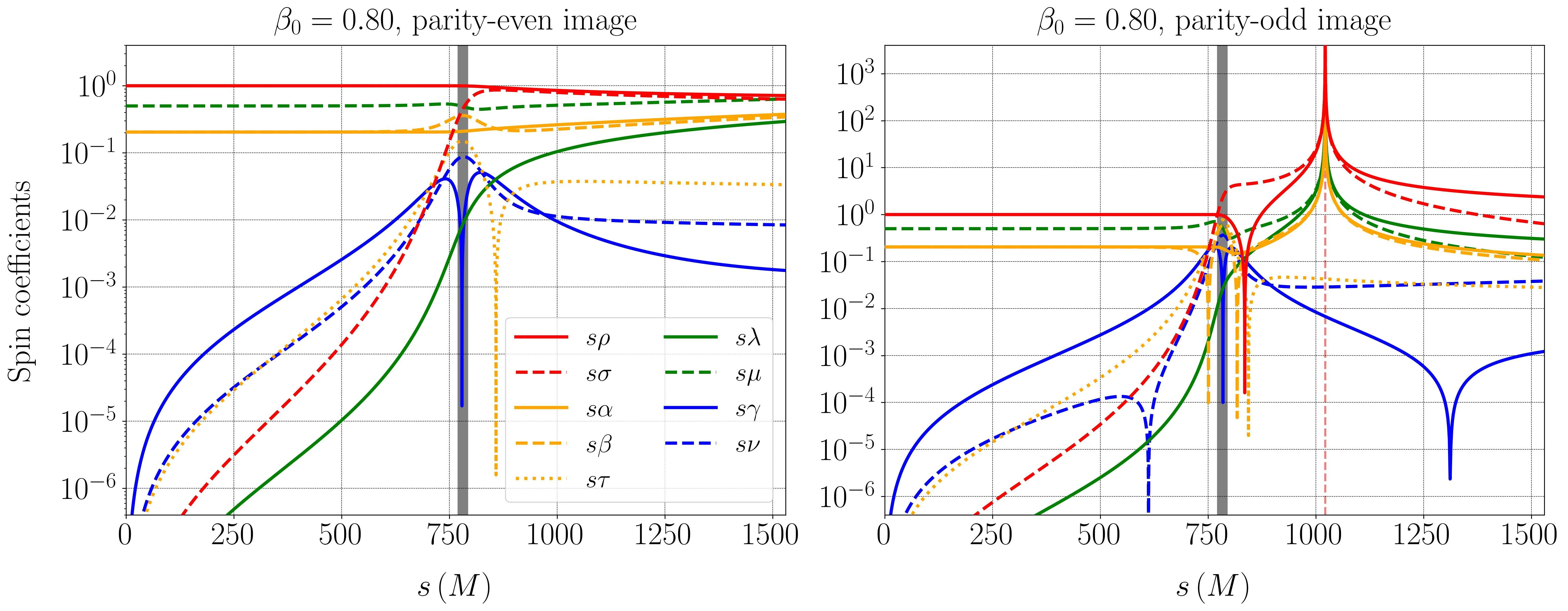
Light bends in a lens — everyone knows that. Gravitational waves passing a massive body also curve their path. But the authors of this work looked further: what happens to the wave's very "color" — its polarization, that is, the direction of oscillation?
Usually, calculations use either the geometric optics approximation (as for light) or the complex Kirchhoff integral. But both methods miss polarization details. The authors, relying on the Newman–Penrose formalism, reduced the gravitational wave equations to a set of scalar equations and derived explicit formulas for quantities describing polarization. Then they combined two approaches — the solution for ray deflection and polarization transport along those rays — and obtained a system that can be solved.
Applying it to a Schwarzschild black hole (the simplest non-rotating one), they showed numerically: "ghosts" appear in the signal — vector and scalar modes. These are not new wave types but simply the result of the lens smearing the polarization plane and distorting the wavefront. The effect is purely from spacetime curvature — no new physics.
Such detailed calculations are important for future detectors: if we see "extra" modes in a lensed signal, we won't mistake them for exotic physics but understand — it's just light (or rather, gravity) playing tricks on us.
Original abstract
as written by the authors arXiv:2607.24091
In this work, we study the gravitational lensing of gravitational waves (GWs) by extending the geometric-optics approximation to higher order. With the help of the Newman-Penrose formalism, we reexpress the GW propagation equations as a series of scalar equations and present explicit expressions for the Weyl scalars that describe the GW polarizations. By combining the approaches of solving geodesic deviation and transport equations, we construct a solvable system of equations that describes the evolution of GW polarization along null geodesics. This framework fills the gap left by the leading-order geometric optics and the Kirchhoff diffraction integral, neither of which captures the polarization characteristics of GWs during the lensing process. This work applies the above framework to a Schwarzschild lensing configuration. Through a rigorous theoretical formulation and detailed numerical analysis, our results reveal the emergence of apparent vector and scalar modes in lensed GW signals, which originate from the smearing of the polarization plane and distortion of the wavefront and do not represent genuine dynamical degrees of freedom but rather arise as the propagation effects imposed by gravitational lensing.
Gravitational lensing for waves was predicted by Einstein himself, but only in 2015, after the first detection of gravitational waves, did hope arise to catch such an effect. So far, no lensed signal has been reliably detected.
In the movie "Interstellar," characters use gravitational anomalies to send messages across spacetime — much like wavefront distortions could carry information about massive objects in the path.