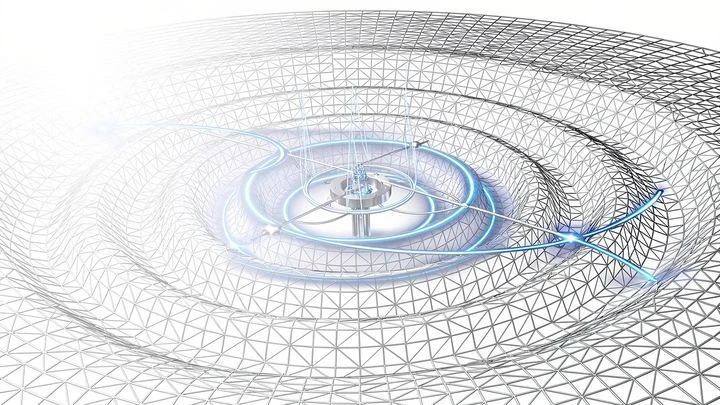
Alternative gravity theories are theoretical frameworks that propose modifications to general relativity to explain cosmic phenomena—such as galaxy rotation curves and the accelerated expansion of the universe—without invoking dark matter or dark energy. Instead of adding invisible substances, these theories alter the laws of gravity at large scales or in weak-field regimes. They aim to account for observations like gravitational lensing, the cosmic microwave background, and the dynamics of galaxy clusters purely through geometric or field-theoretic adjustments to Einstein's equations.
History
The idea dates back to the early 20th century, with Einstein himself exploring unified field theories. Modern alternatives gained traction in the 1980s with Mordehai Milgrom's MOND, followed by relativistic extensions like Tensor-Vector-Scalar (TeVeS) theory by Jacob Bekenstein in 2004.
How it works
Most alternative theories introduce additional fields, higher-order curvature terms, or non-local effects into the gravitational action. For example, f(R) gravity replaces the Ricci scalar R with a function f(R), while Modified Newtonian Dynamics (MOND) adjusts the force law below a characteristic acceleration. These modifications change how spacetime curvature responds to matter, producing effects that mimic dark matter's gravitational pull or dark energy's repulsion. The theories are constrained by solar-system tests, gravitational-wave observations, and cosmological data, which narrow the allowed parameter space.
In practice
These theories guide the design of precision tests for gravity, such as satellite missions measuring the equivalence principle and analyses of gravitational-wave signals from merging black holes.
Fun fact
Some alternative gravity theories predict that gravitational waves travel at slightly different speeds than light, a prediction now tightly constrained by the 2017 neutron-star merger observation GW170817.
Light freezes at the edge of the abyss: that's what the event horizon of an ordinary black hole looks like. But at the center of this abyss lurks a singularity, a point where the laws of physics break down. What if, instead of a point, there were a hard shell?
A gravastar is not a black hole.
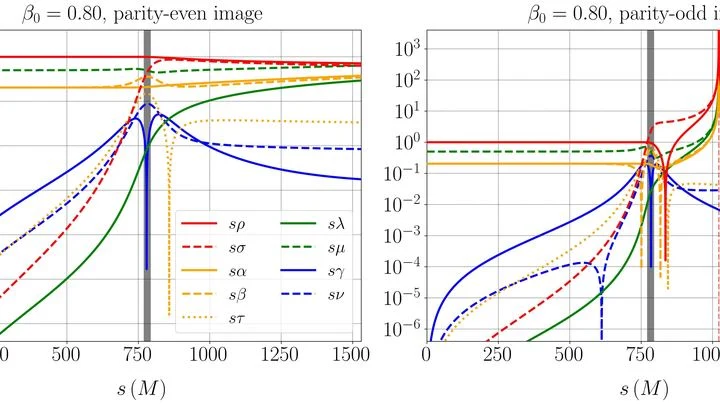
Light bends in a lens — everyone knows that. Gravitational waves passing a massive body also curve their path. But the authors of this work looked further: what happens to the wave's very "color" — its polarization, that is, the direction of oscillation?
Gravitational lensing is the deflection of…
A light ray passing by a massive body gets deflected: this is the effect of gravitational lensing, familiar from images of distant galaxies. The astrophysicists started with a rotating black hole (Kerr spacetime) and added a tiny correction to how light itself propagates.
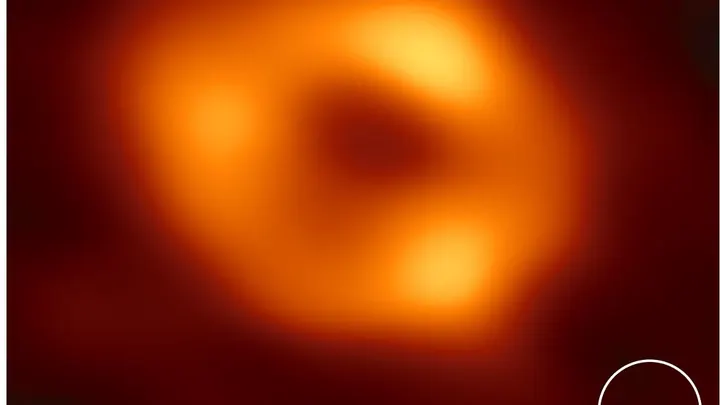
At the center of the Milky Way, shrouded in dust and glare, lurks a supermassive black hole — Sagittarius A*. Around it, like moths around a flame, swarm dozens of guide stars. Two of them, S2 and S38, with eccentric orbits and periods of just a few years, have become the protagonists in testing the fundamental laws of the cosmos.
When a distant galaxy sends us light, it dims with distance, and from that dimming, we can tell how far away it is. Gravitational waves work in much the same way: the farther their source, the weaker the ripple in space that detectors on Earth pick up.
Electrons and muons are tiny magnets. Their magnetism is slightly more than two (in special units), and this 'excess fraction' (anomalous magnetic moment) arises from constant ripples in the vacuum: particle pairs momentarily pop into existence and vanish.
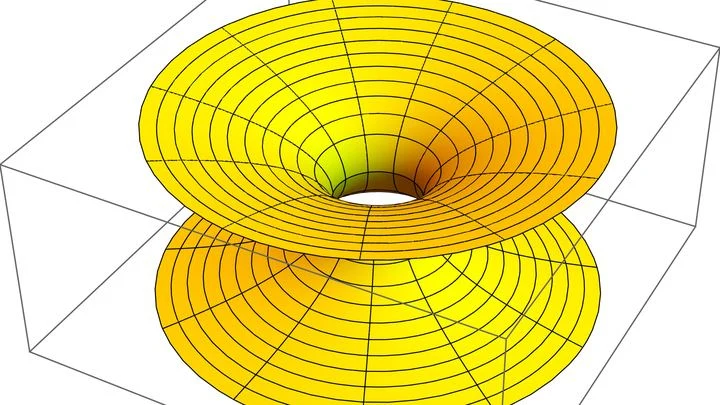
A wormhole is a tunnel through the fabric of spacetime, an idea expanded by John Wheeler and Kip Thorne. Just as a mountain passage tends to cave in, the throat of a wormhole wants to snap shut.
The Universe speaks two fundamental languages — gravity and light. Under normal conditions, they do not mix: gravitational waves glide through matter without a trace, while photons dance in mirror labyrinths.
A galaxy is like a cosmic highway where stars, like cars, race along circular orbits. Their speed is set by the invisible "cargo" of mass enclosed within the orbit: the more massive the central region, the faster the stars at the periphery.
An ordinary kettle: you heat it up — temperature rises, molecular chaos grows, and steam shoots out. But in the lab, they've created a peculiar "kettle"—an analog black hole made from superconducting circuits cooled to the extreme.
Spacetime sometimes resembles a sheet of paper in which you can punch a hole and connect the edges with a short tube: you get a wormhole. In the simplest mathematical models of such wormholes, massless scalar fields appear — something like an invisible fog filling everything around.
A stone thrown into a pond leaves ripples spreading across the water. In quantum physics, the role of such ripples is played by equations that relate the properties of particles. Recently, mathematicians proposed a set of such equations for a world without gravity but with a large number of 'degrees of freedom'—roughly like the complex ripples on water.
Einstein's theory of gravity explains how mass warps space and time. Its predictions have been tested near Earth, but the most grueling tests lie around black holes, where distortions reach their breaking point. Until now, astronomers saw them as blurry smudges on an underexposed photo.
When light swings past a massive body like a black hole, its path warps — an effect predicted by Einstein. New research has taken into account that near such objects, clouds of hadrons often swirl — the very particles we know from protons and neutrons in atomic nuclei.
A tuning fork, once struck, makes neighboring strings vibrate. Much the same happens with a cloud of ultralight particles (also called axions) around a rapidly spinning black hole. The hole, like a motor, spins up the particles, and they begin to emit gravitational waves — a trembling of space itself.
A balloon in your hand springs back equally in all directions. But a bottle of soda behaves differently: along the neck it is stiff, while across it is easily squeezed. This is roughly how pressure works inside some stars: it can be unequal in different directions. Such stars are called anisotropic, and their behavior has so far been described by disparate methods.
A tailor cuts a suit, but the seams pucker and the buttons won't align. In quantum field theory, similar glitches are called anomalies: they appear when a symmetry of the equations breaks down in the transition to a quantum description. Usually, they are fixed by sewing in extra patches, the so-called Bardeen–Wess–Zumino counterterms.
The merger of two black holes is like a dance that ends in a powerful burst — a gravitational wave. This wave carries the imprint of how spacetime is curved around the objects. If the geometry differed from what we're used to, as if a ball rolled not on a flat floor but on wavy linoleum, the signal would be different.
When stars at the edges of galaxies rotate faster than calculations based on visible mass predict, standard cosmology invokes the hypothesis of hidden dark matter — invisible substance that reveals itself only through gravity. A new study offers an alternative that requires no new particles.
Two black holes spiral faster and faster until they merge into one. This dance shakes space itself: waves ripple outward from the collision site, like ripples from a stone thrown into a pond. Sometimes the merger also produces a flash of light.
If you look at a map of distant galaxies, it is not perfectly uniform: on one side of the sky there are slightly more, on the other — slightly fewer. This lopsidedness has been noticed in several sky surveys, and it does not look like a random fluke. Usually, it is explained by the fact that our Galaxy itself is flying somewhere, making distant objects appear shifted.
Back in the last century, Vera Rubin discovered that stars on the outskirts of galaxies rotate too fast, as if held by some invisible substance. Since then, dark matter has remained a puzzle. Usually, its origin is linked to new particles or forces. But a new study points to a simpler source — the geometry of space itself.
Light from distant galaxies, passing through clusters of matter, gets distorted — much like the bottom of a pool breaks up into ripples of water. Astronomers measure these barely perceptible bends in shape and create a map of gravitational ‘ripples.’ This is weak lensing — a natural detector of invisible matter.