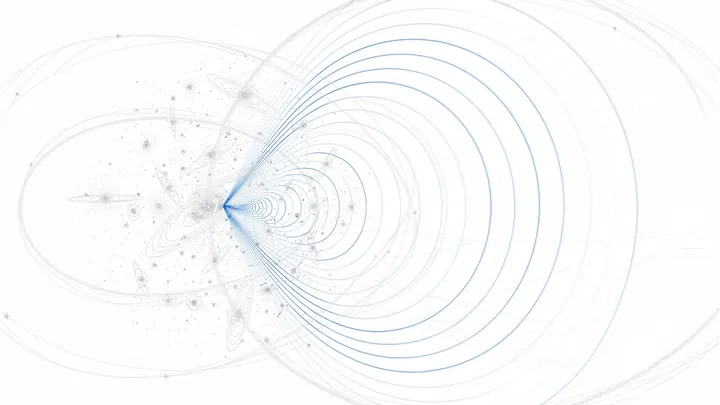
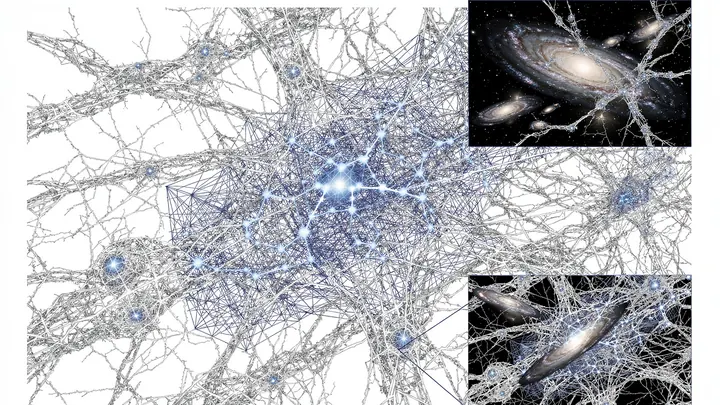
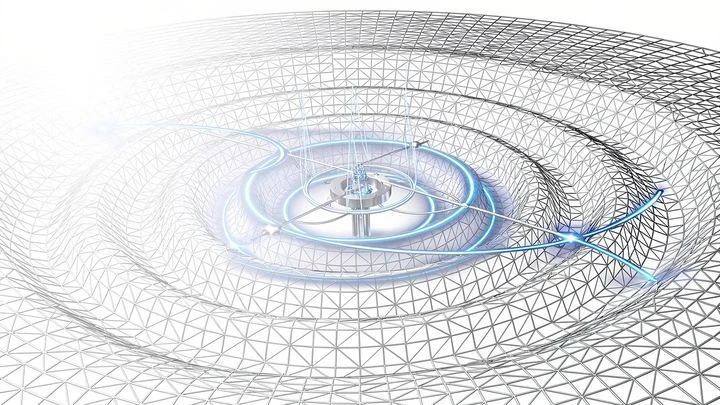
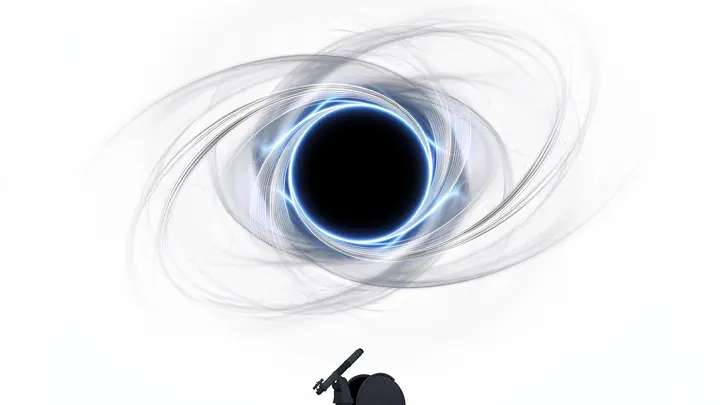
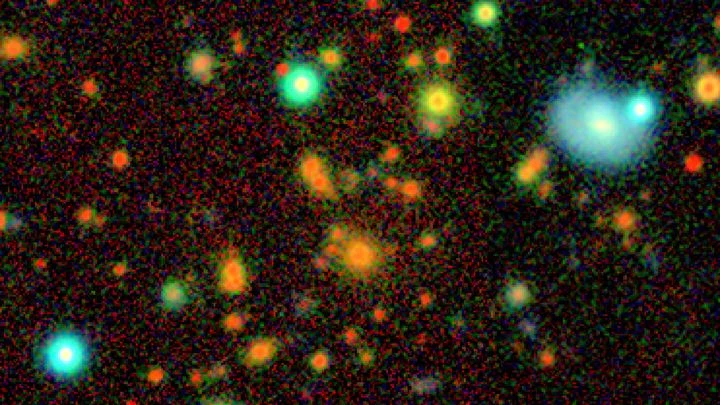
Gravitational lensing modeling is the process of reconstructing the mass distribution of foreground matter (like galaxies or galaxy clusters) and the properties of background sources (like distant galaxies) from the distorted, magnified images produced by gravitational lensing. When light from a distant source passes near a massive object, its path is bent, creating multiple images, arcs, or Einstein rings. Modeling these effects allows astronomers to map dark matter, measure the expansion of the universe, and study galaxies that would otherwise be too faint to detect.
History
The theoretical framework was developed in the early 20th century, with Einstein's general relativity predicting light deflection. The first strong gravitational lens was discovered in 1979 (the Twin Quasar). Modern modeling techniques evolved in the 1990s with computational advances.
How it works
The modeling uses the lens equation, which relates the observed image positions to the source position and the lens's gravitational potential. By fitting observed images to predicted ones, astronomers iteratively adjust the mass distribution model (often parameterized as dark matter halos with elliptical symmetry) and the source's surface brightness profile. Advanced techniques include pixelated source reconstruction and machine learning to speed up the fitting.
In practice
Gravitational lensing modeling is used to map dark matter in galaxy clusters, measure the Hubble constant via time delays in lensed quasars, and detect high-redshift galaxies that are magnified for detailed study.
Fun fact
The first gravitational lens discovered, the Twin Quasar, was initially thought to be two separate quasars until their identical spectra revealed they were two images of the same object.
A translator learns a language not from a dictionary but from living conversations: they hear fragments of phrases, street noise, different accents. Out of that chaos they assemble rules that are written in no book.
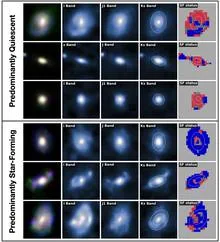
A ground-based image of a distant galaxy looks like a view through frosted glass: the atmosphere smears details, hiding the internal structure. Astronomers have long wanted to know where exactly star formation shuts off in galaxies, but ground-based telescopes could not resolve the subtle color gradients.
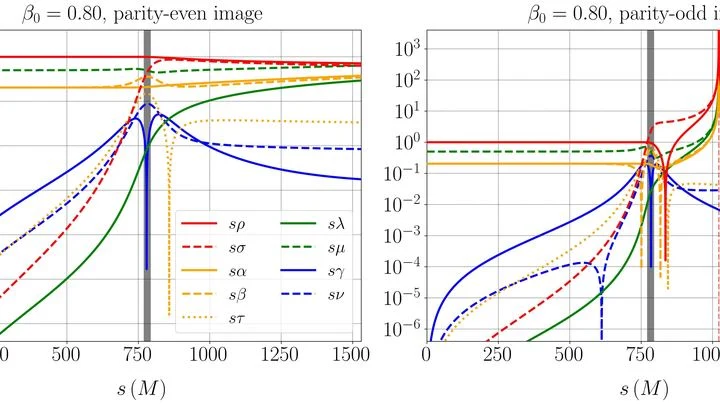
Light bends in a lens — everyone knows that. Gravitational waves passing a massive body also curve their path. But the authors of this work looked further: what happens to the wave's very "color" — its polarization, that is, the direction of oscillation?
Gravitational lensing is the deflection of…
Two hundred million stars. In the heart of the Galaxy, where the future survey by the Nancy Grace Roman telescope will aim, about 250 times during its mission the light of one of them will flicker at an invisible touch.
Look into the night sky — before you is not a scattering of lights, but a multi-layered manuscript. Under the bright ink of stars and galaxies appears a faded, almost erased text.
In 1981, Alan Guth proposed a scenario of cosmological inflation — a lightning-fast expansion of space that stretched quantum fluctuations to the scale of entire galaxies. Since then, cosmologists, like archaeologists, have been excavating this event from the structures of the Universe.
The Universe is a giant labyrinth of curved mirrors. The mass of galaxies and clusters distorts the light of distant quasars, as if toying with our perception of the cosmos. Hidden in this hall of mirrors is the key to the greatest mystery: dark energy, which is pushing space apart ever faster.
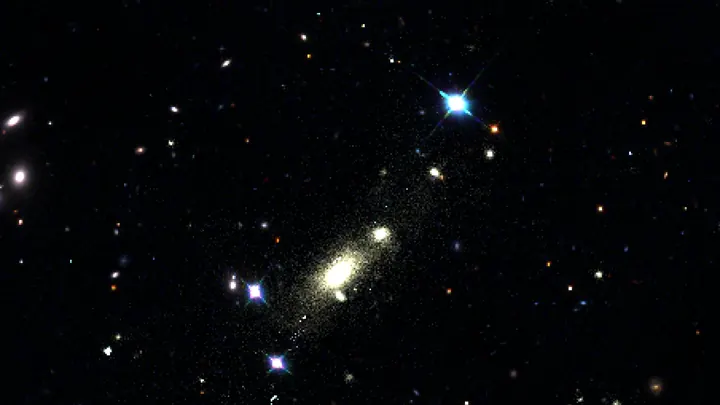
Within a field of view the size of a grain of sand held up to the eye, hundreds of galaxies lie hidden, smeared into arcs by the massive cluster Abell S1063.
Light from distant galaxies travels to us for billions of years, but along the way it gets bent and twisted by the invisible web of dark matter. This effect, predicted by Albert Einstein within general relativity, is called gravitational lensing.
X-ray detectors work like honeycombs: particles flash here and there in hexagonal cells. Conventional algorithms stretch these combs onto a square grid, creating ghostly polarization artifacts. Scientists used a neural network that lives by the rules of the hive — it processes the hexagonal structure directly, preserving the natural pattern.
Two dots on the surface of a balloon: that's all the reference points you have when trying to figure out how it inflates. That's roughly how cosmologists reconstruct the history of the universe's expansion.
The Universe speaks two fundamental languages — gravity and light. Under normal conditions, they do not mix: gravitational waves glide through matter without a trace, while photons dance in mirror labyrinths.
In 2019, the Event Horizon Telescope gave humanity the first image of a black hole shadow — a fiery ring around the abyss at the center of galaxy M87. This gravitational self-portrait, painted by the light of infalling plasma, instantly became an icon of modern astrophysics.
Imagine a river that doesn't flow in an open channel but through the inside of a sponge, with its currents shifting from place to place. That's a good way to think about the brain's glymphatic system: a network of ultra-fine channels around blood vessels, through which cerebrospinal fluid seeps into the tissue and washes away the waste that has piled up during the day.
Light passing through a turbid medium like milk or living tissue scatters in all directions. Reconstructing where light was absorbed more strongly is like guessing the shape of a fallen object from a puddle on the asphalt. Optical tomography solves this problem, but usually requires large computational resources.
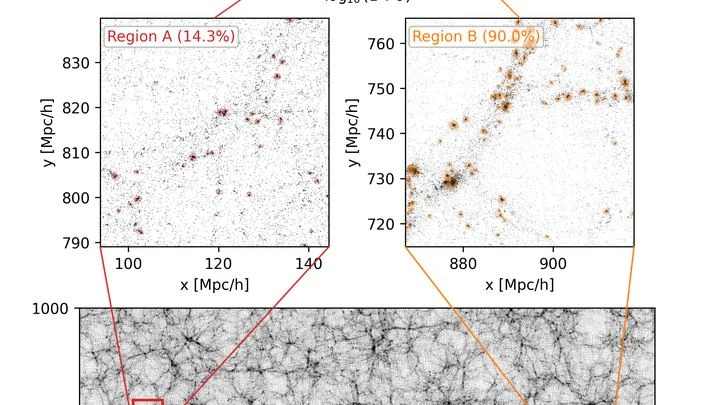
The Universe is vast, and figuring out how galaxies and dark matter are distributed within it is no easy task. Usually, scientists run computer simulations that "play out" the evolution of entire regions of space billions of light-years across. But such calculations demand colossal resources and time.
Toss a handful of glitter into a river, and some flakes will drift straight while others spin in tiny eddies. Galaxies in the universe do something similar: they don't just recede due to cosmic expansion: they also swirl in giant currents, like wood chips caught in invisible whirlpools.
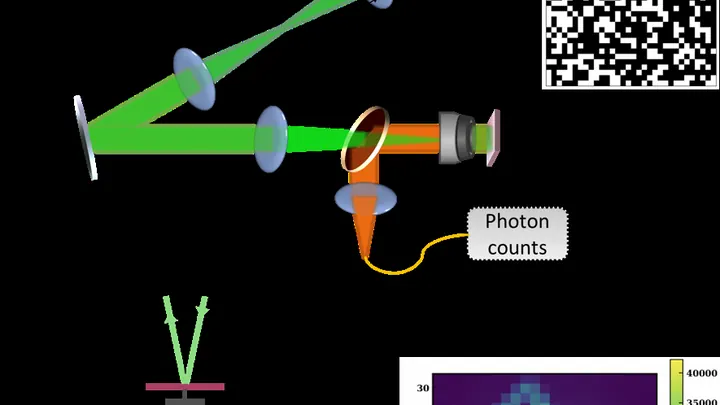
Hunting for a single glowing spot in a dark sample is like trying to find a needle in a haystack: the microscope beam crawls line by line, wasting time and light. Physicists replaced this slow sweep with random light patterns. The sample is illuminated with a broad field, but each time with a new pattern of bright and dark patches, as if random shadows from a grid were projected onto it.
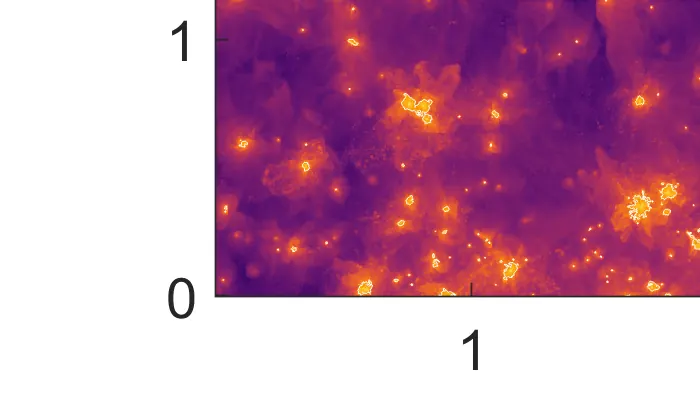
Every galaxy floats in an invisible cloud of gas, like fruit in syrup. This gas is the leftover building material from which stars were assembled, and it is constantly replenished by fresh supplies from intergalactic space. Seeing it directly is nearly impossible: it is too tenuous and too cold.
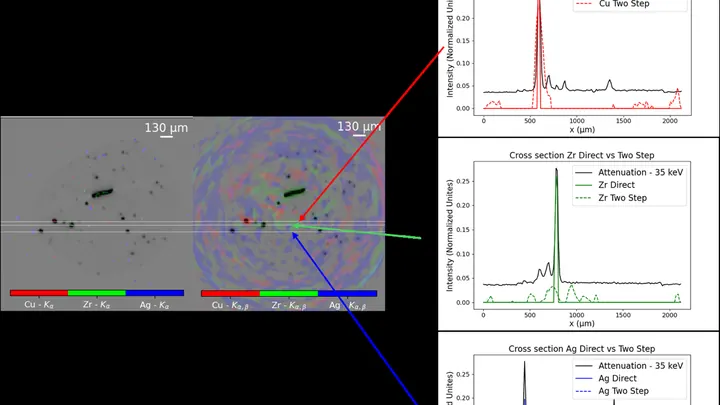
Conventional X-ray fluorescence analysis works like a meticulous scribe: to learn the composition of a picture, it walks over every square centimeter and logs whether lead or copper is present. For a flat sheet, that's tolerable, but for a three-dimensional object, it's torture.
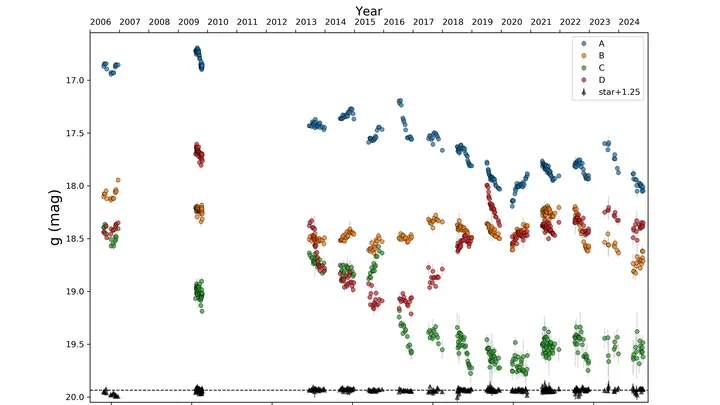
A distant quasar appears as four points of light arranged in a cross. This is how the gravity of a galaxy lying along our line of sight distorts the view: it acts like imperfect glass, multiplying the image. Each point is the same object, but its light travels different paths.
Previously, astronomers calculated galaxy mass as if they were perfect spheres. But a galaxy is a flat pancake. The new 'Lost and Found' model takes the actual shape into account: it sums up the gravitational pull from all parts of the disk, not just the central bulge. The result is stunning: many galaxies need a third less invisible dark matter than previously thought.
Light from a distant galaxy travels for billions of years, and on its way its path is slightly bent: this is how the invisible mass called dark matter reveals itself. This bending slightly stretches or compresses the galaxy's image, like a reflection in wavy glass.
Images of distant galaxies are riddled with curved arcs and smears — light warped on its way to us. This effect, predicted by Albert Einstein, acts like a giant funhouse mirror: a massive galaxy cluster distorts the images of background sources.
Light born at the moment of the Big Bang has traveled to us for almost 14 billion years. But along the way, it passed through the gravitational fields of galaxies and clumps of dark matter, which bent its rays. To an observer, this looks like an image stretched and smudged by an old window pane.
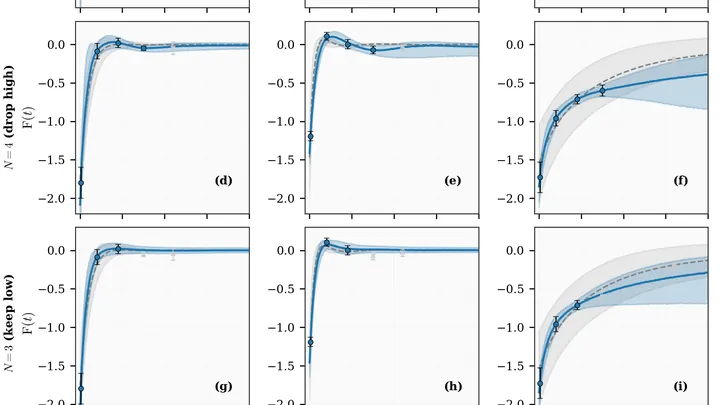
The proton is not a smooth ball but a tangle of quarks and gluons in constant motion, exchanging energy. Finding out exactly how energy, pressure, and spin are distributed inside it is impossible to do directly: measurements yield only sparse, noisy points. It's like trying to guess a face from a few blurry photos taken from different angles.
Earth's magnetic field is like an invisible river that meanders beneath our feet. Navigators and geologists rely on maps of this river, but instruments only take readings at scattered points, leaving blank spots in between. Filling those gaps is like trying to sketch the river's course from a few pebbles found on the bank.
The Bullet Cluster is a cosmic collision site where two vast clouds of galaxies, gas, and invisible matter slammed into each other. When light from distant stars passes near such a cluster, gravity bends its path like a lens. Astronomers study these distortions to work out where the mass is hiding.
A galaxy cluster's gravity warps spacetime, acting like a colossal lens: it focuses and amplifies light from distant objects, as predicted by Einstein. Such lenses are rare, but they let us glimpse what lurks at the edges of the cosmos.
Light from distant galaxies, passing through clusters of matter, gets distorted — much like the bottom of a pool breaks up into ripples of water. Astronomers measure these barely perceptible bends in shape and create a map of gravitational ‘ripples.’ This is weak lensing — a natural detector of invisible matter.
Glasses with flat lenses show a symmetric world: rise and fall, heat and cold look the same. For decades, climatologists have viewed El Niño through such glasses, using linear inverse models. These captured the rhythm of oscillations but missed that the warm phase of El Niño is typically sharper and stronger than the cold La Niña.