Gravitational lensing is a phenomenon predicted by Einstein's general relativity: massive objects like galaxies or black holes bend the path of light passing near them, acting like a giant lens. When this lensing is caused by dark matter — the invisible substance that outweighs ordinary matter by a factor of five — it distorts the images of background galaxies in characteristic ways. By mapping these distortions, astronomers can trace the distribution of dark matter even though it emits no light. This technique has become a cornerstone of modern cosmology, revealing that dark matter forms a vast cosmic web of filaments and halos around galaxies.
History
The concept of gravitational lensing was first discussed by Einstein in 1936, but the first observed lens was the 'Twin Quasar' in 1979. Dark matter mapping via weak lensing was pioneered in the 1990s by groups including Anthony Tyson and Yannick Mellier.
How it works
Light from a distant galaxy travels in straight lines through empty space, but when it passes through a region with dark matter, the gravitational field curves spacetime. The light follows the curved paths, so the galaxy appears shifted, stretched, or even split into multiple images. The amount of distortion depends on the mass of the dark matter along the line of sight. By measuring the shapes of millions of background galaxies statistically, astronomers can reconstruct the dark matter map — a method called weak lensing. Strong lensing, where a single galaxy is dramatically warped into arcs or rings, provides a more direct but rarer probe.
In practice
Gravitational lensing is used to map dark matter distributions in galaxy clusters, measure the expansion rate of the universe, and even detect exoplanets via microlensing events.
Fun fact
The Hubble Space Telescope's most famous deep-field images are actually gravitational lenses — the faint smudges of distant galaxies are magnified and distorted by dark matter in the foreground.
A light ray passing near a massive body bends around it, like a runner rounding the corner of a stadium. For a neutron star, this deflection angle is usually assumed to be the same as for a point mass. But if the star is wrapped in an invisible halo of dark matter, the picture changes: light passing through the halo is deflected less than the total mass would predict.
An invisible scaffold holds galaxies together, keeping them from flying apart. This is dark matter — matter that doesn't shine and barely interacts with ordinary stuff. Astrophysicists have long debated what it's made of.
In the dark outskirts of our Galaxy, far from bright star clusters, millions of black holes lurk. They are invisible: they don't shine and don't noticeably accrete matter. Conventional search methods, designed for dense stellar fields, are useless here. A different approach is needed.
Astronomers have proposed using the very fabric of space as a detector.
Light bends in a lens — everyone knows that. Gravitational waves passing a massive body also curve their path. But the authors of this work looked further: what happens to the wave's very "color" — its polarization, that is, the direction of oscillation?
Gravitational lensing is the deflection of…
On November 23, 2023, LIGO detectors caught something strange. The gravitational wave signal from a black hole merger, designated GW231123, pointed to record masses—137 and 101 solar masses, and anomalously fast spin. That would be the most massive and fastest-spinning pair ever detected.
Two hundred million stars. In the heart of the Galaxy, where the future survey by the Nancy Grace Roman telescope will aim, about 250 times during its mission the light of one of them will flicker at an invisible touch.
Eight bright spots on the radio sky. They are all the same quasar HS 0810+2554, whose light passed through a gravitational lens — a massive foreground galaxy.
In 2019, the LIGO facility recorded a gravitational waves, a ripple in the fabric of spacetime, whose time-frequency map resembled a strange comb. Each such signal from a black hole merger leaves a unique pattern, like a fingerprint.
The Universe is a giant concert hall, where instead of walls and balconies, invisible clouds of dark matter float. This architectural ensemble is not static: it refracts and scatters the 'music' rushing through it — gravitational waves from merging black holes.
The light of a distant star briefly brightens when a massive invisible object passes between it and a telescope. This phenomenon, gravitational microlensing, acts as a natural telescope. Usually, the lens is a black hole, warping the spacetime around it.
Light passes through a crumpled film — and comes out slightly altered. In much the same way, gravitational waves born in the early universe feel the lumpy distribution of galaxies and dark matter.
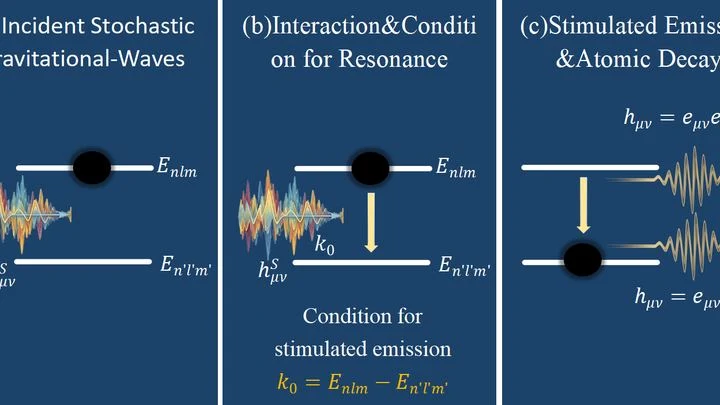
If a black hole spins quickly, it can hold a cloud of ultralight particles around it, so light that their mass almost vanishes. They arrange themselves in layers, like electrons in an atom, only here gravity does the job instead of electric forces. This structure stores energy, like a coiled spring.
Gravitational waves — the cosmic tremors from distant cataclysms — are so faint that detecting them is like trying to hear a whisper in a hurricane. But a black hole can amplify that whisper many times over.
The gravity of a black hole creates a curvature of spacetime, acting like a lens: light from a distant galaxy splits in two, stretching into arcs. Dark matter around the hole barely changes the picture, as if a transparent curtain was added to a window pane.
Two ocean liners sail at night without lights. One was built in a shipyard from steel plates, the other seems to have grown by itself from foam and waves. By ear they are almost indistinguishable, but an experienced hydroacoustician will catch the difference in the hum of the propellers and the contours of the hull.
Twenty-first-century astrophysics is deafening with triumphs: we’ve caught the tremor of spacetime from the merger of invisible giants; glimpsed the 'shadow' of a supermassive monster in a distant galaxy; traced the orbits of stars dancing around a compact something at the heart of the Milky Way.
In 2019, the Event Horizon Telescope gave humanity the first image of a black hole shadow — a fiery ring around the abyss at the center of galaxy M87. This gravitational self-portrait, painted by the light of infalling plasma, instantly became an icon of modern astrophysics.
In 2015, two giant facilities in the United States caught the shiver of space — a gravitational wave from the collision of black holes. Since then, such signals have been caught regularly, but the detectors themselves are enormous: their arms stretch for kilometers.
Classical black holes, regions of spacetime with gravity so strong that even light cannot escape, according to general relativity, hide a singularity at their center: a point of infinite density and curvature where the known laws of physics break down.
A heavy spinning top launched near a black hole doesn't follow the curve that textbooks draw. Its own rotation and oblateness, like a pumpkin squashed at the poles, make the trajectory wobble. In a new study, this wobbling path has been calculated more precisely than ever before.
Usually, a small body in a black hole's field is treated as a point — without size or spin.
The Bullet Cluster is a cosmic collision site where two vast clouds of galaxies, gas, and invisible matter slammed into each other. When light from distant stars passes near such a cluster, gravity bends its path like a lens. Astronomers study these distortions to work out where the mass is hiding.
The merger of two neutron stars is like a strike on a gong: a ripple in space, a gravitational wave, spreads through the universe. Detectors on Earth catch this ripple and, from its strength, calculate the distance to the source.
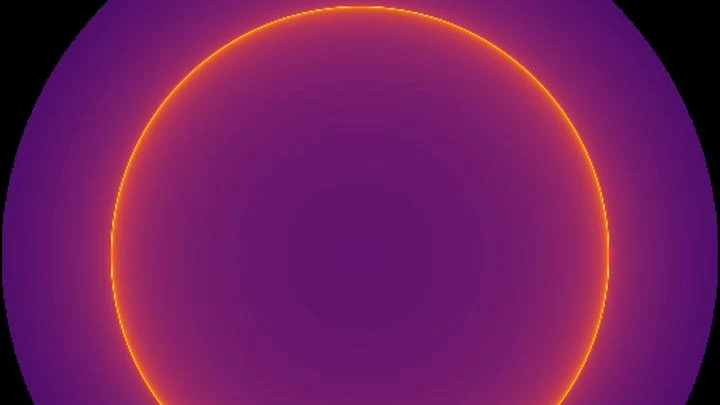
If you briefly flash light near a black hole, it will respond with a long echo, like a bell that keeps ringing after being struck. The light gets trapped near the hole, bouncing repeatedly off an invisible boundary: the photon sphere, where rays circle around like sound in a metal.
A black hole merger gives birth to a gravitational wave. Sometimes the wave’s path is blocked by a galaxy or a clump of dark matter, predicted by Zwicky and discovered by Rubin.
Dark matter is an invisible ocean that, as shown by observations by Vera Rubin, keeps stars in galaxies from flying apart. Physicists suspect that if dark matter consists of ultralight particles, in the cosmic cold it turns into a frictionless fluid — a so-called condensate.
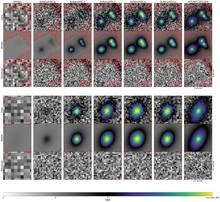
The light from a distant galaxy split into two, then three, then four, and in the center a fifth ghost appeared. That is HerS-3: a young galaxy full of dust and newborn stars, whose light passed through a gravitational lens, a massive object that bends rays like a magnifying glass bends light.
Gravitational waves from a neutron star merging with a black hole carry the imprint of the intricate dynamics of spacetime. To decode that imprint, physicists compute scattering amplitudes, the quantum probabilities that two bodies fly apart at a given angle.
An electron gliding over invisible hills and valleys created by a spin texture: that is the picture behind a new chapter in condensed matter physics. In quantum materials where the direction of localized spins varies smoothly (a spin texture), an electron is no longer just a particle flying through the lattice.