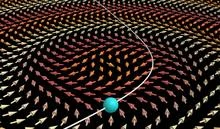
The gravitationalfield is the region around a massive object where its mass warps spacetime, causing other objects to experience a force we call gravity. In Einstein's general relativity, this field is not a force acting at a distance but a curvature of spacetime itself: massive bodies tell spacetime how to curve, and curved spacetime tells objects how to move. This description explains everything from planetaryorbits to the bending of light around galaxies.
History
Isaac Newton formulated the first quantitative theory of gravity as a force in 1687, but it was Albert Einstein who in 1915 recast it as a geometric property of spacetime in his general theory of relativity.
How it works
Any mass-energy distribution creates a gravitationalfield by distorting the local geometry of spacetime. Objects moving through this curved geometry follow geodesics — the straightest possible paths — which appear to us as accelerated motion. The field's strength depends on mass and distance, and it propagates at the speed of light as gravitational waves when masses accelerate. In quantum theories, the field is often imagined as being mediated by hypothetical gravitons, though a complete quantum description remains elusive.
In practice
Gravitationalfield models are essential for GPS satellite timing corrections, spacecraft navigation, and detecting gravitational waves from merging black holes with observatories like LIGO.
Fun fact
The gravitationalfield of the Sun bends starlight by about 1.75 arcseconds — a tiny angle, but one that was famously measured during the 1919 solar eclipse to confirm Einstein's theory.
A light ray passing by a massive body slightly changes its direction, like a stream of water bending around a rock in a creek. In the solar system, there are many such "rocks": planets, their moons, asteroids. And each one, with its own gravity, bends the path of light coming from distant stars.
A superconductor pushes out a magnetic field like a sponge squeezing out water. This Meissner effect has been known for nearly a century, but it's usually calculated in a flat world — without gravity. In the strong field of a black hole or at enormous speeds, the picture changes.
Quantum field theory is the language physicists use to describe elementary particles and their interactions. The authors of the work decided to slightly "tweak" this language: they introduced deformations, that is, small changes to the rules of the game.
A scale that weighs not a body, but the very space around it. That's how Einstein's equations work in general relativity: they link the curvature of spacetime to what resides within it.
At the center of nearly every galaxy lurks a supermassive black hole. Its gravity is so strong that it warps space itself. But few stop to wonder: what does it do to the very fabric of reality — the fields that permeate the cosmos?
One such field is the Higgs field.
An engineering blueprint of a skyscraper always includes a number: the maximum load on the foundation — say, 500 kilopascals. Einstein's field equations in curved spacetime impose a similar limit on the 'force load' inside stars, planets, and any other clumps of matter.
Two balls dropped from different heights fall to the ground with different accelerations. In space, things are more complicated: even emptiness makes bodies move differently.
A quantum wave is like a long-exposure photograph: everything’s blurred, but the blur itself reveals motion. Usually these frozen waves are treated as convenient abstractions. Yet if at each point in the image you estimate, by brightness, the moment on the particle’s internal clock it landed there, flat space suddenly acquires curves.
Dim the lights. The stage belongs to a shadow theater, with just r puppeteers, but the screen obeys the laws of hyperbolic geometry. Every wave of the hand births a pattern that mathematicians call a discrete group of isometries.
At the centers of many galaxies lurk black holes — regions with gravity so strong that even light cannot escape. Stars often orbit them, and sometimes one of those stars is a pulsar, a cosmic lighthouse sending out strictly periodic radio pulses. When such a pulsar moves behind a black hole, its signals reach us with a delay.
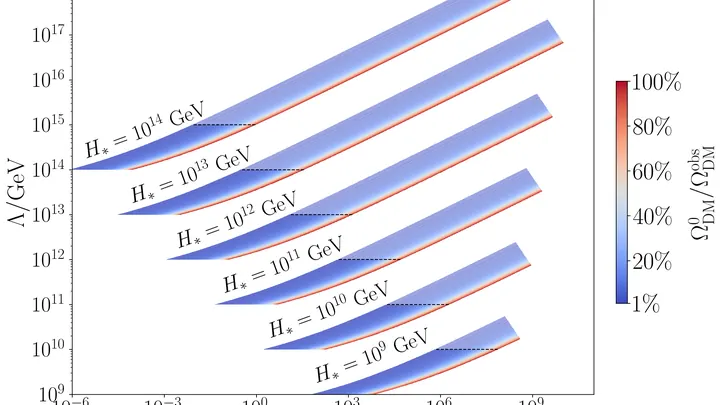
In the first moments, the universe expanded at an unimaginable rate — a phase called inflation. It is thought that particles of dark matter, the invisible substance that holds galaxies together, could have been born from the vacuum during this time. But what determines exactly how many are produced?
The authors considered a model with two fields.
The early universe was a restless place. Space trembled with gravitational waves — ripples in the very fabric of reality. In this churning cauldron, dark matter is thought to have been born. But the newborn particles had no mass: it had to come from somewhere.
Usually, the Higgs field is responsible for mass.
Two floats on the waves. Throw a stone into water, and the ripples will spread, rocking both floats one after another — not simultaneously. In the quantum world, such rocking is called entanglement: particles, like floats, begin moving in sync.
Inflation is the ultra-fast expansion of the universe in its first moments. It was driven by a field resembling a ball rolling down a hill. But there could have been a second, almost imperceptible ball nearby. The authors of this work considered exactly that scenario: a light spectator field (the axion), frozen at the top of its potential.
Spacetime can be imagined as a tightly stretched fabric. A massive body dents it, guiding light. Rotation twists the fabric into a spiral. Such a gravitational funnel can entangle a passing photon with the very source of rotation — say, a tiny mirror. Quantum entanglement springs up: an invisible thread binding their fates.
Two pebbles drop into water, and the ripples on the surface intersect, blending their patterns. Neutrinos behave much the same way: light particles that pierce us by the billions every second. They can transform from one type to another, like an actor changing masks. Physicists call this dance oscillations.
Imagine an air mattress being stretched, with a whirlpool of water spinning on it. As you stretch, the whirlpool tightens: its size relative to the whole surface shrinks.
Gravity is the curvature of spacetime, not just an attraction, as Einstein showed. On such a curved "dance floor", even the hypothetical carriers of gravity — gravitons — move oddly.
A stone falls into a pond — ripples spread across the water. If the stone doesn't fall but whizzes over the surface at tremendous speed, a straight wave runs along the water. When it hits a floating log, ripples spread out from the point of impact. That's roughly how gravity works in the new study.
A warp drive creates a bubble around the ship, compressing space in front and stretching it behind. This is a clever way to bypass the speed-of-light limit without violating Einstein's theory.
A stone falls into a pond — near the shore, the ripples are barely visible, while the water churns at the point of impact. The electric field around a charge behaves similarly: close in, it's sharp and tangled, but at a distance it stretches into a smooth wave that carries energy away. Physicists call this distant region the radiation zone.
Spacetime resembles a giant crystal. Gravitational waves, born from collisions of black holes, not only make it tremble — they leave indelible defects: edge ones, as if an extra plane of atoms was inserted into the crystal, and screw ones, where the layers twist.
A handful of sand lands on the table. The grains settle in different ways, but if the handful is large, the total volume barely changes. That's roughly how classical gravity works: space appears smooth and definite. But look closely at the individual grains, and you'll find that at the quantum level, volume itself is no longer fixed.
Toss a handful of glitter into a river, and some flakes will drift straight while others spin in tiny eddies. Galaxies in the universe do something similar: they don't just recede due to cosmic expansion: they also swirl in giant currents, like wood chips caught in invisible whirlpools.
A heavy spinning top launched near a black hole doesn't follow the curve that textbooks draw. Its own rotation and oblateness, like a pumpkin squashed at the poles, make the trajectory wobble. In a new study, this wobbling path has been calculated more precisely than ever before.
Usually, a small body in a black hole's field is treated as a point — without size or spin.
Back in the last century, Vera Rubin discovered that stars on the outskirts of galaxies rotate too fast, as if held by some invisible substance. Since then, dark matter has remained a puzzle. Usually, its origin is linked to new particles or forces. But a new study points to a simpler source — the geometry of space itself.
A century ago, Einstein's equations predicted black holes, but inside them physics broke down: particle trajectories ended at the singularity, a point of infinite curvature. It was a dead end, the end of spacetime. Now physicist Itzhak Bars proposes a radical twist: the singularity is not a wall but a door.
An electron gliding over invisible hills and valleys created by a spin texture: that is the picture behind a new chapter in condensed matter physics. In quantum materials where the direction of localized spins varies smoothly (a spin texture), an electron is no longer just a particle flying through the lattice.