Solar Twist Waves: How to Spot Them from Earth express
The solar corona is the Sun's outer atmosphere, heated to millions of degrees. How it gets so hot is still unclear. One candidate is torsional waves: they twist magnetic field lines like a rubber band. Such waves were recently spotted with the new Daniel K. Inouye Solar Telescope.
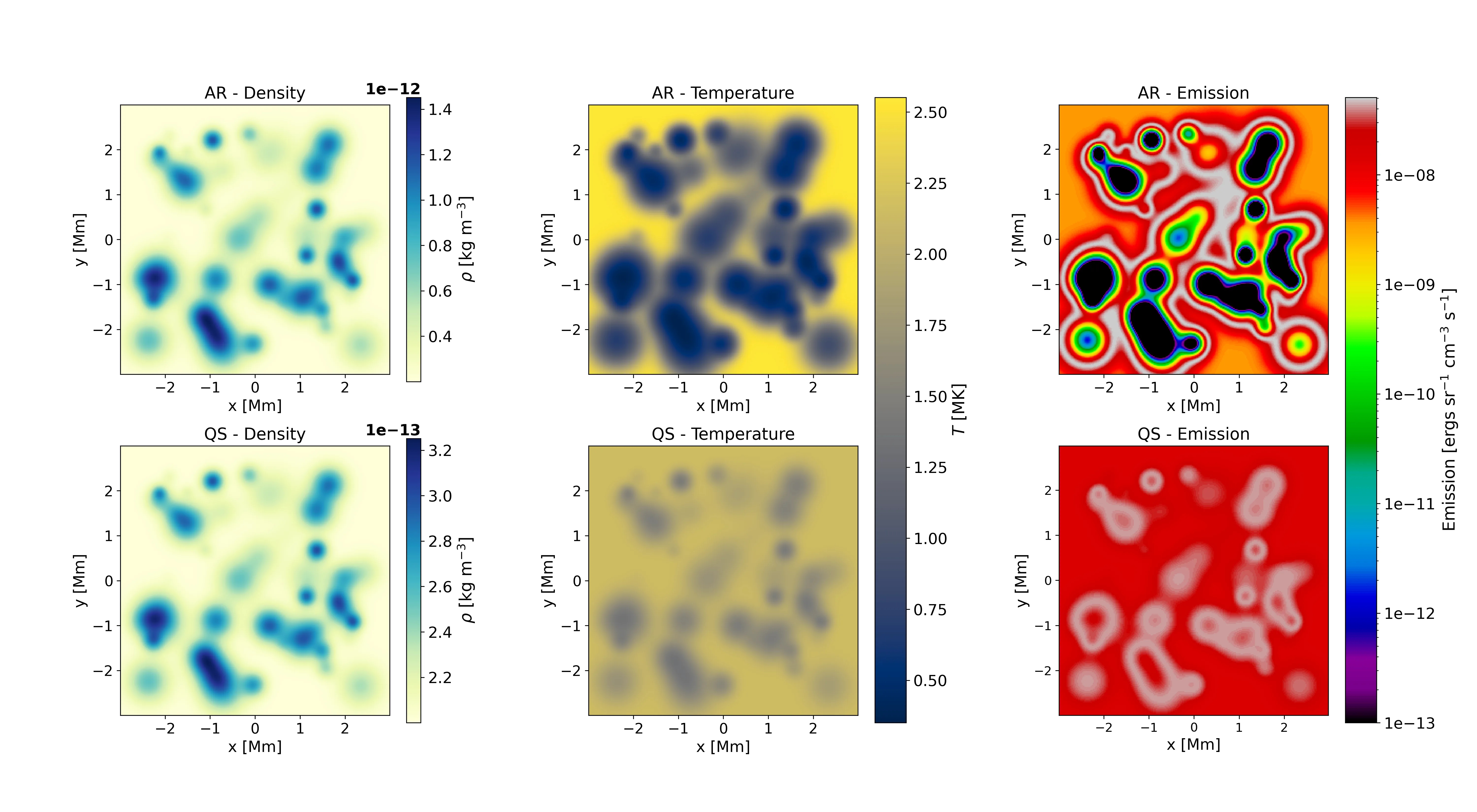
But the telescope doesn't see the waves themselves; it sees light from iron ions that reaches us along the line of sight. Within that line, many different layers contribute, and their signals mix. Scientists simulated this on a computer: they took several magnetic tubes in the corona, launched waves along them, and calculated what light the telescope would see.
In quiet regions of the Sun, the torsional wave signal is visible but weaker than it actually is — due to line-of-sight mixing. In active regions, where the plasma is denser and more inhomogeneous, a similar signal appears even without torsional waves. It is created by strong eddies between the tubes, where the light is brightest.
So, in quiet regions torsional waves can be recognized, but in active regions it's easy to be misled. This matters for future observations: first you need to understand how inhomogeneous the medium is, and only then draw conclusions about waves.
Original abstract
as written by the authors arXiv:2608.08812v1
Torsional Alfv\'{e}n waves are a promising mechanism for transporting energy through the solar atmosphere, with implications for coronal heating and solar wind acceleration. Recently, signatures of torsional Alfv\'{e}n waves have been observed with the Daniel K. Inouye Solar Telescope. We aim to investigate the effects of line of sight integration and plasma conditions on the observable properties of the torsional mode. Here we present three-dimensional magnetohydrodynamic simulations of multiple coronal waveguides, driven by a combination of transverse kink and torsional wave drivers, considering two plasma regimes representative of active region (AR) and quiet Sun (QS) conditions. Synthetic observables of the Fe~\textsc{xiii}~1074.7~nm coronal emission line are produced using the pyCELP forward-modelling framework to enable direct comparison with spectroscopic observations. In the QS regime, red-blue Doppler asymmetries are associated with the driven torsional waves, though their observed amplitudes are substantially reduced by line-of-sight integration. In contrast, the AR regime exhibits red-blue Doppler asymmetries even in the absence of an imposed torsional driver, which may be misidentified as the $$m=0$$ torsional Alfv\'{e}n mode. In the AR setup, the red-blue Doppler asymmetries arise from strong phase mixing, generating shear flows and localised vorticity between waveguides where emission is strongest. The differences between the two regimes are governed by the location of peak emission, which is determined by the degree of density inhomogeneity. Our results support the identification of torsional Alfv\'{e}n wave signatures in the quiet Sun (a weakly inhomogeneous environment), but caution should be exercised when interpreting spectroscopic observations in strongly inhomogeneous environments such as active regions.
The temperature of the solar corona is higher than the Sun's surface: millions of degrees versus about 5500°C. It's like the air around a campfire being hotter than the flame itself.