The chromosphere is the Sun's lower atmosphere, sitting just above the visible surface (the photosphere) and below the corona. It is a thin, translucent layer where plasma boils and churns, generating the electric fields that shape much of the Sun's magnetic activity. Though invisible to the naked eye except during a total solar eclipse (when it appears as a reddish rim), it is a dynamic region where temperatures rise from about 6,000 K at the bottom to over 20,000 K at the top, defying simple expectations of cooling with altitude.
History
The chromosphere was first observed during solar eclipses in the 19th century; its name (from Greek 'chroma', color) was coined by Angelo Secchi in the 1860s. The discovery of its spectrum's emission lines, particularly hydrogen, came later with the development of spectroscopy.
How it works
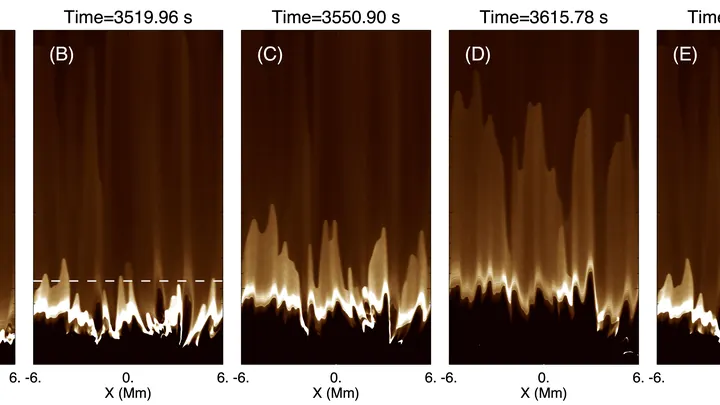
The chromosphere is heated by a combination of magnetic field interactions and mechanical waves. Convection in the photosphere pushes plasma upward, creating spicules—jets of gas that shoot into the chromosphere and beyond. These spicules, along with magnetic reconnection events, transfer energy into the chromosphere, ionizing hydrogen and making it glow in characteristic red light (the H-alpha line). The electric fields generated by this boiling plasma play a key role in driving solar activity, including flares and the heating of the corona above.
In practice
Studying the chromosphere helps predict solar flares and space weather, which can disrupt satellites, power grids, and communication systems on Earth.
Fun fact
The chromosphere's reddish glow during an eclipse is so bright that it was once mistaken for a planet or a hole in the Moon's shadow.
Picture a guitar string stretched between two frets. When you pluck it, a standing wave forms: some points on the string oscillate strongly, while others, the nodes, remain almost still. The chromosphere, a layer of the solar atmosphere sandwiched between the photosphere and the corona, behaves in much the same way.
In a pot on the stove, water starts to churn from the bottom long before the whole thing boils. Bubbles of steam rise from the base even though the burner itself hasn't heated up yet.
The Sun has a layer called the chromosphere, sitting just above the visible surface. Bright arcs often flare up there, visible through telescopes, but to understand what ignites them, you need to look at invisible magnetic fields.
The Sun's edge looks like a fuzzy fringe: thin jets of hot gas, spicules, shoot upward from it. They live only a few minutes and are constantly changing. In 2024, a balloon-borne telescope managed to spot not only the jets themselves but also their faint glow in hydrogen lines that had never been captured there before.
The Sun has quiet regions where the magnetic field is barely visible. But even there, sound waves find loopholes to rise higher. These loopholes are magnetic tubes that expand upward like funnels. Inside them, sound travels more freely.
In a pot of boiling soup, light fat droplets rise to the top, while heavy vegetable chunks sink to the bottom. Particles in the tenuous hot gas around the Sun and other stars behave much the same way — except instead of broth, there's a mixture of charged particles: electrons, protons, and alpha particles.
The solar wind is a stream of charged particles constantly blown off the Sun's surface, filling the entire solar system. It's not like a steady breeze: it has eddies, gusts, and calm patches. Scientists call this turbulence.
The solar corona is the Sun's outer atmosphere, heated to millions of degrees. How it gets so hot is still unclear. One candidate is torsional waves: they twist magnetic field lines like a rubber band. Such waves were recently spotted with the new Daniel K. Inouye Solar Telescope.
The solar corona lives its own turbulent life. Magnetic fields here are governed by the motions of the dense surface — the Sun's photosphere — but occasionally they rewrite the magnetic pattern themselves.
Jupiter's atmosphere resembles a layered cake, where each layer plays its role. Scientists took data from four instruments at once (VLT/MUSE, Cassini/VIMS, IRTF/SpeX, and Juno/JIRAM) and built a model of clouds and ammonia in the planet's equatorial zone, from 0.1 to 10 bar (pressure equivalent to hundreds of kilometers below Earth's…
The Sun is a giant cauldron where light struggles through a thick layer of scorching matter. On its way out, photons (light particles) constantly bump into atoms and lose energy. How strongly matter holds back light is called "opacity," and it determines how quickly heat escapes.
Iron is one of the main culprits for opacity in the Sun's interior.
A waterfall that doesn't heat up from the fall but freezes — that's roughly how gas behaves as it flows onto a neutron star in an X-ray pulsar when the star shines dimly. Usually, infalling matter is heated to a white-hot glow, but new work shows the opposite.
Deep beneath our feet, in the scorching mantle, iron leads a double life. It can be divalent or trivalent, like a coin that lands heads or tails. Which side dominates determines how much oxygen stays in the planet's rocky shell and how much sinks into the core.
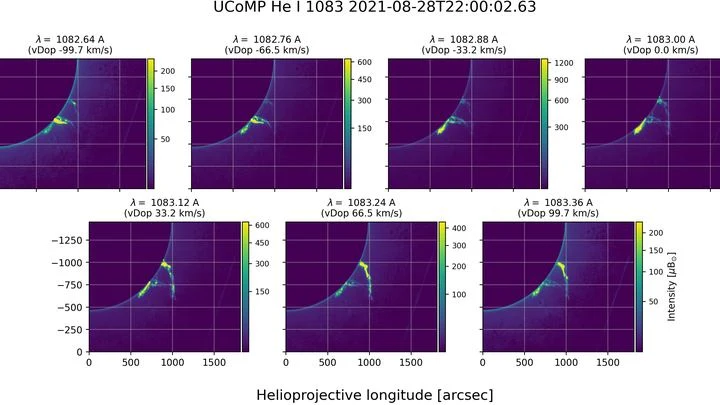
A sunspot cools, and above it a dark filament, a prominence, hangs for weeks. Inside it, like a compressed spring, hides the magnetic field. It can be laid out in neat arches, or it can be twisted into a tight rope.
In astrophysics, some numbers seem random yet recur with the persistence of a spell. One such number is the ratio of X-ray brightness to H-alpha hydrogen emission in turbulent gas tails. From galactic winds to ‘jellyfish’ slicing through clusters, this ratio steadily holds at around three.
Two white sheets lie in the sun — one rough, one smooth. Which one heats up less? The rough one scatters light more strongly, so it seems it would stay cooler. But if the coating is made of many transparent glass beads, the logic changes. Light wanders through it like in a thick fog, and at some point it stops noticing individual droplets.
The ionosphere at an altitude of 70 kilometers acts like a giant mirror for radio waves. Ground antennas constantly beam signals into it and listen for the reflection. When a solar flare occurs on the Sun, a stream of X-rays reaches Earth in 8 minutes and compresses the lower layer of the ionosphere.
The crown of a huge tree sways in the wind, but the roots and trunk are hidden underground. On the Sun, magnetic fields play the role of such invisible roots. They emerge from the depths, thread through the entire atmosphere, and govern the motion of the hot gas — plasma.
In the scorching solar corona, where temperatures soar past a million degrees, float cold, dense clouds — solar prominences. They hang for weeks, neither falling nor dissolving, like icebergs in a boiling ocean. How they got there is a question that has puzzled astronomers for decades.
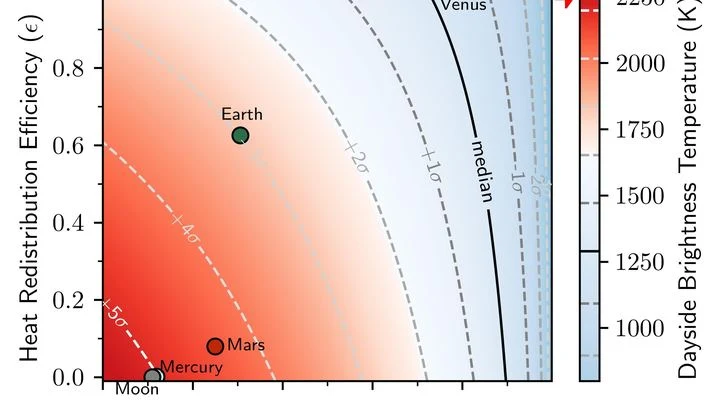
A hot skillet on the stove glows in the dark, but if you cover it with a lid, the heat escapes more slowly and the surface doesn't look as bright. That's roughly the situation on planet HD 3167 b: it always shows the same face to its star, and the dayside is heated to temperatures that melt rock.
The Sun's corona looks like a shaggy dandelion: bright petal-like loops hold hot gas near the surface, while long, tenuous jets escape into space between them. These jets, the heliospheric current sheet, stretch across the entire solar system.
If you build a giant blanket around a star, you get a Dyson sphere. It absorbs all the radiation and glows in invisible heat rays. No such sphere has been seen yet, but astronomers know: to find it, look for this thermal glow.
The Sun's surface boils like water in a pot. Hot gas rises, cools, and sinks: that's convection. Magnetic fields churn around, tearing and reconnecting. In this frenzy, spicules are born: narrow plasma jets that shoot thousands of kilometers upward.
4 billion years ago, the young Earth was mercilessly bombarded by meteorites, leaving behind impact craters. Rains filled them with water, forming shallow ponds where lipid bubbles accumulated. These bubbles, like soap bubbles but with a double-layered lipid membrane (just like modern cells), formed spontaneously when water mixed with fat-like substances.
The Sun occasionally hurls enormous clouds of plasma into space — coronal mass ejections. Often tangled within these clouds are prominences: cooler, denser clumps of material. These contain plenty of neutral atoms that shine brightly in specific spectral lines.
The solar corona, the Sun's outer atmosphere, stretches millions of kilometers, yet it's visible only during a total eclipse or with specialized instruments. Typically, we gauge the corona's density by how it scatters white light, but that method relies on simplifications that can skew the results.
A solar flare is like a tightly coiled spring suddenly uncoiling. In the Sun's corona, energy accumulates in the twisted magnetic field, and then it is abruptly released, accelerating particles and heating plasma.
A solar flare is like an explosion in a star's atmosphere: in minutes, it releases energy comparable to billions of nuclear bombs. On May 4, 2022, the RT-7.5 radio telescope in Moscow was watching an M5.7-class flare. The instrument was catching millimeter radio waves: those shorter than a centimeter and invisible to the eye.
The Sun doesn't rotate as a solid body: its equator spins faster than its poles. This difference in rotation speed creates layers that move at different speeds, like ocean currents at different depths.
The James Webb Space Telescope is watching TRAPPIST-1—a tiny red dwarf with seven Earth-sized planets in orbit. And it sees something unusual: bright flares on this star barely reach 3500–4000 degrees. For comparison, a typical solar flare heats up to 9000–10000 degrees.