An eddy is a swirling, circular current of fluid that forms when the main flow is disturbed — by an obstacle, a change in depth, or a difference in speed between adjacent layers. Eddies range from tiny whirls in a teacup to massive ocean gyres, and they are the building blocks of turbulence. In physics, eddies are crucial because they mix momentum, heat, and dissolved substances far more efficiently than smooth, laminar flow could. They also mediate how energy cascades from large-scale motions down to tiny scales where it dissipates as heat.
History
The concept of eddies has been studied since the 19th century, with Lord Kelvin and Hermann von Helmholtz laying early groundwork on vortex motion. The modern statistical theory of turbulent eddies was developed by Lewis Fry Richardson in the 1920s, who famously described the energy cascade in a poem.
How it works
Eddies arise from instabilities in the flow. When a fluid layer moves faster than its neighbor, or when it rubs against a solid boundary, the shear creates a torque that rolls the fluid into a vortex. Once formed, an eddy can persist, travel, and interact with other eddies, sometimes merging or splitting. In turbulent flows, eddies of many sizes coexist, with large ones feeding energy into smaller ones — a process called the energy cascade. The behavior of eddies is governed by the Navier-Stokes equations, but their chaotic nature makes exact prediction difficult, which is why they are studied with simulations and experiments.
In practice
Eddies are key in engineering — they affect drag on vehicles, mixing in chemical reactors, and dispersion of pollutants in rivers and the atmosphere. Understanding eddies also helps design more efficient propellers and wind turbines.
Fun fact
In the ocean, eddies can be so large that they transport heat and salt across thousands of kilometers, acting like invisible 'weather systems' in the sea.
A hydrogen bubble on a platinum electrode behaves like a swimmer trying to surface, but every time it almost breaks free, something below grabs its legs. In the lab, high-speed cameras captured this behavior: a millimeter-sized bubble hangs near the surface, even though buoyancy pulls it upward with a force thousands of times stronger than surface tension can hold.
A branch falls into a whirlpool. It gets spun and broken, but sometimes a powerful fountain of water bursts from the center. Similarly, a black hole tears apart a passing star, and occasionally a blinding plasma jet, a jet, shoots into space.
The brain self-cleans its waste: cerebrospinal fluid flows through narrow channels surrounding arteries. The channel walls are soft and ripple with each pulse, and the tissue is porous like a sponge. Every heartbeat turns arteries into tiny pumps, driving fluid through the pores.
The book is open to the middle. Current runs along the spine, while the pages remain cool. That's roughly how a two-dimensional topological insulator works — a material where electricity flows only along the edges, while the interior stays still.
In the new model, each active particle has an internal rhythm: it spins either left or right. Chirality is key: some twirl clockwise, others counterclockwise. But when such a particle bumps into an obstacle or a neighbor, it flips its spin, like a figure skater who, after touching the board, explodes into a reverse pirouette.
A stone falls into a pond, and ripples spread evenly in all directions. But some media behave as if the wave knows which way to turn, like water that only swirls clockwise. This asymmetry comes from odd viscosity and odd elasticity — properties of media with broken mirror symmetry.
Imagine two immiscible liquids, such as oil and water. Under normal conditions, they tend to separate, forming a clear interface. But introduce microscopic swimmers (bacteria, whose basis is carbon) and the picture changes dramatically.
A black hole rips apart a star, and we see a dazzling flare. Then, a couple of years later, when everyone has forgotten about it, radio telescopes suddenly pick up a new signal, like an echo from the past.
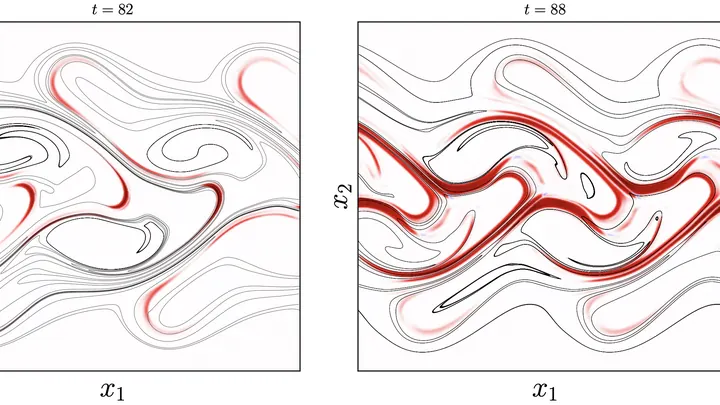
Mountain river water doesn't flow smoothly: it churns, swirls into eddies, and suddenly accelerates. This chaotic motion is called turbulence. But even within it, there are hidden rhythms — rare and intense bursts that briefly alter the entire flow pattern.
A juggler tosses clubs while sitting on a spinning chair. If he starts spinning the clubs all in one direction, the chair will rotate the opposite way — otherwise, the conservation of angular momentum would be violated.
In a pot of boiling soup, churning currents carry heat to the walls, and the soup cools. In a tokamak, a huge magnetic bottle for plasma, the same thing happens: turbulent eddies carry energy outward, hindering the ignition of a fusion reaction. But sometimes the plasma seems to find a way to calm itself.
River water often swirls into funnels. But in semiconductors, the foundation of microchips, electrons at low temperatures and high purity also turn into a fluid. If you create a circular cavity, vortices appear, just like in a river backwater.
A ship gliding through water constantly rubs against it, like a palm against a rough surface. This friction eats fuel and slows progress. One way to reduce it is to blow air under the hull: water stops sticking to the hull, and drag drops. But air is finicky: sometimes it helps, sometimes it hurts.
Above the Sun's surface hang long ribbons of glowing gas — streamers. They look like giant harps stretched across the corona. When a wave runs along such a ribbon, it trembles and bends like a string after being plucked.
For a long time, it was thought that only a very fast ejection of material, one traveling at more than 500 kilometers per second, could launch such a wave.
A sudden gust hits a wing, and a huge vortex swirls above it. Such a vortex can abruptly change lift, making the plane's nose dip. Engineers have long sought ways to predict these vortices, but complexity gets in the way: fast airflow is full of small chaotic eddies.
A calm river suddenly starts churning in the middle of a flat stretch: that's the puzzle the authors of a new study set out to solve. They took a thin layer of charged gas with a very weak magnetic field and tracked on a computer what would happen to it. At first, everything flows smoothly, like water from a tap.
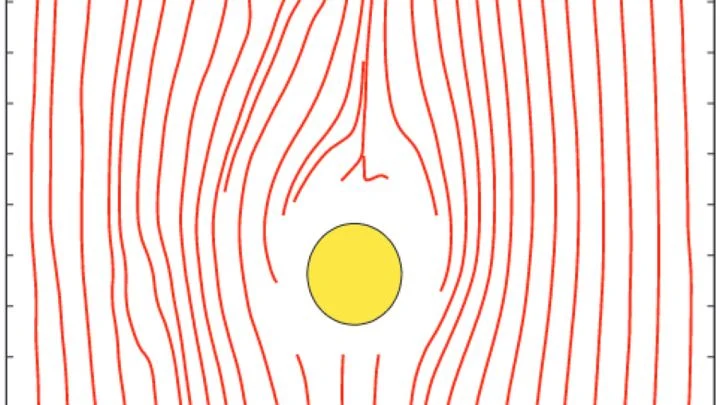
Liquid helium cooled to near absolute zero behaves like two fluids at once: a normal viscous part and a superfluid part that flows without friction. When such a flow hits a cylinder, vortices are born behind it. But sometimes vortices appear in front of the cylinder — where classical laws say they shouldn't be.
In a jar of oily liquid float millions of tiny magnetic grains: each about the size of a bacterium. Switch on a magnet, and the grains, like obedient little soldiers, line up into long threads. But why do they form threads rather than clumps? It turns out it's not just about magnetism.
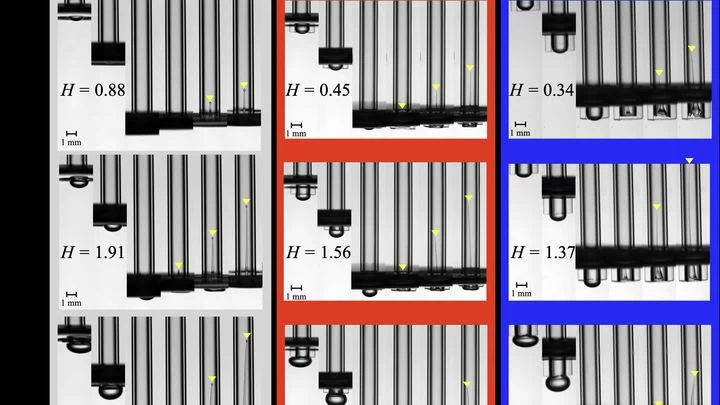
A drop falls into a glass, and a tiny jet, a thin fountain, shoots up from the surface for an instant. Something similar happens with a bubble stuck to the wall of a tube when you yank the tube downward. Water around the bubble rushes in, and a jet fires from its top. The speed of this jet depends on the bubble's shape — how much it bulges, like an umbrella dome.
A blunt cylinder flying at six times the speed of sound isn't the most elegant object, but it's the star of a new simulation. The surface of such a vehicle is never perfectly smooth: during atmospheric entry, the heat shield ablates, leaving bumps and pits.
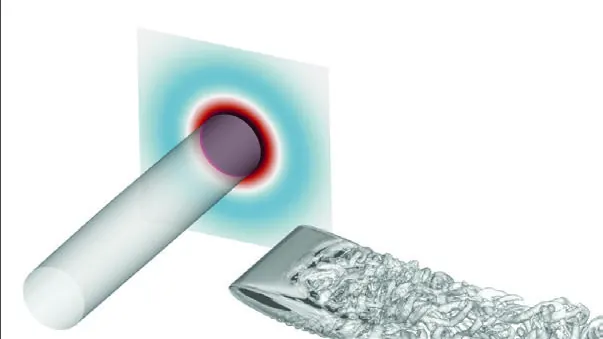
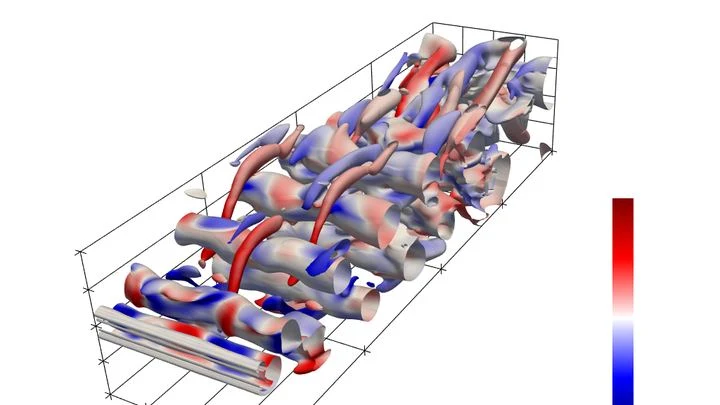
A thin plate stands across a flow of water or air. Behind it, a wake forms — a region where the flow becomes tangled and mixed. Usually, such a wake becomes turbulent when the flow speed is high enough, quantified by the Reynolds number.
Sound in a thin plate behaves like ripples on water: it travels, reflects off edges, and changes shape. But sound has a peculiar trait: it can pass through places where waves are forbidden to exist. It's as if ripples on a pond suddenly vanished before a stone barrier and reappeared on the other side, without going around it.
Water swirls into a ring, and that ring flies through the bulk without breaking apart. Such vortex rings, from smoke rings to underwater currents, follow laws that are hard to capture on paper. Usually, the flow is divided into millions of cubic cells, and each one is tracked.
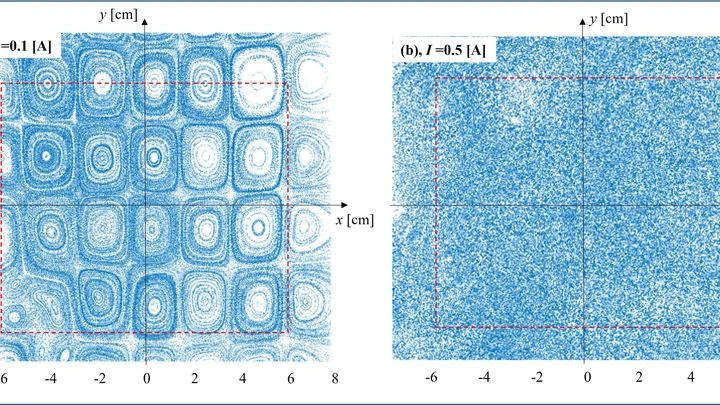
Water in a puddle after rain swirls differently than in a deep lake. A thin layer of fluid feels the bottom, and that changes the nature of its vortices. Scientists created such a layer in the lab: they poured in an electrolyte, ran a current and a magnetic field, and the fluid began to move.