Plasma in a Trap: How Copper Blows a Bubble in Helium express
A copper plate the size of a coin vaporizes under the laser's strike in billionths of a second. The hot copper cloud slams into cold helium like a jet of steam into frosty air. The images show a distinct bubble with thin filaments at the edges — the plasma doesn't expand uniformly but breaks into fibers as thin as a human hair.
Plasma is a gas in which electrons are stripped from atoms. It conducts electricity and responds to magnetic fields. In the experiment, the copper bubble pushes against the helium, and vortices form at the boundary. Proton radiography revealed magnetic fields inside the bubble that are invisible to ordinary cameras.
Such bubbles occur inside fusion targets, where the chamber walls vaporize and hinder fuel compression. Understanding how plasma expands into gas will help fine-tune lasers for future power plants.
Original abstract
as written by the authors arXiv:2608.11664v1
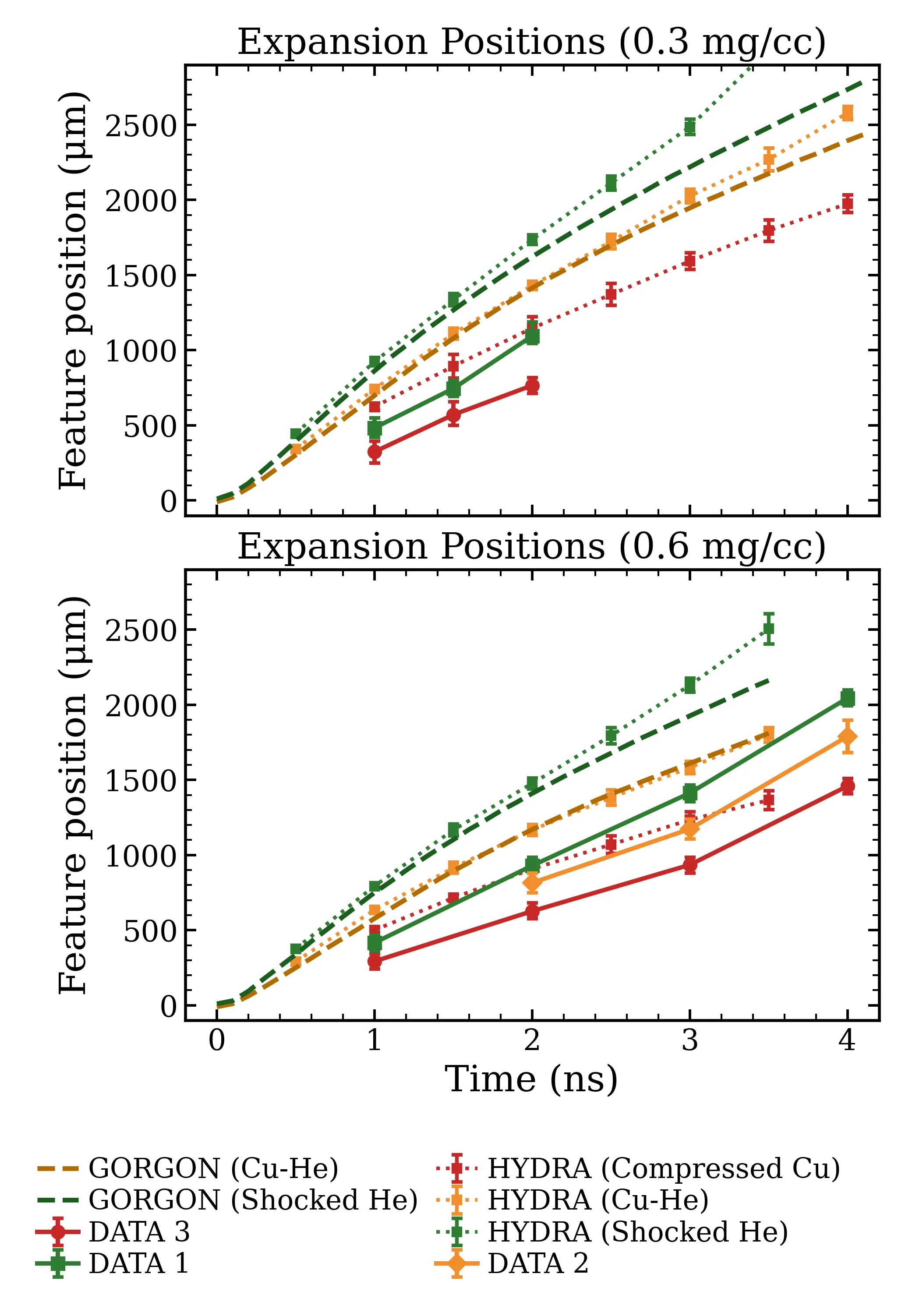
Experiments at the OMEGA EP laser facility were designed and executed to study plasma expansion into hohlraum-relevant gas fills (0.3-0.6 mg/cc of helium), providing a surrogate platform for investigating hohlraum wall blow-off, non-local transport, and magnetized plasma effects. We observe well-defined density features and filamentary structures as laser-driven copper plasma expands into a low-Z background gas. Shadowgraphy resolves sharp density features over time and reveals fine-scale filamentation in the laser spot region with characteristic transverse scales of 10-100 microns near the foil surface. Proton radiography provides sensitivity to path-integrated magnetic fields and density modulations throughout the bubble volume. We extract the bubble expansion as a function of time for two gas pressures, 350 psi (producing 0.3 mg/cc equivalent conditions) and 700 psi (0.6 mg/cc equivalent conditions), and compare the measured propagation to magnetohydrodynamic simulations performed with Gorgon and HYDRA. While the large-scale shape of the bubble is well reproduced by both codes, the time-dependent expansion rate shows significant discrepancies (20-50% faster) compared to experimental observations between 1 and 3 ns. This leads to increasingly larger differences in bubble sizes at later times. The optical measurements of bubble expansion and evolution of small-scale structures point to additional constraints required for Biermann-battery field generation, thermal transport, and instability growth in hohlraum-relevant plasmas, to ensure accurate, predictive modeling of gas-filled hohlraums.
The temperature of the copper plasma in the experiment reached hundreds of thousands of degrees — tens of times hotter than the Sun's surface.