A filament is a thin, elongated structure of gas or plasma that appears in various astrophysical contexts, most notably in supernova remnants, the interstellar medium, and the solar corona. These structures are often shaped by magnetic fields, which channel the flow of charged particles and confine the gas into thread-like formations. Filaments are also observed in the large-scale structure of the universe, where galaxies align along vast cosmic webs of dark matter and gas.
History
The study of filaments dates back to the early observations of the solar corona during eclipses, where thread-like structures were noted. In the 20th century, radio and X-ray observations of supernova remnants revealed the prevalence of filaments, and the role of magnetic fields in shaping them was established throughtheoretical work by astronomers such as Ludwig Biermann and others.
How it works
Filaments form when magnetic fields or fluid dynamics create anisotropic conditions that favor elongation along one axis. In supernova remnants, shock waves compress the surrounding gas into thin sheets that are then stretched by magnetic field lines, producing the intricate filamentary networks seen in images like those of the Crab Nebula. In the interstellar medium, turbulence and magnetic pressure can also align gas into filaments, which are often sites of activestar formation as gravity pulls material together along these dense threads.
In practice
Understanding filaments is crucial for interpreting astronomical observations, particularly in mapping magnetic fields in space and identifying regions of star formation. They also inform models of plasma behavior in laboratory settings, such as in fusion reactors, where similar filamentary instabilities can occur.
Fun fact
The largest known filaments in the universe are the cosmic web threads that span hundreds of millions of light-years, connecting galaxy clusters in a vast network that resembles the neural connections of a brain.
A river drawn on a map is always a single line. But stand on the bank, and you will see that within the channel there are faster currents, eddies, and branches that merge and split. The cosmic web is like that river, but made of dark matter, and until recently astronomers drew it as a single line.
The night sky looks like a random scattering of stars. But zoom out to enormous distances, and the chaos disappears. Galaxies gather into long filaments and flat walls, with colossal voids gaping between them — cosmic voids. This structure is called the cosmic web.
In a world locked in a crystal lattice and cooled nearly to absolute zero, matter knows how to hide its deepest secrets. A quantum spin liquid is a state where electron spins never freeze, even at zero temperature, remaining in an eternally flickering superposition.
The night sky sometimes throws up riddles that take your breath away. One of them is a ring of galaxies stretching across a third of the horizon. Astronomers have named it the “Giant Ring on the Sky”: a cluster of galaxies stretched into a thin filament and closed into a circle about 400 megaparsecs in diameter.
The center of our galaxy is a crowded kitchen where several dishes are simmering at once, and their steam blends into a single cloud. X-rays from the exploded star's remnant, from the stellar wind around the supermassive black hole, and from hot gas between stars all overlap.
In cold clouds of interstellar gas, long, dense filaments stretch out. Inside them, like overcrowded incubators, future stars are maturing. For a long time, it was thought that within such filaments, everything was governed by gravity: matter smoothly flows toward the centers, where density increases and eventually a star ignites.
A sheet of graphene one atom thick is like a perfectly smooth tablecloth on which electron marbles roll. Place an electric barrier in their path, and usually they'll bounce back. But in graphene, it's different: under certain conditions, electrons pass through the barrier without even noticing it, as if the wall were made of mist.
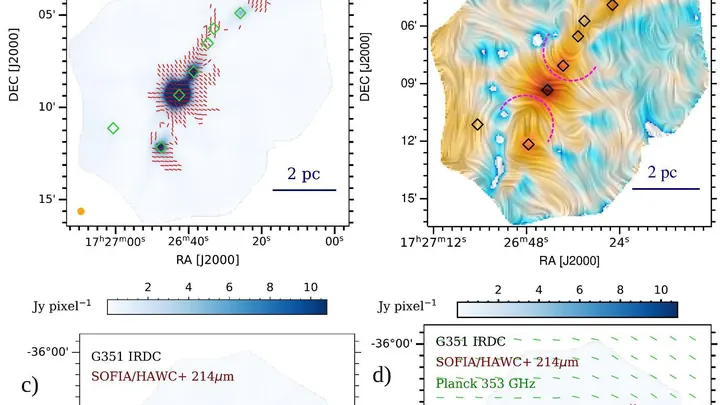
In the dark cloud G351, where new stars are about to emerge from gas and dust, the magnetic field has bent into an hourglass shape. Such a shape is a sign that the field is not just watching star birth from the sidelines but is actively taking part.
Scientists used the SOFIA telescope, mounted on an airplane, to see the dust in the cloud.
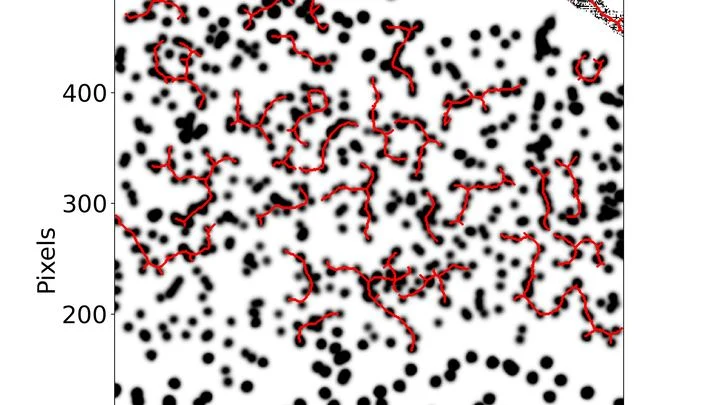
Inside cold clouds of gas and dust where new stars ignite, astronomers have spotted unexpectedly delicate structures. The ALMA telescope, working in the millimeter range, has revealed more than 323 ultra-thin dust filaments within 121 massive clumps.
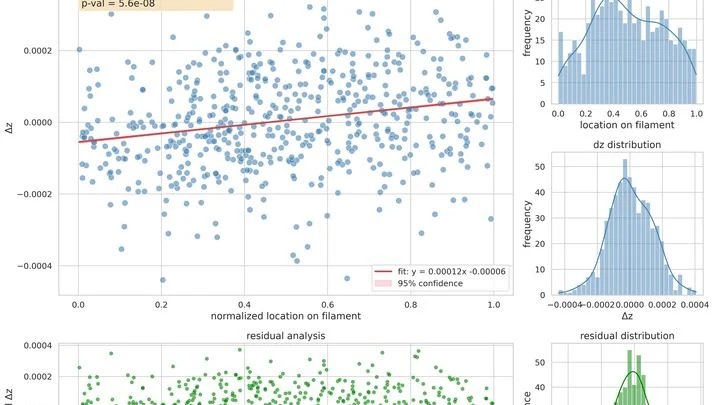
On large scales, the universe resembles a giant spiderweb: bright galaxy clusters are connected by long filaments of galaxies, gas, and dark matter. Previously, it was thought that matter flows along these filaments like water through pipes, heading toward the clusters.