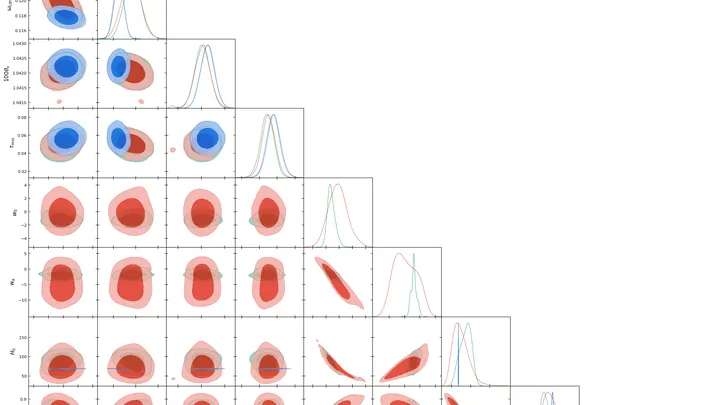
Holographic dark energy is a theoretical model that attempts to explain the observed acceleration of the universe's expansion by applying the holographic principle to cosmology. The holographic principle, inspired by black hole thermodynamics, suggests that all the information contained within a volume of space can be described by a theory on its boundary. In this model, the dark energy density is not a constant but is linked to the size of the cosmic horizon, effectively making it a dynamic quantity that changes as the universe evolves.
History
The holographic dark energy model was proposed in the early 2000s, with key contributions from Miao Li in 2004, who formulated it using the holographic principle and the Hubble scale as the infrared cutoff.
How it works
The model posits that the energy density of dark energy is inversely proportional to the square of the Hubble radius (or a similar length scale), meaning that as the universe grows, the dark energy density decreases. This is derived from the idea that the total energy within a region cannot exceed the energy of a black hole of the same size, setting an upper bound. The resulting equation of state can mimic a cosmological constant at late times but also allows for variations, potentially easing the coincidence problem—why dark energy's density is comparable to matter's density today.
In practice
While primarily a theoretical framework, holographic dark energy is used to fit observational data from supernovae, cosmic microwave background, and baryon acoustic oscillations, providing an alternative to the standard cosmological constant model and guiding future observations to distinguish between them.
Fun fact
The model's name comes from the idea that the universe's dark energy might be a holographic projection of information on the cosmic horizon, a concept that blurs the line between quantum information and gravity.
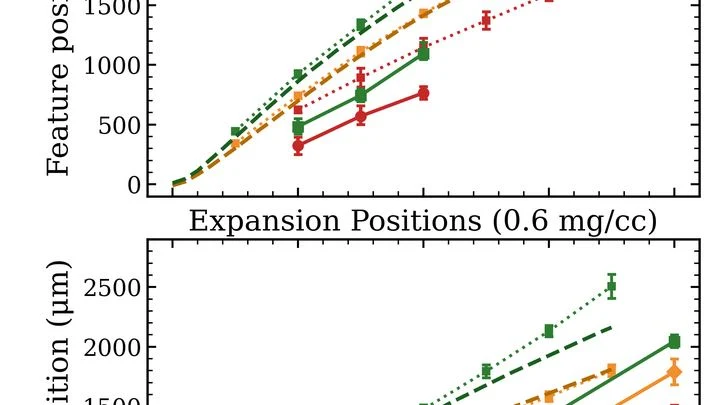
A copper plate the size of a coin vaporizes under the laser's strike in billionths of a second. The hot copper cloud slams into cold helium like a jet of steam into frosty air. The images show a distinct bubble with thin filaments at the edges — the plasma doesn't expand uniformly but breaks into fibers as thin as a human hair.
The universe is like dough rising in an oven. Galaxies are flying apart, and the rate of this expansion is accelerating. To explain the accelerating expansion, cosmologists came up with dark energy — a mysterious force that pushes space apart from within. The standard recipe, called Lambda-CDM, works pretty well, but it has its inconsistencies.
Gravity is a remarkably weak force. A small magnet holds a paperclip against the pull of an entire planet. Physicists have long sought the reason for this weakness, and one guess leads us into hidden dimensions. Perhaps gravity 'leaks' into them, losing strength in our three-dimensional world.
A black hole cooled to nearly absolute zero resembles a musical instrument with only a limited set of possible notes. Strike it, and it will respond not with any sound, but only with a strictly defined set of frequencies.
Water turns to ice at zero degrees — sharply, with no intermediate states. Something similar happens to complexity when we take a random quantum state of an entire system and look only at a part of it. As long as that part occupies less than half the system, its complexity grows smoothly. But as soon as the fraction crosses 50%, a jump occurs.
10⁻¹²⁰. That's not just a small number: it's a chasm. That's the ratio of dark energy density to the Planck density, the natural scale of quantum gravity. The colossal difference of 120 orders of magnitude has long seemed an unsolvable puzzle. But the answer might lie in a drama played out at the dawn of time.
Imagine a steam engine where instead of a steel piston there is an event horizon, and the cylinder is curved space itself. This metaphor has gained mathematical flesh: physicists have for the first time constructed a complete set of reversible heat cycles with a Schwarzschild black hole confined in a spherical cavity.
The cosmological principle – the notion that the Universe is homogeneous and isotropic on large scales – has guarded our understanding of the world since the time of Edwin Hubble and Georges Lemaître, whose ideas formed the basis of the Big Bang model.
A classical black hole has a temperature and other thermodynamic properties. When physicists began accounting for changes in the cosmological constant, the energy of empty space, a strange coupling emerged in the equations.
Einstein’s cosmological constant — a blunder or a boomerang insight? The universe’s acceleration caught physicists off guard: ΛCDM works, but why is the vacuum energy so absurdly tiny? Imagine an ocean heaving with quantum fluctuations, yet on the surface only a microscopic ripple.
A bonfire doesn't burn out all at once. If you glance at the flames at a random moment, all you see is a jumble of fire tongues, and you can never tell what exactly burned: a wet branch, an old magazine, or an armful of dry grass. But if you watch the fire hour after hour, rhythms emerge in its dance: a burst of heat, a lull, a change in color. These rhythms tell the story of what was thrown into the flames.
Quantum noise, like the hiss of an untuned radio, filled the infant Universe. Alan Guth showed that superfast expansion (inflation) caused this ripple to freeze, giving rise to clumps of matter — the seeds of galaxies.
A new method extends this picture to any theory of gravity.
Imagine a huge layered cake, where the layers of dough are space and the filling is a special region resembling an invisible wall. This wall is not made of bricks but of energy, and it could be as thick as the entire universe. If such a wall exists, it should stretch the dough layers differently: those lying along it spread apart faster, while those across it spread slower.
A pendulum chooses how to swing on its own. If you give it a strong push, it quickly returns to a smooth rhythm. If you hold it at its extreme position, it will stay there, but as soon as you let go, it resumes its usual motion.
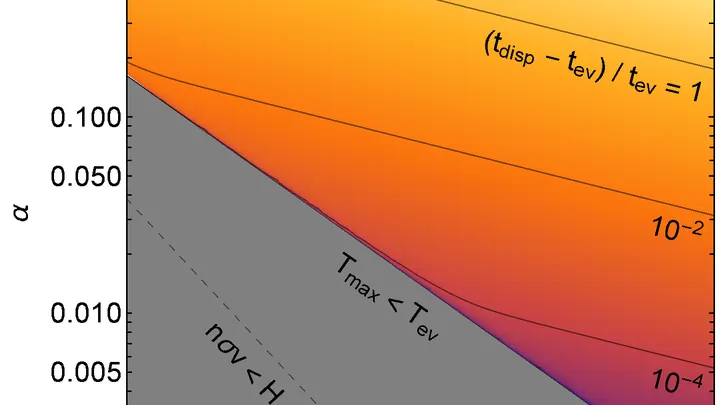
A tiny black hole zips through a gas cloud. Instead of swallowing the gas, it heats it up, like an iron left on a damp cloth. Radiation streams from the black hole, creating a hot spot — a region where the temperature is hundreds of times higher than in the surrounding space.
A stone thrown into a pond leaves ripples spreading across the water. In quantum physics, the role of such ripples is played by equations that relate the properties of particles. Recently, mathematicians proposed a set of such equations for a world without gravity but with a large number of 'degrees of freedom'—roughly like the complex ripples on water.
Black holes aren't faceless devourers. Sometimes they behave like water: they can 'freeze' or 'boil', changing their internal state. Scientists described this by modeling light near a black hole as a gas.
A magnetic field can hold a star against complete collapse: that's the idea behind a new kind of black hole. Instead of the usual point of infinite density, inside there is a field that prevents space from crunching down to zero. It's like a spring: the harder you squeeze, the more it pushes back.
A black hole is like a whirlpool in a river: anything that falls in can never escape. But it also has an outer zone, the ergosphere, where space itself moves faster than light and drags any object along. Usually, the size of this zone is tightly linked to the hole's mass and spin rate.
Imagine inflating a balloon. At first, it expands slowly; then someone gives a sharp blast of air, and it swells faster. But as the airflow weakens, the balloon's growth slows again. According to a new study, the Universe has behaved much the same way: after the Big Bang, it expanded, then suddenly accelerated, and now that acceleration is fading.
The universe is expanding faster and faster, and scientists blame it on dark energy. Its origin is explained in a new way: dark energy isn't eternal, but appears only after dark matter clumps together into lumps — future galaxies.
The mechanism works like a pump that turns on when pressure drops.
When two black holes collide, they send out gravitational waves and ring like a massive bell. The fading sound, or ringdown, carries the imprint of the final black hole. But if dark energy, the force accelerating the universe, changes over time, it can cling to the black hole like a thin paint layer.
Scientists proposed a model in which the mysterious force (dark energy) possesses something like inertia: it needs time to respond, like a heavy pendulum. Because of this, the expansion of the Universe doesn’t accelerate forever, but instead decays, like a pendulum in thick honey.
The universe is expanding, and the rate of that expansion is a hot topic in cosmology. Nearly a century ago, Edwin Hubble discovered that galaxies are flying apart, but modern measurements of the Hubble constant, which characterizes the expansion rate, give conflicting values.
The Universe is expanding, and it's doing so faster and faster. This acceleration is driven by mysterious dark energy. For a long time, it was thought to be as constant as a textbook constant. But new data from DESI, an instrument that captures spectra of millions of galaxies, hint that dark energy may have been stronger or weaker in different epochs.
The 'double copy' method in physics is a culinary trick: a chef takes a cold soup recipe, doubles the ingredients, and gets a recipe for a hot roast. Likewise, particle interactions via electric forces (the basis of the Standard Model) morph into gravity, which describes spacetime curvature.