Helium-3 is a rare isotope of helium with two protons and one neutron. Unlike the more common helium-4, helium-3 is a fermion, meaning it obeys Fermi-Dirac statistics. At extremely low temperatures, around 2.5 millikelvin, helium-3 becomes a superfluid, a state of matter with zero viscosity. This superfluid state is a fermionic superfluid, analogous to superconductivity in metals, where pairs of helium-3 atoms form Cooper pairs and condense into a single quantum state. The superfluid phases of helium-3 are highly complex and exhibit exotic properties, such as anisotropic superfluidity and the existence of multiple phases.
History
Helium-3 was first predicted to be a superfluid by theorists in the 1970s, and it was experimentally discovered by Douglas Osheroff, Robert Richardson, and David Lee in 1972, for which they received the Nobel Prize in Physics in 1996.
How it works
At low temperatures, helium-3 atoms, being fermions, cannot all occupy the same quantum state due to the Pauli exclusion principle. However, through weak attractive interactions, they can form pairs, similar to Cooper pairs in superconductors. These pairs are bosons and can condense into a single macroscopic quantum state, leading to superfluidity. The pairing can occur in different angular momentum channels, giving rise to the A-phase and B-phase, each with distinct symmetries and properties. The superfluid state exhibits phenomena like the Josephson effect and quantized vortices.
In practice
Helium-3 is used in cryogenics, particularly in dilution refrigerators, which are essential for cooling quantum computers and other ultra-low-temperature experiments. It is also used in neutron detection and in medical imaging for lung ventilation studies.
Fun fact
Helium-3 is extremely rare on Earth, but it is relatively abundant on the Moon, where it has been deposited by the solar wind over billions of years, making it a potential resource for future lunar mining.
The map of dense nuclear matter resembles a road map: lines of phase transitions cross at critical points, like highways at intersections. Until now, only two intersections were known on such a map: the nuclear liquid-gas and deconfinement, where hadrons dissolve into quarks.
A thin film of zirconium nitride lies on a magnesium oxide substrate. Its thickness is two-tenths of a micron, like a spider's web, but inside it quantum life is boiling. When cooled to half a kelvin, superconductivity does not disappear all at once: it breaks up into rare islands that still hold on amid the disorder.
In the depths of sub-Neptunes, the most common type of planet in the Galaxy, though not one you could stand on, silicate magma and hydrogen mix into a single supercritical cocktail. Previously, it was thought that beneath the dense hydrogen atmosphere lay a sharp boundary with molten silicate, like oil on water.
The neutron is a particle that usually sits in the atomic nucleus and doesn't disappear. But some theories suggest that occasionally it might transform into its invisible twin — a particle that ordinary detectors can't catch.
The helium atom is like a tightly stretched string: every note it plays is strictly predicted by theory. But in recent years, precise measurements of one such "note"—the energy needed to strip an electron from an excited helium atom — have started to sound slightly higher than they should.
Three billiard balls scatter across the table after a strike: their trajectories depend only on the initial push. But in the world of atomic nuclei, things are more complex: particles sense each other on the fly, even if they are not bound together. For a long time, physicists could only measure pairwise interactions, while what happens when three meet remained behind the scenes.
Superconductivity and magnetic field are age-old foes: the field barges in like a whirlwind, tearing apart the delicate pairing of Cooper pairs, destroying order.
A potter uses a sharp stylus to trace a pattern on a still-damp clay tile. One wrong move, and the line blurs, the tile cracks. Physicists work with films of the high-temperature superconductor YBCO (a compound of yttrium, barium, copper, and oxygen) in much the same way.
A swarm of fireflies rarely collides, yet they synchronously change color by exchanging signals. This is how neutrinos behave in dense streams from collapsing stars: they collectively transform from one type to another, even though individually they interact extremely weakly.
When the interstellar comet 3I/ATLAS approached the Sun, its tail lit up with a metallic sheen, as if a tin can full of nickel and iron had burst open. By breaking down its light into colors, astronomers detected the lines of these metals using spectral analysis.
A match flares from both ends. First the head ignites, and a moment later the flame engulfs the wooden stick. Something similar may happen in some Type Ia supernovae — except the match is a white dwarf (a star the size of Earth), and the flame is a thermonuclear explosion.
In superfluid helium, friction disappears — the liquid flows like a mountain stream, but without a single eddy. A short laser pulse rippled this smooth surface, and scientists using spectroscopy captured the spreading ripples — quantum waves with many speeds.
A superconductor does not let a magnetic field penetrate its interior. But if the field is strong enough, it does get in — not as a continuous flux, but as individual vortex filaments, like tiny tornadoes. Inside each filament, superconductivity is destroyed, and around it flows a persistent current.
A mosaic floor made of many small tiles, each turned in a different direction. It seems that any pattern trying to cross such a floor would get scrambled and vanish. That's how people usually think about disorder in crystals: if atoms aren't arranged in a perfect lattice, delicate quantum effects should fall apart.
In a dark room, a flashlight only illuminates what falls within its beam. That's roughly how physicists study atoms: a short flash of light knocks out electrons, and by tracking their paths, you can figure out how the atom is built. But helium has states that don't fall into the ordinary 'beam'—they hide in the shadows.
In the binary system Cygnus X-3, right here in our Galaxy, a black hole and a giant star whirl so tightly together that the star loses matter: it's swept away by a powerful wind. Jets blast out from near the black hole; recently, a telescope caught photons from them, each carrying the energy of a flying mosquito.
A frictionless liquid that flows forever: that's superfluidity. Helium-3 only achieves it at thousandths of a degree above absolute zero. The theory of this state was developed by Lev Landau and Richard Feynman.
A sheet of paper hundreds of times thinner than a human hair: that's roughly the thickness of the vanadium oxide film scientists grew. Inside this film, electrons, the tiny carriers of electric current, move almost without collisions. Like cars on an empty night highway, they accelerate and don't lose speed.
A quantum bit is like a spinning top that must keep spinning steadily for a long time. In germanium, researchers have learned to set such tops spinning, but the floor around them is always trembling: electrical noise knocks the spin off course.
An ordinary wire heats up when current flows through it. A superconductor doesn't. But almost all known superconductors require either very low temperatures or enormous pressures, like those deep inside planets. Scientists have long searched for a material that avoids these extremes.
Light in semiconductors is born from pairs of charges, an electron and a hole, that attract each other like a magnet to a fridge. Such a pair is called an exciton. If you add one more charge to the pair, you get a trion — a trio of three particles.
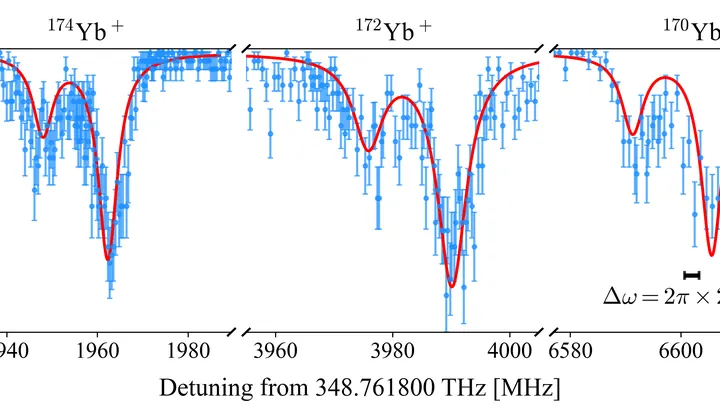
The light an atom emits or absorbs is like a fingerprint: each element has its own pattern of lines. In an ytterbium ion (an atom that has lost one electron), researchers have found three new lines that were previously unused. These lines are very narrow, like thin slits in a fence that let you see far and clearly.
A sheet of germanane just one atom thick sits on a piece of germanium, and current races across it like a highway with no traffic lights. Germanane is a flat lattice of germanium atoms covered with hydrogen, a cousin of graphene.
Uranus and Neptune have long puzzled scientists: their magnetic fields are heavily tilted and tangled, nothing like Earth's. The answer lay in an exotic form of water — superionic ice, which fills their interiors.
The law discovered by Wolfgang Pauli forbids identical particles from occupying the same spot. Hence, in cold matter, a Fermi sea is born: particles, like water, fill energy levels from bottom to top. The shape of the sea's surface — including 'islands' of emptiness — dictates the properties of the whole system.
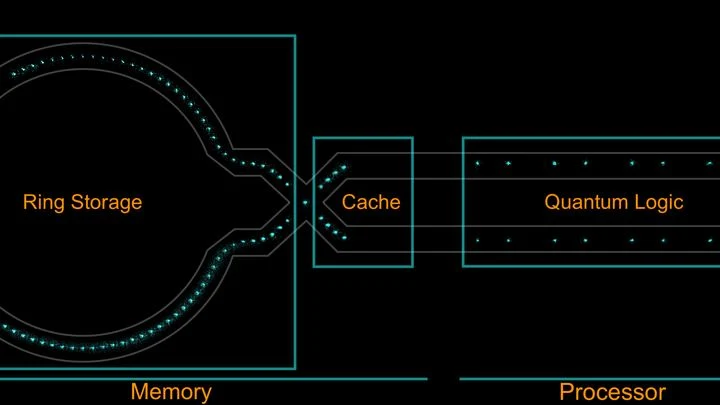
In the new Helios processor, 98 barium ions circle along a closed loop, like horses on a carousel. This architecture allows any ion to exchange data with any other, making the system flexible and powerful. Laser pulses, like a conductor's baton, issue commands at the speed of light.
Ordinary wires: electrons jostle, lose energy, and heat up: that's resistance. In superconductors, some electrons pair up in sync, like dancers swirling without collisions. But these pairs hide: you can't see them directly, only infer their presence from flawless coordination.
Planet WASP-121b orbits so near its star that the fierce heat boils its atmosphere away, streaming like a comet's tails. With the James Webb Space Telescope, astronomers continuously watched this process for the first time.
The light from a distant galaxy split into two, then three, then four, and in the center a fifth ghost appeared. That is HerS-3: a young galaxy full of dust and newborn stars, whose light passed through a gravitational lens, a massive object that bends rays like a magnifying glass bends light.