Stone Clusters from the Early Solar System express
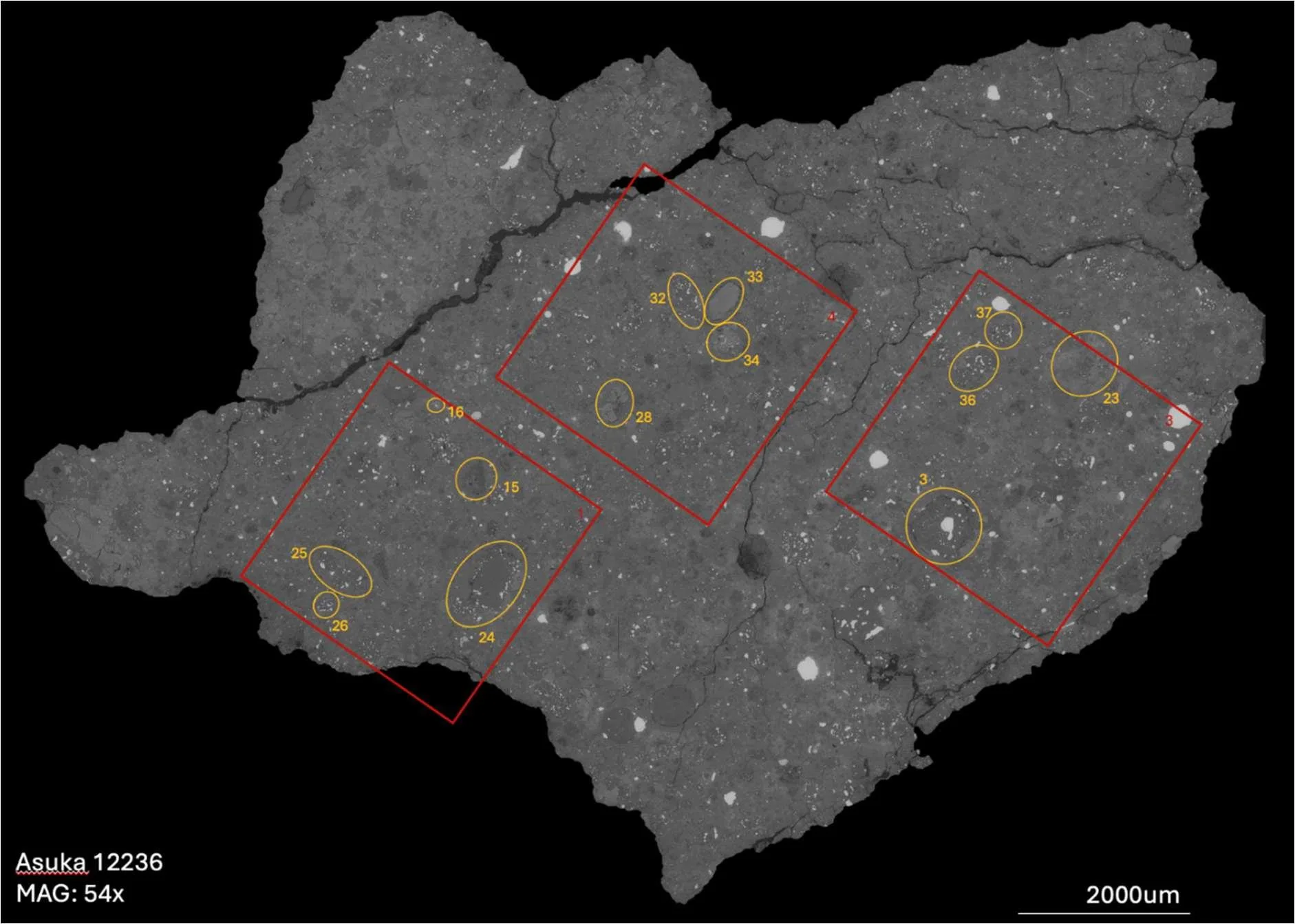
In the cold depths of space float rocks older than Earth itself. Inside some of them hide tiny glassy spheres — chondrules. They formed when a disk of gas and dust still swirled around the young Sun.
Carbonaceous meteorites Asuka 12236, Paris, and Maribo have preserved these spheres almost untouched. Scientists X-rayed 66 chondrules and measured their chemical composition. It turned out that each chondrule is like a frozen droplet from a blast furnace. When heated, metals and silica vapor escaped from it. This vapor settled around it as tiny particles, like cosmic ash.
Then comes the most interesting part. Many chondrules stuck together into clusters, like bunches of grapes. First, very small droplets, micron-sized spheres, formed. They attracted dust and ice, and then welded together. This explains why the composition of chondrules and the surrounding dust complement each other: the material that evaporated from the spheres settled nearby, like condensation on cold glass.
This picture changes our view of planet formation. Dust and pebbles didn't just stick into clumps: they went through fire, evaporation, and reassembly. And in these stone clusters is recorded a chemical memory of the first few million years of the Solar System.
Original abstract
as written by the authors arXiv:2608.12931v1
Chondrules and their associated fine-grained rims record key processes in the early protoplanetary disk, yet the links between chondrule chemistry, morphology, and matrix complementarity remain poorly constrained. We investigate the major, minor, and trace element compositions of 66 chondrules and FGRs from the relatively unaltered CM carbonaceous chondrites Asuka 12236, Paris, and Maribo, together with their 3D morphology, using LA-ICP-MS and X-ray tomography. CM chondrules record systematic metal loss and evaporation of Si-rich mesostasis, driving initially CI-like precursor compositions toward more Mg- and Si-rich bulk compositions along the CI ratio line and toward increasingly Si-poor forsteritic assemblages. GEMS-like materials in pristine CM matrices closely mirror chondrule compositions and likely represent complementary condensates derived from evaporated mesostasis. Dust accreted onto chondrules is predominantly CI-like but contains about 14 wt.% complementary condensate material represented by chondritic amorphous silicates, reconciling Mg/Si complementarity between chondrules and matrix with the preservation of primordial organics and presolar grains. Morphological observations show no significant sectioning bias, consistent with CM chondrules being dominated by agglomerates of ~100 um microspherules. Many display grape-bunch textures produced by welding of smaller chondrules with metal-rich or CI-like rims. This structure may explain the chondrule moderately volatile-element plateau at about 0.3xCI. We propose a "micro-chondrule-first" scenario in which localized heating events produced small molten droplets that subsequently accreted CI-like dust and ice, aggregated, and experienced limited aqueous alteration. These observations place new constraints on chondrule formation in the outer disk and highlight the importance of localized melting and aggregation processes.
Some chondrules look like grape clusters: dozens of tiny spheres welded together, each once a separate molten droplet.