Chemical composition is the identity and relative amounts of substances that make up a material or object. It is the fundamental 'recipe' of matter, distinguishing a pure element from a compound, an alloy, or a complex mixture. Knowing the composition of something — whether a distant star, a speck of dust, or a piece of metal — is the first step to understanding its origin, its properties, and its behavior.
History
The concept of chemical composition solidified in the late 18th and early 19th centuries with the work of Antoine Lavoisier, who established the law of conservation of mass, and John Dalton, who proposed the atomic theory and the law of definite proportions, showing that compounds always contain the same elements in the same ratio.
How it works
Composition is determined by identifying the elements or molecules present and measuring their proportions. This can be done through techniques like spectroscopy, which analyzes the light a substance emits or absorbs, or mass spectrometry, which sorts atoms and molecules by their mass. The relative amounts are often expressed as percentages by mass, by atom count, or as ratios, and these numbers dictate everything from a material's melting point to its chemical reactivity.
In practice
It is used everywhere from metallurgy, where the exact mix of elements in an alloy determines its strength and memory properties, to astrobiology, where the elemental composition of a planet's atmosphere or surface can hint at the presence of life.
Fun fact
The smell of a substance is rarely due to a single molecule; even a simple odor like that of a rose is a complex mixture of dozens of different chemical compounds, meaning its 'composition' is what your nose actually detects.
When sugar goes into tea, it dissolves. But why doesn't it just fall back out? It's all about chemical potential — a quantity that shows how 'favorable' it is for a substance to be in a given place and state. For a pure substance, it's easy to calculate, but for a mixture of several components, it's a real puzzle.
A perfume bottle is not just glass with liquid. It is a snapshot of its time, a frozen melody of fragrant notes. From 1900 to 2024, tens of thousands of such 'melodies' have accumulated, and now they can be studied as a single organism.
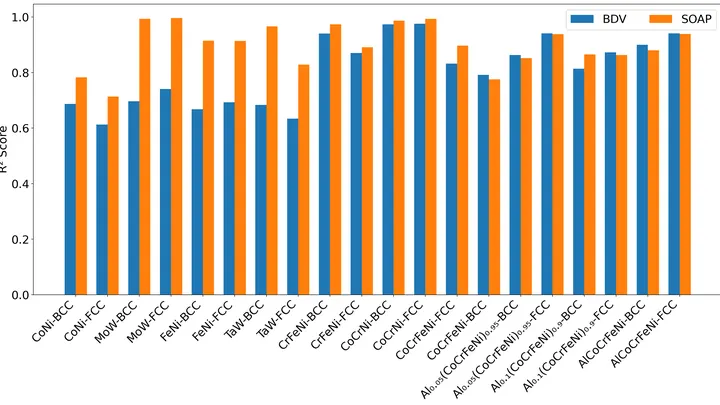
Creating an alloy from several metals is like cooking a soup from mysterious ingredients: guessing the final texture without trial and error is nearly impossible. Conventional models often get it wrong when there are more than three different kinds of atoms.
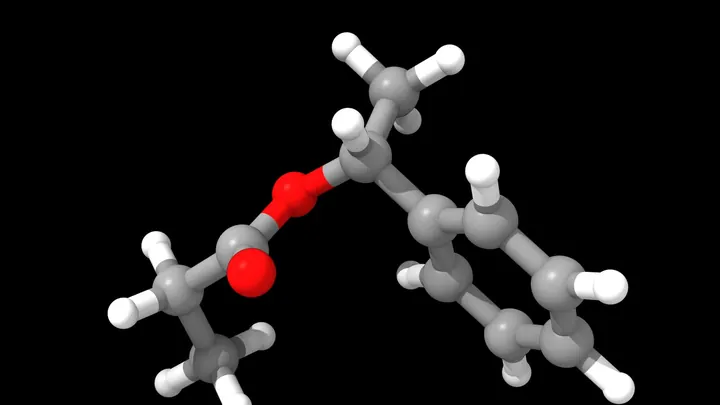
From carbon, nitrogen, oxygen, and sulfur, you can assemble 10⁶⁰ different small molecules: that's a 1 with 60 zeros, more than the stars in the visible universe. Life uses only a tiny fraction of this menu, but not randomly.
The nose is an amazing instrument. A single coffee molecule entering a nostril can awaken a memory of a morning kitchen. Another, nearly identical in shape, smells like rotten eggs.
A crystal one atom thick is like a sheet of paper you can write on with electricity. Such a material promises to become the foundation for tiny, fast microchips. But before putting it into production, you need to know exactly what it's made of. And that's where the usual formula falls apart.
Making a new drug is like assembling a complex construction set, where each piece is a molecule and the instructions are written in an unfamiliar language. Chemists spend years finding the right combinations, but the slowest step isn't coming up with the idea: it's making it happen in a test tube. Synthesizing a molecule can take weeks, and any mistake sends the whole process back to square one.
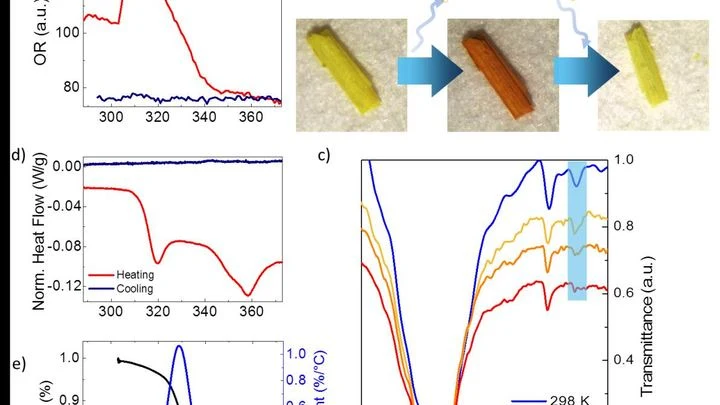
In the air of factory floors and laboratories, invisible solvent molecules drift. One of them, acetonitrile, has a faint smell, but at high concentrations it can harm health. Typical sensors for it are bulky and expensive, but here we have a thin crystalline film that responds on its own to the presence of vapor.
A team assembling a jigsaw puzzle from random pieces: how many simultaneous moves does it take to complete the picture? If the pieces are independent, they all go down at once. If each piece depends on the previous one, you have to work one at a time. So it is with systems: some states assemble instantly, others require a long sequential effort.