Cosmic dustmagnetism refers to the magnetic properties of tiny solid particles — typically micrometers in size — that float in interstellar and interplanetary space. These grains, composed of silicates, carbon, and iron compounds, can become magnetized and interact with ambient magnetic fields. Their behavior is crucial for understanding how dust clouds collapse to form stars, how planets assemble from protoplanetary disks, and how light is polarized as it travels through the galaxy.
History
The study of interstellar polarization began in 1949 with observations by William Hiltner and John Hall, who discovered that starlight is polarized by aligned dust grains. The theoretical framework for grain alignment was developed in the 1970s by astronomers like Adolf Witt and later refined by Bruce Draine and colleagues.
How it works
Dust grains acquire magnetization primarily through the presence of ferromagnetic inclusions, such as iron-nickel alloys or magnetite. When exposed to a magnetic field, these inclusions align, giving the grain a net magnetic moment. This causes the grain to precess around the field direction, which affects how it absorbs and scatters light — a phenomenon called polarization. The alignment also influences how dust grains stick together during planet formation, as magnetic forces can either attract or repel grains depending on their orientation.
In practice
Understanding cosmic dustmagnetism helps astronomers interpret polarization maps of the cosmic microwave background, which are used to probe the early universe and search for gravitational waves from cosmic inflation.
Fun fact
Magnetite chains found in ancient bacteria on Earth are nearly identical to structures that may exist in cosmic dust, suggesting that magnetic alignment is a universal physical process.
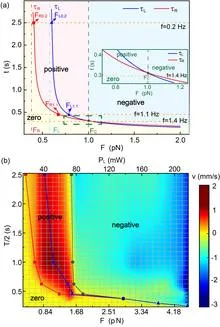
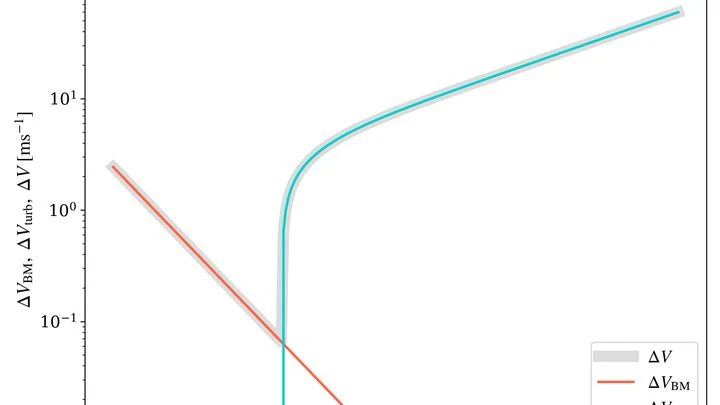
A swing that rocks on a sawtooth hill behaves strangely: without kicks, it gets stuck in the first dip, but with rhythmic pushes it can move uphill, downhill, or stay frozen in place. That is exactly what physicists saw when they placed a single dust grain in a trap with a sawtooth bottom and started pushing it alternately with laser beams.
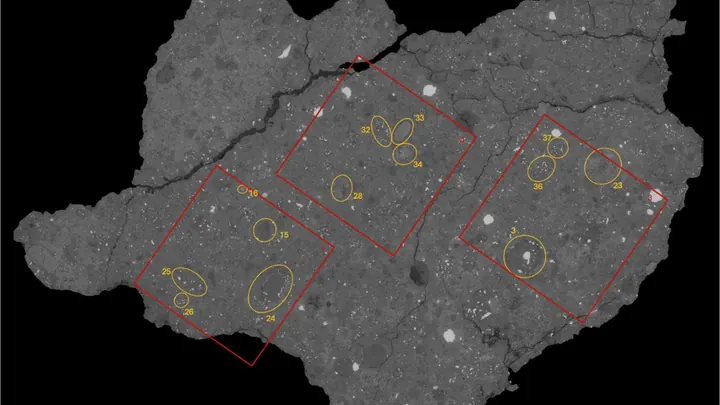
In the cold depths of space float rocks older than Earth itself. Inside some of them hide tiny glassy spheres — chondrules. They formed when a disk of gas and dust still swirled around the young Sun.
Carbonaceous meteorites Asuka 12236, Paris, and Maribo have preserved these spheres almost untouched.
Space is threaded with magnetic fields. They exist around galaxies, stars, and even in nearly empty voids — the vast empty spaces between galaxy clusters. It's usually thought that fields are amplified from weak 'seed' fields by turbulence, much like a dynamo. But the origin of the seed fields themselves has remained a puzzle.
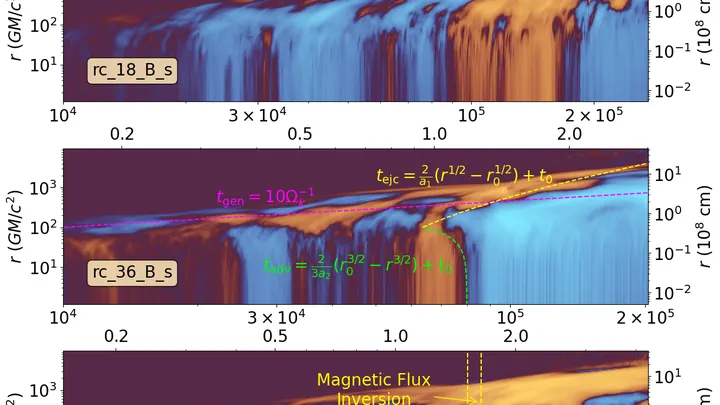
A fire hose blasts into a snowdrift. The water doesn't just shove the snow aside — at the point of impact, spray, steam, and a roar are born. That's roughly how jets behave: narrow streams of matter shooting out from around a black hole at enormous speeds.
A massive star collapses, and a black hole is born, surrounded by a disk of incandescent plasma. For narrow jets to burst out of this disk, an ordered magnetic field is needed. But inside the star, it's tangled.
A dust storm that has raged for millions of years is not in a desert but between the stars. There, clouds of tenuous gas drift, threaded by magnetic fields. These fields align dust grains like compass needles along field lines. When such dust emits, its light becomes polarized: it oscillates in a single plane, like a rope shaken only up and down.
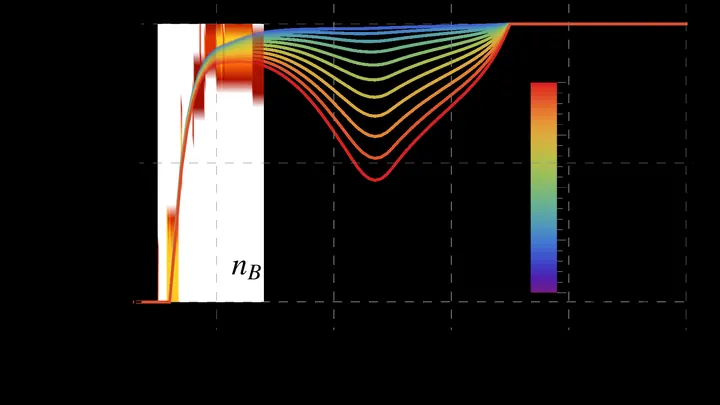
A neutron star is the collapsed core of a massive star, squeezed to the size of a city. In its heart, matter is packed so densely that atoms cease to exist, and protons and neutrons dissolve into a sea of quarks.
In dark, cold clouds of interstellar gas, astronomers have for several years been spotting aromatic molecules — compounds built around a benzene ring (a hexagon of carbon atoms), like the benzene we know. One such substance, benzonitrile (benzene with a cyano group attached), had only been found in very calm and cold places, like the Taurus cloud.
A vast, dark cloud of gas stretched across the young universe. Inside it, like invisible fingers, magnetic field lines left over from the very birth of the cosmos threaded through. These fields act on charged particles, pushing them together, like a gentle breeze gathering fallen leaves into piles.
When a massive star explodes as a supernova, its outer layers are blasted into space at thousands of kilometers per second. A shock wave forms — a giant invisible bulldozer that sweeps up interstellar gas and dust. In this maelstrom, particles can be accelerated to energies comparable to that of a flying tennis ball compressed into a single proton.
In a large gas cloud where stars are born, the magnetic field lines are roughly aligned in one direction, like the fibers in a piece of felt. But look inside, into the dense clumps that will eventually become stars, and the picture changes: there the lines are twisted every which way, like a ball of yarn after a kitten has played with it.
During a thunderstorm, the sky acts like a giant battery: charge builds up in the cloud, and a lightning bolt discharges it. That charge is invisible, but cosmic particles (muons, which constantly rain down on Earth from space) can sense it. As a muon flies through a charged cloud, it speeds up or slows down slightly, and these changes reveal the voltage inside the cloud.
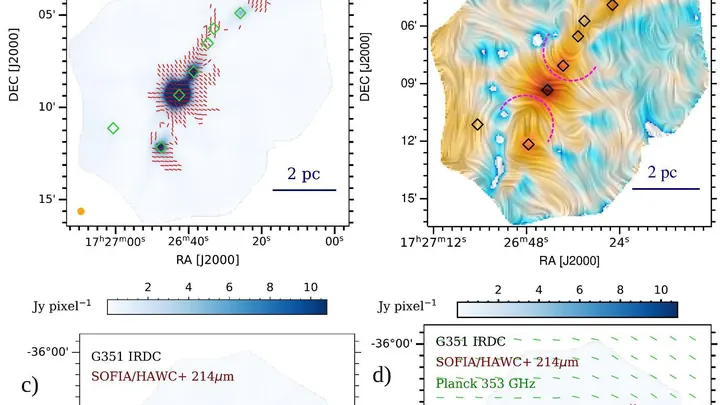
In the dark cloud G351, where new stars are about to emerge from gas and dust, the magnetic field has bent into an hourglass shape. Such a shape is a sign that the field is not just watching star birth from the sidelines but is actively taking part.
Scientists used the SOFIA telescope, mounted on an airplane, to see the dust in the cloud.
A white dwarf is what remains of a star like the Sun after it sheds its outer layers. What's left is a hot core the size of Earth but with a mass close to that of the Sun. A teaspoon of this material would weigh as much as a truck. Some of these stars have extremely strong magnetic fields — a billion times stronger than Earth's.
In the dark cloud L43, where stars are born, dust grains twirl like tiny compasses. Light from a young star pushes them, while the magnetic field lines them up in a specific direction. When a grain is turned sideways to us, its heat reaches us polarized, like light passing through a narrow slit.
A young planet in a gas disk is like a swimmer trying to swim against the current: friction with the gas slows it down, and it spirals toward the star. For small rocky planets, this fall can take less time than they need to grow. But the disk also has countercurrents — vortices that can push the planet outward.
Scientists built a computer model of a disk around a young star.
A dust grain in interstellar space is like a tiny compass. Inside it sit inclusions of magnetic minerals that make the grain rotate along invisible magnetic field lines. How obediently the grains align determines how they polarize the light of distant stars and what radiation they emit.
In the cold clouds of gas and dust where stars will one day ignite, some atoms have lost electrons and become charged. Charged particles feel the magnetic field, while neutral ones do not, so the charged ones slip through the neutral ones like water through a sieve. Astronomers have measured this drift speed: about a hundred meters per second.
The night sky glows not only with stars. Between them lies a faint microwave radiance that astronomers have noticed for three decades but couldn't explain. One idea: the culprits are polycyclic aromatic hydrocarbons — molecules like tiny soot flakes that spin in space and, like miniature antennas, emit radio waves.
In the first moments, the Universe went through a brief but turbulent period — inflation, when it expanded at a colossal speed. This idea was proposed by Alan Guth. At the same time, particles of ordinary matter were born.
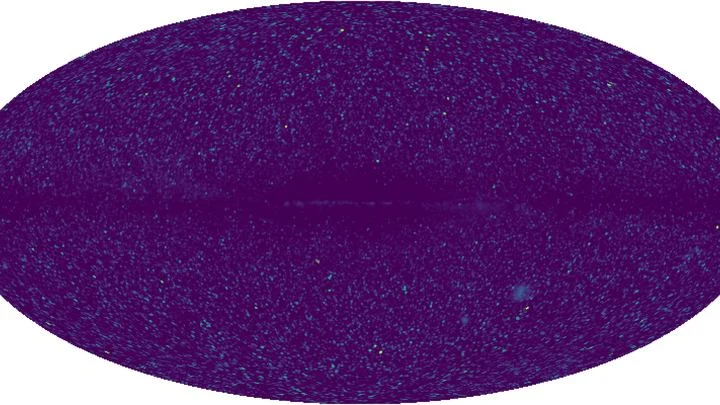
Cosmic dust isn't dirt: it's tiny grains, like soot from a campfire, scattered between the stars. Some of them spin at breakneck speeds, millions of times per second, emitting faint radio waves. Astronomers call this anomalous microwave emission: it interferes with studies of the early universe, but it's also a mystery in its own right.
Without the invisible framework of dark matter, galaxies would fly apart. Astronomer Vera Rubin proved back in the 1970s that stars rotate as if held by an unseen mass. But new research shows it's not just passive ballast.
A century ago, magnetic observatories recorded only the slow breathing of Earth's core. Today, their data have become hunting grounds for particle physics. At the Eskdalemuir Observatory in northern England, fluctuations of the magnetic field are recorded every hundredth of a second.