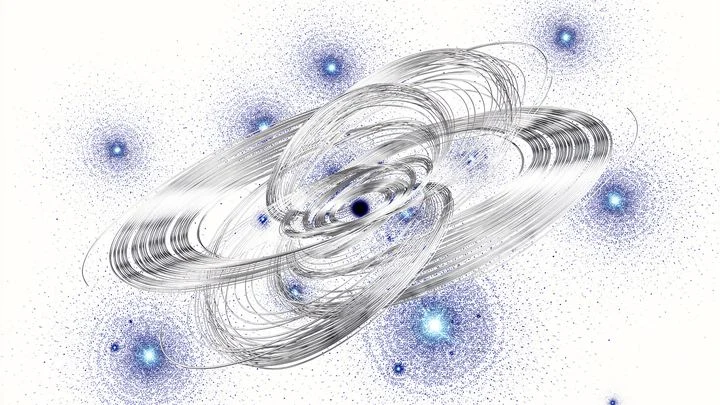
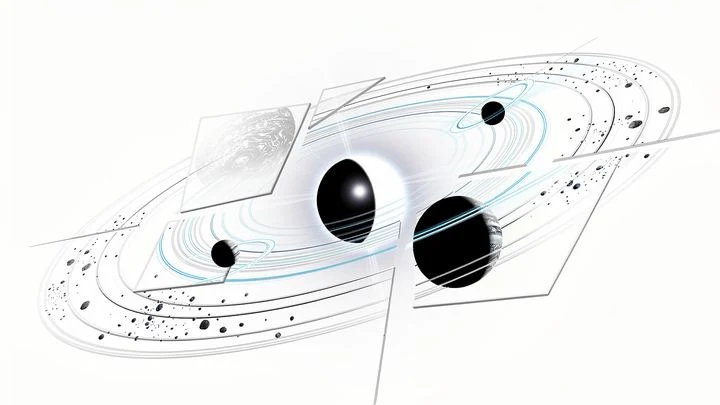
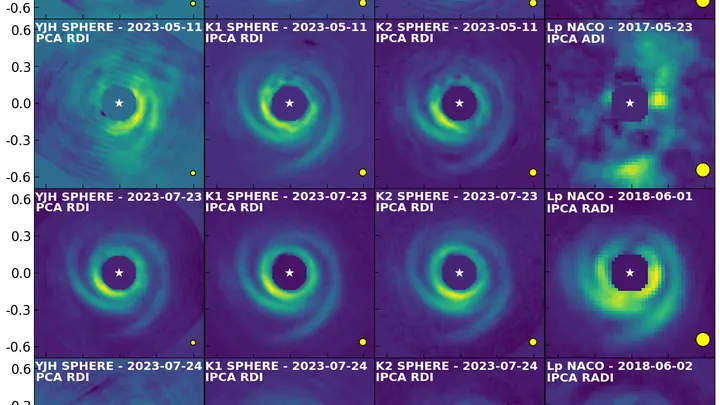
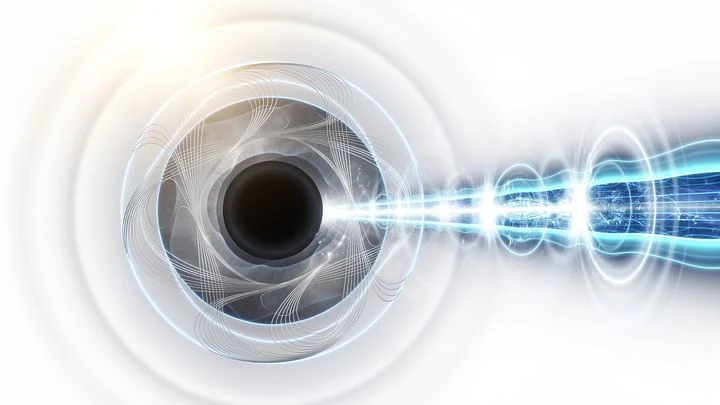
A protoplanetary disk consists of gas (mostly hydrogen) and dust, heated by the star's radiation. The inner part is hotter, there ices evaporate; the outer part is colder, where icy planets and comets form. Disks show gaps — traces of forming planets. Disk lifetime is several million years.
History
The concept of the protoplanetary disk goes back to the nebular hypothesis of I. Kant (1755) and P. Laplace (1796). In the 20th century, the theory was developed by V. S. Safronov, who mathematically described planet accumulation. Observational confirmations came with space telescopes: IRAS (1980s) detected an excess of infrared radiation from young stars, and Hubble and ALMA directly imaged disks.
How it works
Disk formation is a consequence of angular momentum conservation during the collapse of a rotating cloud. Gas and dust falling to the center increase their rotation speed, and centrifugal force in the equatorial plane balances gravity, forming a disk. Further evolution: dust settles to the midplane, grows through sticking. When planetesimals reach ~km size, gravitational focusing kicks in. In the gas phase, planetary migration is possible. Chemical transformations occur in the disk (beyond the ice line). The disk phase ends via photoevaporation or accretion, leaving a planetary system.
In practice
Observations of protoplanetary disks help understand how our Solar System formed and predict the architecture of exoplanetary systems.
Fun fact
Astronomers discovered a disk around the star HL Tauri with a clear ring structure, revealing planetary embryos.
In a dense cloud of gas and dust where massive stars are born, two young stars recently passed very close to each other. Their dance has lasted only about sixty years, and astronomers have now seen it in detail for the first time.
An old city gains new suburbs. In the center, narrow streets where life has nearly stopped, while on the outskirts construction is booming. That is what a spiral galaxy looks like when its core stars have long aged and new stars are still being born in the outer disk.
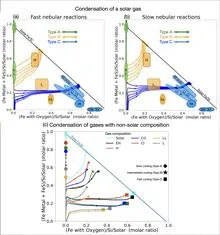
Three cabinets full of rocks. In one, metallic grains and the gray mineral enstatite; in the second, the same grains but with rusty streaks; in the third, layered clays swollen with water. All three sets were pulled from meteorites that fell to Earth: chondrites. They were born in the same gas-and-dust disk around the young Sun, yet somehow turned out so different.
Life begins with a bubble. In a warm puddle on ancient Earth, fat molecules could gather into tiny spheres — prototypes of cells. Inside such a sphere, a polymer happened to be present that accelerated the uptake of new fats from the surrounding water. The bubble grew, divided, and passed its composition to offspring.
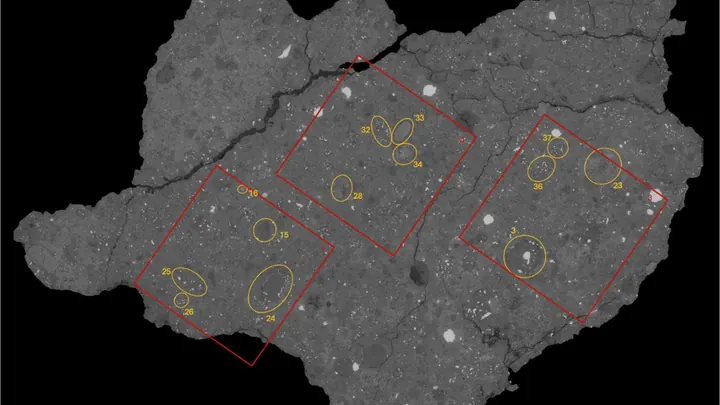
In the cold depths of space float rocks older than Earth itself. Inside some of them hide tiny glassy spheres — chondrules. They formed when a disk of gas and dust still swirled around the young Sun.
Carbonaceous meteorites Asuka 12236, Paris, and Maribo have preserved these spheres almost untouched.
In the coldest, darkest corners of space, dust grains get covered in ice, like a window on a frosty day. This ice isn't just frozen water: it also contains carbon monoxide and carbon dioxide. From such ice, comets and planets may eventually assemble. But until now, it was unclear how the dust grain itself affects the ice that forms on it.
The solar wind is a stream of charged particles constantly blown off the Sun's surface, filling the entire solar system. It's not like a steady breeze: it has eddies, gusts, and calm patches. Scientists call this turbulence.
In the dark kitchen of the Taurus molecular cloud, 450 light-years away, dozens of planetary systems are being prepared. Each young star is a chef, and its protoplanetary disk is a counter piled with flour-like dust and steam-like gas.
Around young stars, flat clouds of gas and dust swirl: these are future planetary systems. Inside some of them, a void gapes: the dust and gas have been swept away, as if someone thinned out the middle of a vinyl record.
In the dark kitchen of the Taurus molecular cloud, 450 light-years away, dozens of planetary systems are being prepared. Each young star is a chef, and its protoplanetary disk is a counter piled with flour-like dust and steam-like gas.
Around young stars, flat clouds of gas and dust swirl: these are future planetary systems. Inside some of them, a void gapes: the dust and gas have been swept away, as if someone thinned out the middle of a vinyl record.
The birth of a moon is a cosmic car crash. Two young planets collide, and a cloud of scorching debris swirls around the surviving world. From this disk, like clay on a potter's wheel, a satellite gradually takes shape. That's probably how our Moon came to be.
Around a just-ignited star swirls a vortex of dust and gas. This vortex, the protoplanetary disk, grows by accreting material from the surrounding cloud.
Around a just-ignited star swirls a vortex of dust and gas. This vortex, the protoplanetary disk, grows by accreting material from the surrounding cloud.
In the furnace of star formation, the heat reaches 900 degrees Celsius, like a glowing blast furnace. It is in this hellish heat that cosmic crystals are born. Astronomers have for the first time caught the moment when crystalline dust appears right during an accretion flare (when the star gobbles up surrounding gas) at the very young star EC 53, still cocooned in dense gas.
A disk of gas and dust spins around the young star HV Tau C, nearly edge-on to us. The James Webb Space Telescope examined its spectrum and detected the glow of hot molecular hydrogen (H₂). This revealed a wide, bipolar wind blasting from the inner regions far beyond the disk.
Edge of the spotlight. Remove the dazzling light of the central star, and a theater of shadows emerges. The James Webb coronagraph, like a dense curtain, hid the star TW Hydrae — and on a stage 120 astronomical units long (four times the distance to Neptune), its protoplanetary disk came alive.
Seventy-two protoplanetary disks, swirling cocoons of cosmic dust and gas, came under the gaze of the MIRI instrument on JWST. Most of them shoot outflows into space: dense conical structures and narrow, high-speed jets. They blast like fountains. This process is not accidental.
Dark matter is invisible to telescopes, but its gravity was revealed half a century ago by Vera Rubin. Since then, physicists have explored dozens of hypotheses, and one of the most elegant is primordial black holes, formed in the first moments after the Big Bang.
Among the scorching exoplanets that circle perilously close to their stars lies the secret of their birth. Nearly three decades ago, Michel Mayor and Didier Queloz discovered the first such world, and since then astronomers have been tormented by the question: how does a gas giant end up pressed against…
Around some young stars where star formation has recently ended, there swirl not just dust rings but actual planetary battlefields — extreme debris disks.
When a giant planet grows, it pulls in gas. Some of that gas swirls around it into a small disk — called a circumplanetary disk. It is in such disks that moons are thought to form. For the planet PDS 70 c, located 370 light-years away, such a disk was directly observed using the ALMA antenna array in the millimeter range.
Two million years away, around the young star CI Tau, a gas-dust disk whirls — a protoplanetary cradle. ALMA observations have already shown rings and gaps in it, but the finest details remained invisible: their width is smaller than the instrument's resolution.
In deep space, 95 parsecs from Earth, nature is assembling a planetary clock. The model HD 114082 is a prototype, only 15 million years old. Two massive pendulums — exoplanets b and c — are already swinging with periods of 225 and 314 days, but the whole mechanism is still covered in the construction dust of a debris disk.
A ball, almost weightless for its size, circles its star every four days. Planet TOI-2195 A b is a real riddle: by mass it's slightly heavier than Neptune, yet bloated to Jovian volumes. If there were an ocean big enough, this exoplanet would float on its surface like a giant inflatable ball.
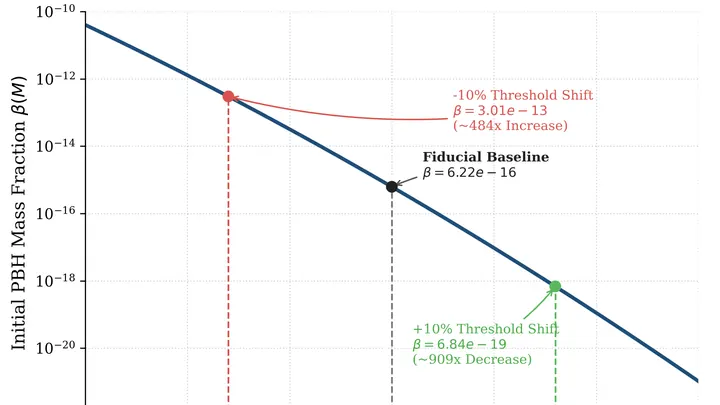
It all began not with emptiness, but with a boiling ocean of plasma. In that primordial broth, sound waves raced through the fiery matter, colliding and compressing it. Sometimes a clump grew so dense that light could no longer escape, and right out of the scorching gas, a primordial black hole was born.
Some 158 light-years away, around the dim star TOI-6894, a red dwarf, a planet moves leisurely. Its year lasts less than two Earth days, yet it is a cool world with an equilibrium temperature around 420 K, just a bit warmer than a sauna.
WASP-121 b is not just a hot ball. It's a world where iron vaporizes and the sky glows with its own heat. A fresh look at it has revealed what 'ingredients' went into making it.
The James Webb Space Telescope has for the first time clearly detected vaporized silicon monoxide in its atmosphere — a refractory substance usually locked inside dust grains.
Young Earth was a boiling sphere of liquid rock, while Theia, which crashed into it, had had time to cool and solidify. It’s like dropping a chunk of cold butter into a pot of soup: the soup splashes out, but the butter barely moves. Similarly, Earth’s interior spewed into space, forming a cloud of cosmic dust and debris.
Stars are born in cold clouds of cosmic dust and hydrogen. Inside these cocoons, protostars — the cores of future suns — were long thought to be just hot clumps. But it turns out many of them are powerful accelerators: they shoot out narrow jets of gas that, slamming into surrounding matter, produce invisible gamma-ray light.
460 light-years away, around the star HD 135344B, a dense disk of gas and dust is swirling. It looks like a giant vinyl record that someone has cracked: a gap yawns in the disk, and across it, like a slender bridge, stretches a dust filament.
The James Webb Space Telescope peered into a disk of gas and dust around a young star where planets are born, and for the first time spotted ice made of heavy water. This water is not ordinary: in its molecules, regular hydrogen is replaced by deuterium, its heavier sibling.
A thick stew slowly cools in a pot. Suddenly, the flame beneath it flares up, and the stew begins to boil, breaking into many small whirlpools. Much the same happens to the disk of gas and dust around a young star when it experiences a flare — a sudden influx of matter from the disk onto the star.
Putting together the Solar System is like crafting a high-end tasting menu: the recipe isn't always set in stone — sometimes the final ingredient is added while the dish is already cooking.
The young super-Jupiter TWA5B, a scorching ball 25 times Jupiter's mass, floats just fifty light-years away. Its faint infrared glow long hid its chemical makeup. Now, high-resolution spectroscopy with CRIRES+ has registered the ghostly trace of SiO — silicon monoxide.
In the silent theater of the cosmos, a star’s life plays out over billions of years. But sometimes an invisible director sneaks onto the stage — a primordial black hole.
The birth of planets is a cosmic forge: gas and dust compress, shock waves and harsh radiation burn away all complexity. It was thought that fragile organic threads like cyanopolyynes couldn't survive this hell.
In the heart of the Eagle Nebula, about 7000 light-years away, three giant pillars of gas and dust rise — the Pillars of Creation. Their shape is familiar to many from Hubble Space Telescope images. Now, Webb's infrared camera has allowed us to peer inside these dense cocoons where stars are born.
Imagine a spinning top the size of a city, weighing more than the Sun and making hundreds of revolutions per second. That's a neutron star — the remnant of an exploded star. Occasionally, its rotation suddenly speeds up, as if something inside has switched. Astronomers call these jumps glitches and suspect that invisible vortices in the star's superfluid interior are to blame.
The cosmic accounting has hit a snag. The bookkeeper is balancing the books: in one column, all the planets astronomers have counted in the galaxy; in the other, the stockpile of building material in the dusty cocoons of newborn stars. The numbers don't line up. Even if you gathered every last grain of dust and molded it into planets, there wouldn't be enough material.