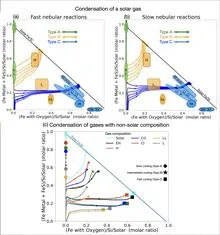
Planetary accretion chemistry is the study of the chemical processes that occur during the formation of planets from protoplanetary disks. It encompasses the condensation of solids from gas, the accretion of these solids into planetesimals and protoplanets, and the subsequent chemical differentiation and processing within these bodies. This field explains the composition of planets, including the origin of water and organic molecules, and why different planets have different volatile content.
History
The field developed in the mid-20th century with the analysis of meteorites and the formulation of condensation sequences by John Larimer and others in the 1960s-70s. The discovery of exoplanets has since provided new constraints on the diversity of planetary compositions.
How it works
The process begins with the cooling of the protoplanetary disk, where different minerals condense at different temperatures, creating a radial chemical gradient. Dust grains collide and stick together, forming larger bodies. Heating from radioactive decay and impacts causes melting and differentiation, leading to the formation of a metallic core and silicate mantle. Volatile elements, including water, can be delivered by icy planetesimals from the outer disk, while chemical reactions between the atmosphere and magma ocean can generate additional water and organics.
In practice
Understanding accretion chemistry is essential for interpreting exoplanet observations, such as the composition of their atmospheres, and for assessing the habitability of rocky worlds.
Fun fact
Water on Earth may have been partly generated by chemical reactions between hydrogen and magma in the planet's early molten interior, not solely delivered by icy comets.
Three cabinets full of rocks. In one, metallic grains and the gray mineral enstatite; in the second, the same grains but with rusty streaks; in the third, layered clays swollen with water. All three sets were pulled from meteorites that fell to Earth: chondrites. They were born in the same gas-and-dust disk around the young Sun, yet somehow turned out so different.
In the cold depths of space float rocks older than Earth itself. Inside some of them hide tiny glassy spheres — chondrules. They formed when a disk of gas and dust still swirled around the young Sun.
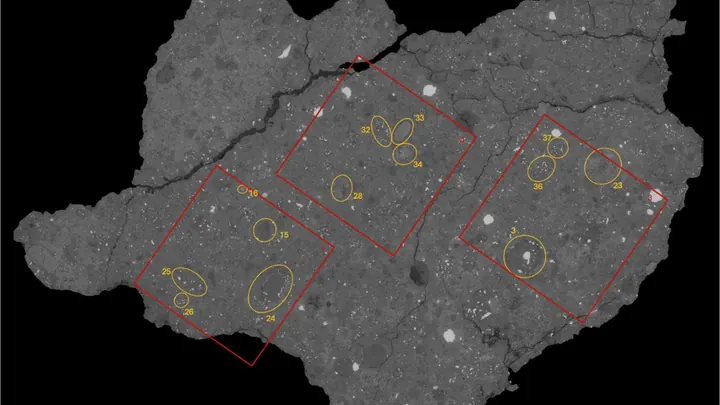
Carbonaceous meteorites Asuka 12236, Paris, and Maribo have preserved these spheres almost untouched.
Around young stars, flat clouds of gas and dust swirl: these are future planetary systems. Inside some of them, a void gapes: the dust and gas have been swept away, as if someone thinned out the middle of a vinyl record.
In the furnace of star formation, the heat reaches 900 degrees Celsius, like a glowing blast furnace. It is in this hellish heat that cosmic crystals are born. Astronomers have for the first time caught the moment when crystalline dust appears right during an accretion flare (when the star gobbles up surrounding gas) at the very young star EC 53, still cocooned in dense gas.
Seventy-two protoplanetary disks, swirling cocoons of cosmic dust and gas, came under the gaze of the MIRI instrument on JWST. Most of them shoot outflows into space: dense conical structures and narrow, high-speed jets. They blast like fountains. This process is not accidental.
The star AB Aur is young, about 4 million years old. Around it swirls a dense disk of gas and dust. Recently, a long gas stream, a flow of material from the surrounding cloud, crashed into it.
Among the scorching exoplanets that circle perilously close to their stars lies the secret of their birth. Nearly three decades ago, Michel Mayor and Didier Queloz discovered the first such world, and since then astronomers have been tormented by the question: how does a gas giant end up pressed against…
When a giant planet grows, it pulls in gas. Some of that gas swirls around it into a small disk — called a circumplanetary disk. It is in such disks that moons are thought to form. For the planet PDS 70 c, located 370 light-years away, such a disk was directly observed using the ALMA antenna array in the millimeter range.
Young Earth was a boiling sphere of liquid rock, while Theia, which crashed into it, had had time to cool and solidify. It’s like dropping a chunk of cold butter into a pot of soup: the soup splashes out, but the butter barely moves. Similarly, Earth’s interior spewed into space, forming a cloud of cosmic dust and debris.
If you squeeze water between two glass plates so that only two layers of molecules fit, it becomes something between a liquid and ice. At room temperature, molecules in such a trap still move but arrange themselves into a semblance of a crystal lattice.
The James Webb Space Telescope peered into a disk of gas and dust around a young star where planets are born, and for the first time spotted ice made of heavy water. This water is not ordinary: in its molecules, regular hydrogen is replaced by deuterium, its heavier sibling.
A thick stew slowly cools in a pot. Suddenly, the flame beneath it flares up, and the stew begins to boil, breaking into many small whirlpools. Much the same happens to the disk of gas and dust around a young star when it experiences a flare — a sudden influx of matter from the disk onto the star.
Putting together the Solar System is like crafting a high-end tasting menu: the recipe isn't always set in stone — sometimes the final ingredient is added while the dish is already cooking.
Chondrules look like frozen raindrops made of stone. They're about the size of a grain of sand, but they record the history of the first few million years of the Solar System. Once, these droplets floated in the scorching gas around the young Sun, then clumped into asteroids and fell to Earth as meteorites.
Long protein threads, their tangled entanglements, and random contacts: this is how the birth of cellular droplets was usually explained. These membrane-less organelles, where important reactions take place, resemble oil drops in water: they arise on their own when molecules separate into phases.
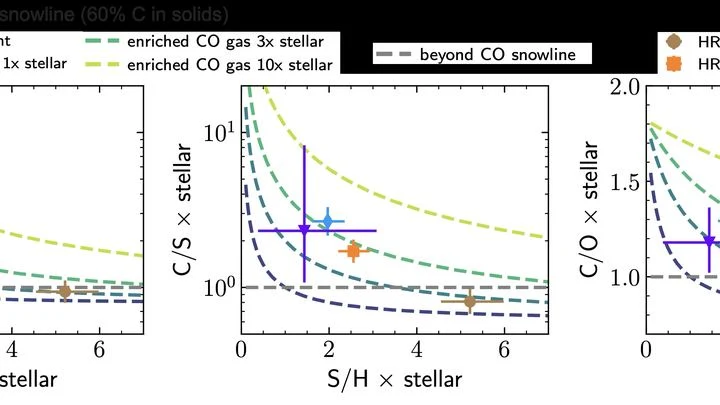
In the cold outer reaches of the Solar System, water is considered the main building material for ices. But some comets and distant icy bodies have an unusually high ratio of carbon monoxide (CO) to water, as if a scoop of ice cream suddenly had too much syrup. The authors of a new study set out to find where this imbalance comes from.
Planets are born from dust. In a disk around a young star, tiny dust grains collide, stick together, and gradually grow like a snowball rolling down a hill. But there's a catch: the gas in the disk moves faster than the dust and drags on it, preventing it from clumping into large chunks.
For dust to stick together, there needs to be enough of it.
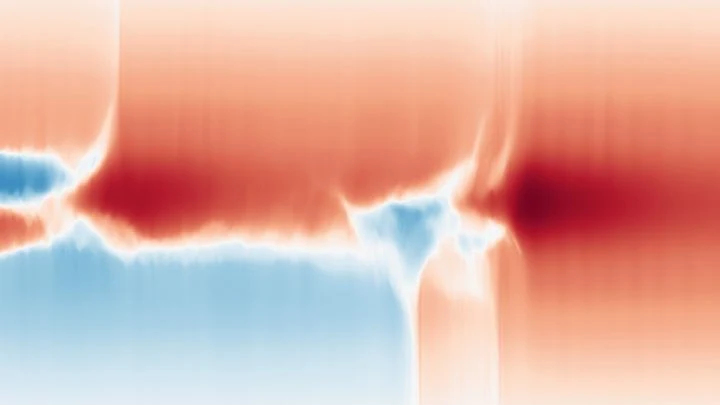
In a protoplanetary disk, a cloud of gas and dust around a young star, dust grains don't just fly in circles. They are carried by the gas flow, like sand by the wind, and in turn alter that flow. Layers emerge, sliding past each other, and at their boundaries an instability arises — waves and vortices.
A young planet in a gas disk is like a swimmer trying to swim against the current: friction with the gas slows it down, and it spirals toward the star. For small rocky planets, this fall can take less time than they need to grow. But the disk also has countercurrents — vortices that can push the planet outward.
Scientists built a computer model of a disk around a young star.
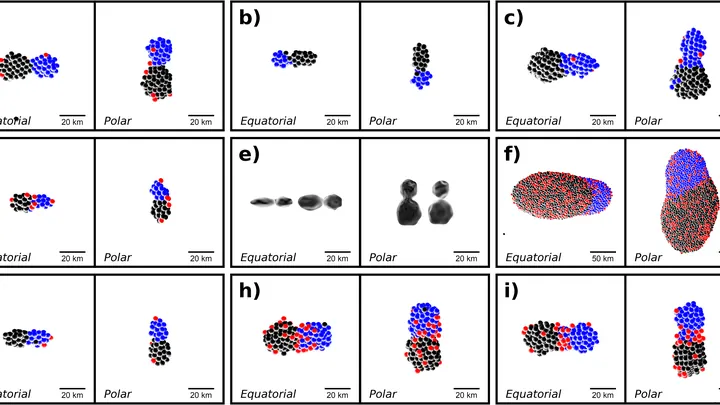
The icy body Arrokoth looks like a snowman: two spheres pressed together. Many such two-headed objects exist beyond Neptune's orbit, in the Kuiper Belt. For a long time, it was thought they formed from the slow collision of two separate bodies.
New simulations show a different path. A cloud of small pebbles around the young Sun collapses under its own gravity.
Life may be hiding in the oceans beneath the ice of Europa, Ganymede, and Callisto. Its carbon-based building blocks perhaps baked before the moons were born — in a disk of gas and dust around a young Jupiter. This giant cosmic oven ran on slow frictional heating, not harsh ultraviolet light.
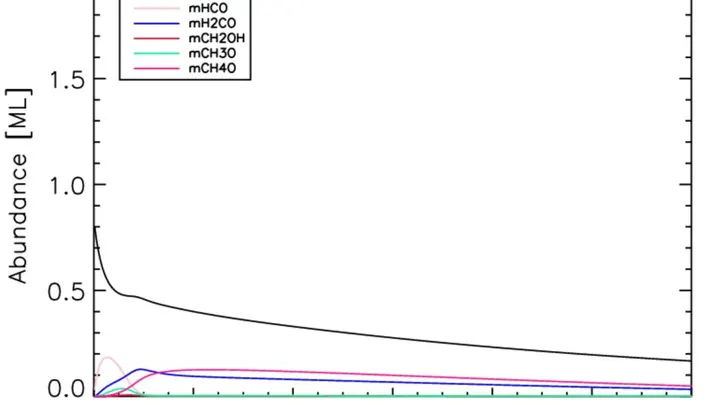
In a dark, cold cloud between the stars, a dust grain a thousandth of a millimeter across catches light molecules. Carbon monoxide and hydrogen stick to its surface like raindrops to glass and react. After a few steps, methanol is produced — the same alcohol found in windshield washer fluid.
130 light-years away, four giant planets orbit the young star HR 8799—each 5 to 10 times more massive than Jupiter. They lie far from the star, at distances from 15 to 70 astronomical units (one astronomical unit is the distance from Earth to the Sun).
Around young stars, flat clouds of gas and dust swirl: these are the birthplaces of planets. For matter in such a disk to clump together, it must be constantly stirred. But what makes the gas move chaotically when it would otherwise be calm? Part of the answer lies in the fact that the gas in the disk barely conducts electricity: it is weakly ionized.
Around the star HD 163296, 330 light-years away, a dense ring of gas and dust is swirling. Astronomers have spotted a small but bright patch of hydrogen cyanide and ethynyl molecules within it. It hangs at a distance of 88 astronomical units from the star — farther than Pluto is from the Sun.
The heat from a forming planet hidden in that patch melts the icy dust.
Around a young star spins a flat pancake of gas and dust — the future building blocks of planets. The star heats it with ultraviolet radiation, and gas from the disk's surface escapes into space, like water from a puddle under the sun.
A young planet grows like a snowball rolling down a slope: countless small pebbles from the surrounding gas disk stick to it. The larger it gets, the stronger it pulls in gas — hydrogen and helium. A dense, hot envelope forms around it. Pebbles falling through it heat up from friction and their own weight, like grains of sand falling into thick honey.
Sub-Neptunes — worlds slightly smaller than Neptune — are common among exoplanets. They are detected using the transit method (by the dimming of a star), pioneered by William Borucki.
The most common type of planet in our Galaxy — rocky worlds around other stars, or exoplanets, shrouded in the simplest gas hydrogen. Their innards remained a mystery until scientists recreated the conditions of the interior in the lab.