Protoplanetary disk winds are outflows of gas from the rotating disks of dust and gas around young stars, from which planets form. These winds are not a single phenomenon but a class of mechanisms that remove material from the disk, shaping its mass, size, and chemical composition. They play a critical role in the evolution of the disk and therefore in the conditions under which planets assemble, migrate, and retain their atmospheres.
History
The concept of disk winds emerged in the 1980s from theoretical work on angular momentum transport in accretion disks, with photoevaporation models developed in the 1990s. Observations of molecular outflows and ionized gas in star-forming regions have since provided strong evidence.
How it works
The winds are driven by magnetic fields or high-energy radiation from the central star. Magnetically driven winds arise because the disk's ionized gas is threaded by magnetic field lines that rotate with the disk; centrifugal forces fling material outward along these lines, carrying away angular momentum. Photoevaporation, by contrast, occurs when X-rays and ultraviolet light from the star heat the disk's outer layers, causing gas to escape thermally. Both processes remove gas that would otherwise be incorporated into planets or affect their orbits.
In practice
Disk winds are key inputs for models of planet formation and migration, helping explain the observed mass distribution of exoplanets and the clearing of gas from young planetary systems.
Fun fact
The same magnetic mechanism that drives protoplanetary disk winds also powers the jets seen shooting from young stars, which can extend for light-years.
The JWST space telescope aimed its lens at the scorching rocky world 55 Cancri e, and spotted a dense gas envelope. But the cooler TRAPPIST-1 b, which orbits a dim red dwarf, showed no envelope: just bare rock. The picture came out upside down: hot planets hold onto atmospheres, while cooler ones lose them.
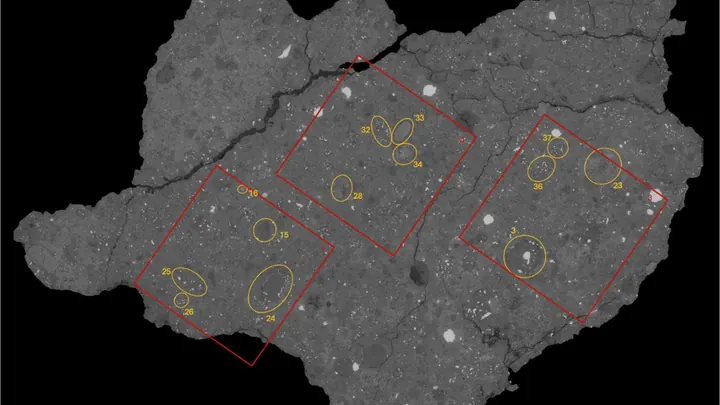
In the cold depths of space float rocks older than Earth itself. Inside some of them hide tiny glassy spheres — chondrules. They formed when a disk of gas and dust still swirled around the young Sun.
Carbonaceous meteorites Asuka 12236, Paris, and Maribo have preserved these spheres almost untouched.
The solar wind is a stream of charged particles constantly blown off the Sun's surface, filling the entire solar system. It's not like a steady breeze: it has eddies, gusts, and calm patches. Scientists call this turbulence.
In the dark kitchen of the Taurus molecular cloud, 450 light-years away, dozens of planetary systems are being prepared. Each young star is a chef, and its protoplanetary disk is a counter piled with flour-like dust and steam-like gas.
After a supernova explosion, a dense ball the size of a city remains at the center — a newborn neutron star. It is hot, compressed, and rings like a bell after being struck. These tremors, the star's oscillations, emit gravitational ripples that sensitive detectors on Earth can catch.
The birth of a moon is a cosmic car crash. Two young planets collide, and a cloud of scorching debris swirls around the surviving world. From this disk, like clay on a potter's wheel, a satellite gradually takes shape. That's probably how our Moon came to be.
A disk of gas and dust spins around the young star HV Tau C, nearly edge-on to us. The James Webb Space Telescope examined its spectrum and detected the glow of hot molecular hydrogen (H₂). This revealed a wide, bipolar wind blasting from the inner regions far beyond the disk.
The fastest wind in the Universe travels at 0,58 times the speed of light. It covers the distance from Earth to the Moon in two seconds. This wind is not a jet stream but a broad flow of gas erupting from the center of a galaxy. Not all black holes work the same: some create such hurricanes, while others produce narrow plasma beams.
Seventy-two protoplanetary disks, swirling cocoons of cosmic dust and gas, came under the gaze of the MIRI instrument on JWST. Most of them shoot outflows into space: dense conical structures and narrow, high-speed jets. They blast like fountains. This process is not accidental.
89 milliseconds. That's how long a vortex avalanche lasts that abruptly speeds up the rotation of the Vela pulsar — one of the most famous 'glitching' pulsars. Pulsars are rapidly spinning neutron stars born in the collapse of supernovae.
In a single star system, two teams of planets orbit. Some follow neat paths, like figure skaters on an ice rink, avoiding collisions. Others crowd together, their trajectories cross, and sooner or later a cosmic accident occurs — a giant impact.
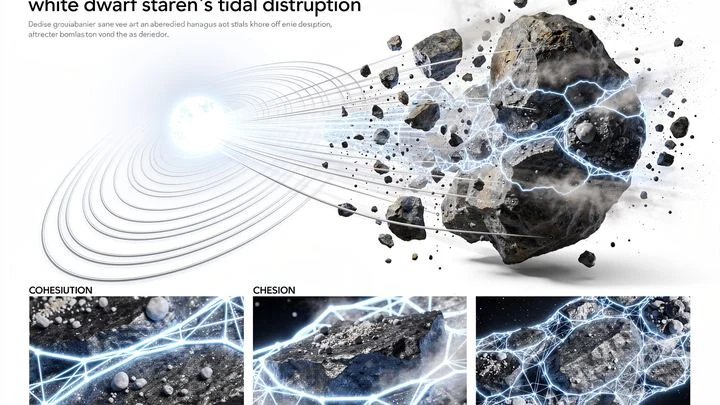
Like an exquisite clockwork mechanism, a multi-planet system responds sensitively to the slightest nudge. And when the star at the heart of this mechanism dies, shedding its envelope and turning into a white dwarf, even a modest kick at a speed of 0.75 km/s can trigger a cascade of events, flinging entire worlds into interstellar emptiness.
Massive gas outflows from active galactic nuclei are a key regulator of galactic evolution. They sweep out the interstellar medium, quench star formation, and dictate the growth of supermassive black holes.
A pot of porridge boiling over a high flame: bubbles carry grains from the bottom to the surface. A similar mechanism works on a neutron star. As it accumulates hydrogen and helium from a companion star, it occasionally triggers a powerful nuclear explosion — an X-ray burst.
A pot of boiling soup is shaken hard — the liquid sloshes, waves crash against the walls. Something similar happens inside a gas planet when it swings past its star on an elongated orbit. The star's gravity excites powerful internal waves in the planet, known as tidal fundamental modes. These waves can completely change the planet's fate.
A vast city lights new streetlamps every night. But then a hurricane sweeps in, rips all the fuel from the warehouses, and the lamps go out one by one. Something similar has been spotted by astronomers in a galaxy whose light has traveled 12.5 billion years to reach us.
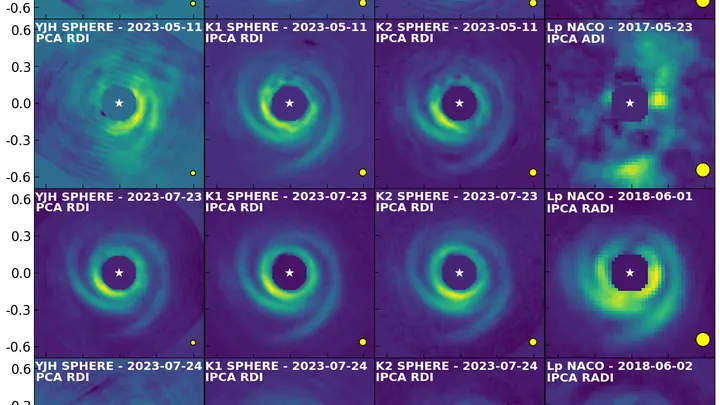
460 light-years away, around the star HD 135344B, a dense disk of gas and dust is swirling. It looks like a giant vinyl record that someone has cracked: a gap yawns in the disk, and across it, like a slender bridge, stretches a dust filament.
A thick stew slowly cools in a pot. Suddenly, the flame beneath it flares up, and the stew begins to boil, breaking into many small whirlpools. Much the same happens to the disk of gas and dust around a young star when it experiences a flare — a sudden influx of matter from the disk onto the star.
The paradox of the young solar wind has long puzzled heliophysicists. Measurements showed that near the Sun, proton beams aren’t smeared out but sharply compressed, as if someone had neatly hammered them into the shape of a hammerhead.
When a telescope catches the light of a distant white dwarf, the spectrograph sometimes fishes out heavy elements — calcium, iron, magnesium. These metals could not have stayed in the thin atmosphere of the stellar remnant; they are the traces of recently fallen planetary debris.
In an orchestra, each musician plays their own part, but at a certain moment all instruments pause on a single note. Cosmic rays behave somewhat like this — particles flying toward us from distant stars.
A black hole rips apart a star, and we see a dazzling flare. Then, a couple of years later, when everyone has forgotten about it, radio telescopes suddenly pick up a new signal, like an echo from the past.
The cosmic accounting has hit a snag. The bookkeeper is balancing the books: in one column, all the planets astronomers have counted in the galaxy; in the other, the stockpile of building material in the dusty cocoons of newborn stars. The numbers don't line up. Even if you gathered every last grain of dust and molded it into planets, there wouldn't be enough material.
A pot of boiling porridge, where instead of grains there are layers of oxygen and silicon, and the fire beneath is about to go out, and the star will collapse in on itself. Until now, astrophysicist cooks have used a simplified recipe: they assumed that bubbles and eddies in the porridge obey one and the same average temperature throughout the depth.
In a city park, trees grow faster than in a deep forest — not because the soil is better, but because branches collide and seeds are exchanged more often. Galaxies in the Spiderweb protocluster behave much the same way. This vast clump of matter will become a mature cluster billions of years from now.
A massive star collapses, and a black hole is born, surrounded by a disk of incandescent plasma. For narrow jets to burst out of this disk, an ordered magnetic field is needed. But inside the star, it's tangled.
The first exoplanet was discovered around an unusual cosmic lighthouse — a neutron star known as a pulsar. These ultra-dense remnants of dead stars spin at tremendous speeds and emit precise radio pulses.
A huge rotating pancake of gas and dust surrounds a young star. In such a "maternity ward" for planets, rings and gaps are often seen, as if an invisible plow had carved furrows. These are usually attributed to already-formed planets that clear paths with their gravity.
A spinning top that wobbles as it rotates: that's roughly how astronomers picture the neutron star in the binary system Hercules X-1. It completes one full turn on its axis every second, but its axis slowly traces a cone with a period of 35 days.
Planet WASP-121 b always shows the same face to its star, like a rock in a campfire. The dayside is so hot that ordinary hydrogen, the very stuff most of the universe is made of, can't take it: its molecules tear apart into individual atoms, and the temperature flips upside down: the higher you go, the hotter it gets.
Chondrules look like frozen raindrops made of stone. They're about the size of a grain of sand, but they record the history of the first few million years of the Solar System. Once, these droplets floated in the scorching gas around the young Sun, then clumped into asteroids and fell to Earth as meteorites.
Around small, cool, but extremely restless red dwarfs, planets the size of Earth often orbit. Such a star is like a temperamental stove that intermittently erupts flares: powerful streams of light and particles batter the planet's atmosphere, as if someone splashed fire into a simmering soup pot.
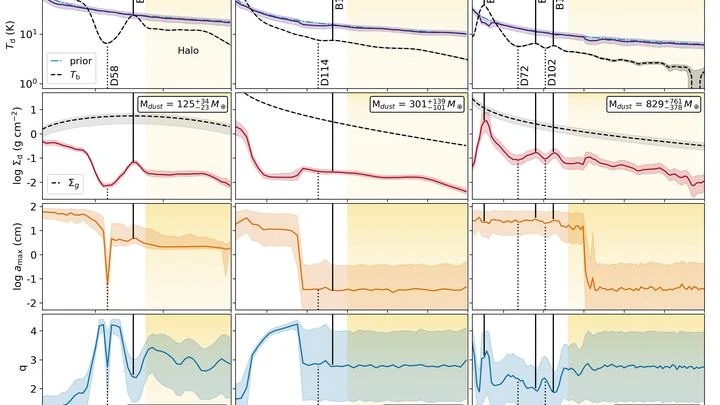
A young star is surrounded by a flat, rotating disk of gas and dust, like pizza dough that's been spun out. Planets are born inside such a disk. But around three stars (Elias 2-24, IM Lup, and DM Tau) astronomers noticed something odd: far beyond the edge of the bright disk stretches a barely visible but enormous dust halo.
The solar wind isn't a smooth flow: it's gusty. Inside it, protons and helium nuclei don't all travel at the same speed; they spread out like droplets in a hose stream. Usually, this spread is described by a simple bell-shaped curve.
In a disk of gas and dust around a young star, dust particles behave like sand grains in a stream of water: the gas flows faster, the dust lags behind, and friction arises between them. This friction can rock the magnetic waves that run through the disk. The galaxy is full of such disks: it is precisely in them that planets are born.
Around young stars, flat clouds of gas and dust swirl, like pizza dough from which planets will eventually be shaped. This cloud contains various chemical elements, and sulfur is one of the most elusive: it's hard to catch with telescopes because it hides in solid grains or escapes as gas.
A newborn star is like a kitchen mixer: it whips up the surrounding cloud, and splatters fly in all directions. Only instead of batter, it's gas and dust. Previously, astronomers had only seen gas jets, and dust was considered too fragile: the shock wave should shatter dust grains into atoms.
In cold clouds of interstellar gas, long, dense filaments stretch out. Inside them, like overcrowded incubators, future stars are maturing. For a long time, it was thought that within such filaments, everything was governed by gravity: matter smoothly flows toward the centers, where density increases and eventually a star ignites.