Planetary composition and formation is the study of how the chemical makeup of planets is determined by the properties of their host star and the processes occurring in the protoplanetary disk — the swirling disk of gas and dust from which planets form. The star's mass, temperature, luminosity, and metallicity (its abundance of elements heavier than hydrogen and helium) dictate the conditions in the disk, including temperature gradients and radiation pressure, which in turn influence which materials can condense and accrete into planets. This explains why some planets are rocky, some are gas giants, and why certain elements like sulfur or carbon are enriched or depleted in different planetary systems.
History
The modern understanding emerged in the 1970s–1980s with the nebular hypothesis refined by researchers like Viktor Safronov and George Wetherill, who developed planetesimal accretion models. The first confirmed exoplanet in 1992 and subsequent surveys like Kepler in the 2000s provided observational constraints that reshaped the field.
How it works
The star's radiation and stellar wind sculpt the disk, creating a temperature gradient: closer to the star, only refractory materials like silicates and metals can solidify, while volatile compounds like water and methane remain gaseous. Farther out, ices condense, allowing the formation of massive cores that can accrete gas. The star's composition also matters — a star rich in heavy elements seeds the disk with more solid material, promoting the formation of rocky planets. Processes like photoevaporation (the star's radiation stripping gas from the disk) and radial drift of solid particles further sort materials by location, leaving a chemical fingerprint in the planets that form.
In practice
This knowledge guides the search for habitable exoplanets by predicting which stars and orbital distances are likely to host Earth-like compositions, and it informs models of our own solar system's formation.
Fun fact
A star's sulfur abundance can act as a 'fossil record' of the building blocks that formed its planets, because sulfur is volatile enough to be lost from hot inner regions but preserved in cooler outer zones.
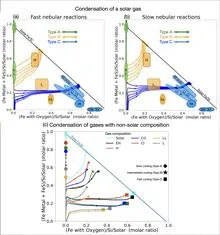
Three cabinets full of rocks. In one, metallic grains and the gray mineral enstatite; in the second, the same grains but with rusty streaks; in the third, layered clays swollen with water. All three sets were pulled from meteorites that fell to Earth: chondrites. They were born in the same gas-and-dust disk around the young Sun, yet somehow turned out so different.
Deep inside a sub-Neptune, where pressures reach a hundred thousand bars and temperatures hit four thousand degrees, rock behaves like boiling soup. Heavy vapors of silicon and magnesium rise, cool, and fall back as a rain of solid particles.
Two stars, AF Lep A and ε Indi A, have become the focus of close attention. Using the GHOST spectrograph on the Gemini telescope, astronomers split their light into colors and, from absorption lines, determined how much carbon, oxygen, sulfur, and thirteen other elements are in the stars' atmospheres.
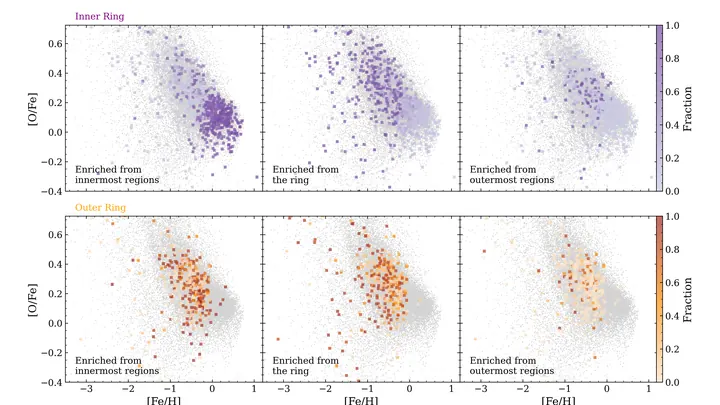
The night sky seems unchanging, but galaxies constantly exchange matter. The Milky Way, like a great river, absorbs smaller streams — dwarf galaxies. Along with their stars, planets may also come to us.
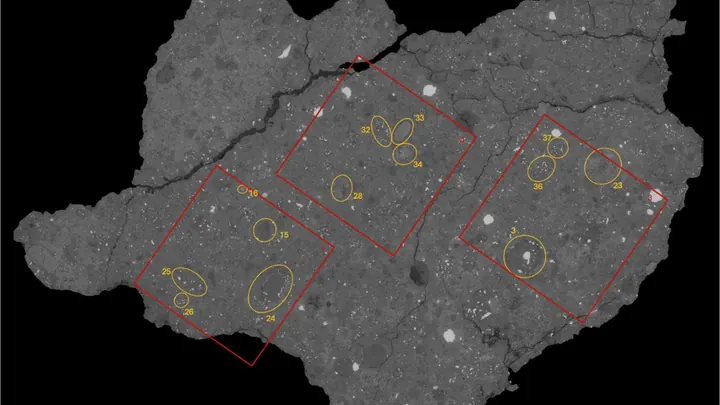
In the cold depths of space float rocks older than Earth itself. Inside some of them hide tiny glassy spheres — chondrules. They formed when a disk of gas and dust still swirled around the young Sun.
Carbonaceous meteorites Asuka 12236, Paris, and Maribo have preserved these spheres almost untouched.
Around young stars, flat clouds of gas and dust swirl: these are future planetary systems. Inside some of them, a void gapes: the dust and gas have been swept away, as if someone thinned out the middle of a vinyl record.
A star is not just a distant sun. It's a cradle for planets, and its light carries the birth story of the entire system. The chemical composition of a star is its DNA. Astronomers peer into this DNA to understand why some stars host rocky worlds like Earth, while others host gas giants.
Seventy-two protoplanetary disks, swirling cocoons of cosmic dust and gas, came under the gaze of the MIRI instrument on JWST. Most of them shoot outflows into space: dense conical structures and narrow, high-speed jets. They blast like fountains. This process is not accidental.
The star AB Aur is young, about 4 million years old. Around it swirls a dense disk of gas and dust. Recently, a long gas stream, a flow of material from the surrounding cloud, crashed into it.
A star's age is the key to the galaxy's history. But prying that key from nature is no simple task: unlike a tree, a star doesn't grow annual rings. Yet, its atmosphere holds a chemical code — the ratio of elements that slowly shifted as generations of stars died and new ones were born.
Among the scorching exoplanets that circle perilously close to their stars lies the secret of their birth. Nearly three decades ago, Michel Mayor and Didier Queloz discovered the first such world, and since then astronomers have been tormented by the question: how does a gas giant end up pressed against…
When the JWST telescope breaks the light of a distant exoplanet into a spectrum, it reads a chemical chronicle. But this chronicle is not a monolithic truth; it's an atmosphere constantly rewritten by the star's radiation.
Around some young stars where star formation has recently ended, there swirl not just dust rings but actual planetary battlefields — extreme debris disks.
Forget the familiar images of planetary cores — a sharp boundary between rock and gas is a thing of the past. The Juno probe, diving into Jupiter’s gravitational field, and Cassini, into the embrace of Saturn, discovered that heavy elements are not gathered at the center but smeared over a vast region, as if someone carelessly shook a cocktail.
Deep space, galactic center. A supermassive black hole is surrounded by a scorching disk of gas and dust. And then, through this fiery veil, a star shoots by every few hours — like an arrow loosed from the bow of gravity. Each passage triggers a dazzling X-ray flare that for a moment outshines the entire galactic nucleus.
Neutron stars — remnants of supernovae — are among the densest objects in the Universe. Their central density exceeds nuclear density many times over, and gravity is surpassed only by black holes.
When a giant planet grows, it pulls in gas. Some of that gas swirls around it into a small disk — called a circumplanetary disk. It is in such disks that moons are thought to form. For the planet PDS 70 c, located 370 light-years away, such a disk was directly observed using the ALMA antenna array in the millimeter range.
For years, the Sun teased astrophysicists. In its atmosphere, refractory elements, like spices in a basic recipe, were slightly less abundant than in nearly identical twin stars. Suspicion arose: could our star be modest, skipping the planetary "dessert" that others devour with gusto?
Like an exquisite clockwork mechanism, a multi-planet system responds sensitively to the slightest nudge. And when the star at the heart of this mechanism dies, shedding its envelope and turning into a white dwarf, even a modest kick at a speed of 0.75 km/s can trigger a cascade of events, flinging entire worlds into interstellar emptiness.
At the center of attention are tiny stellar cities: ultra-faint dwarf galaxies. They resemble sparse swarms of fireflies circling within a vast invisible cloud. This cloud is a halo of ultralight dark matter. Its particles are so light that they behave not like billiard balls but like waves.
WASP-121 b is not just a hot ball. It's a world where iron vaporizes and the sky glows with its own heat. A fresh look at it has revealed what 'ingredients' went into making it.
The James Webb Space Telescope has for the first time clearly detected vaporized silicon monoxide in its atmosphere — a refractory substance usually locked inside dust grains.
At the center of a distant galaxy, a supermassive black hole is surrounded by a flat, rotating disk of gas and dust — a giant cosmic funnel of matter. A small compact object, such as another stellar-mass black hole, may find itself in this disk.
The James Webb Space Telescope peered into a disk of gas and dust around a young star where planets are born, and for the first time spotted ice made of heavy water. This water is not ordinary: in its molecules, regular hydrogen is replaced by deuterium, its heavier sibling.
A thick stew slowly cools in a pot. Suddenly, the flame beneath it flares up, and the stew begins to boil, breaking into many small whirlpools. Much the same happens to the disk of gas and dust around a young star when it experiences a flare — a sudden influx of matter from the disk onto the star.
Putting together the Solar System is like crafting a high-end tasting menu: the recipe isn't always set in stone — sometimes the final ingredient is added while the dish is already cooking.
The cosmic accounting has hit a snag. The bookkeeper is balancing the books: in one column, all the planets astronomers have counted in the galaxy; in the other, the stockpile of building material in the dusty cocoons of newborn stars. The numbers don't line up. Even if you gathered every last grain of dust and molded it into planets, there wouldn't be enough material.
A huge rotating pancake of gas and dust surrounds a young star. In such a "maternity ward" for planets, rings and gaps are often seen, as if an invisible plow had carved furrows. These are usually attributed to already-formed planets that clear paths with their gravity.
If you don’t stir a layered cocktail, the heavy syrup sinks to the bottom. A young planet is much the same — a seething ocean of molten rock. As it cools, minerals crystallize: some, like iron, get heavy and sink, while others float. You’d think a dense layer would pile up at the core.
A patchy landscape isn't just a picture from a geography textbook. For microbes, cells, or animals, the world is a mosaic of patches: warmer here, more food there, and behind that rock — almost poison. When a mutant with a new trait appears in such a mosaic, its fate depends on which patch it lands on.
This new work ties two factors together.
Imagine a spring being compressed with tremendous force. The harder you press, the denser it gets, but at some point the compression stops being uniform — some parts give way more easily, others are stiffer. That's roughly how the matter inside a neutron star behaves — an object born in the flames of a supernova.
Chondrules look like frozen raindrops made of stone. They're about the size of a grain of sand, but they record the history of the first few million years of the Solar System. Once, these droplets floated in the scorching gas around the young Sun, then clumped into asteroids and fell to Earth as meteorites.
The Red Planet is surrounded by the rubble of failed worlds — rocky boulders stuffed with metal. Shipping a kilogram of steel from Earth to Mars costs as much as several cars. It's far cheaper to pick up space junk right in orbit.
In a disk of gas and dust around a young star, dust particles behave like sand grains in a stream of water: the gas flows faster, the dust lags behind, and friction arises between them. This friction can rock the magnetic waves that run through the disk. The galaxy is full of such disks: it is precisely in them that planets are born.
Around young stars, flat clouds of gas and dust swirl, like pizza dough from which planets will eventually be shaped. This cloud contains various chemical elements, and sulfur is one of the most elusive: it's hard to catch with telescopes because it hides in solid grains or escapes as gas.
A star inherits the chemical makeup of its parent gas cloud, just like a child inherits genes from its parents. Astronomers turned this into a method: by measuring the fraction of carbon and other elements with spectroscopy (splitting light into colors), they construct family trees for the stars in a galaxy.
A baker adds more sugar to the dough, and the pie turns out different. So it is with a star: the composition of its "dough"—the cloud of gas and dust from which planets are born — determines what worlds will form around it.
At night, a distant streetlamp seems motionless, but if you walk closer and look carefully, you might notice it swaying slightly in the wind. That's roughly how astronomers hunt for planets around other stars: they measure how a star shifts ever so slightly under the gravitational tug of its invisible companions.
Two very small, cool stars, similar to the famous TRAPPIST-1, reside in the young Upper Scorpius star cluster. They are only 5–10 million years old — by cosmic standards, mere infants. Each is surrounded by a disk of gas and dust from which planets may eventually assemble.
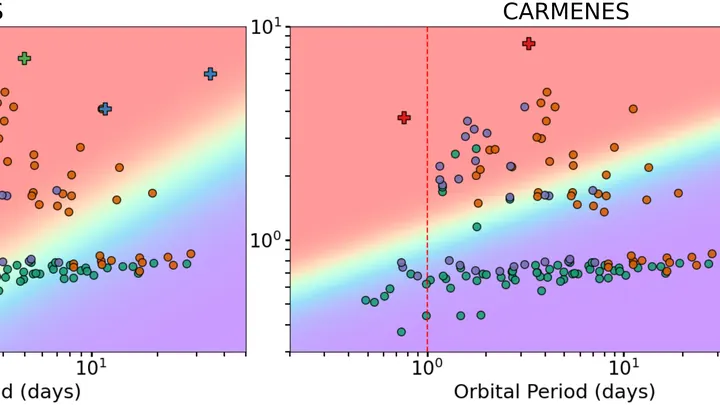
Rocky planets orbit dim red stars. Some of them have a year shorter than an Earth day: these worlds are called ultra-short-period planets. Their surfaces are scorching, and their skies are forever bathed in crimson light.
In the cold outer reaches of the Solar System, water is considered the main building material for ices. But some comets and distant icy bodies have an unusually high ratio of carbon monoxide (CO) to water, as if a scoop of ice cream suddenly had too much syrup. The authors of a new study set out to find where this imbalance comes from.