Counting the Participants in a Nuclear Collision express
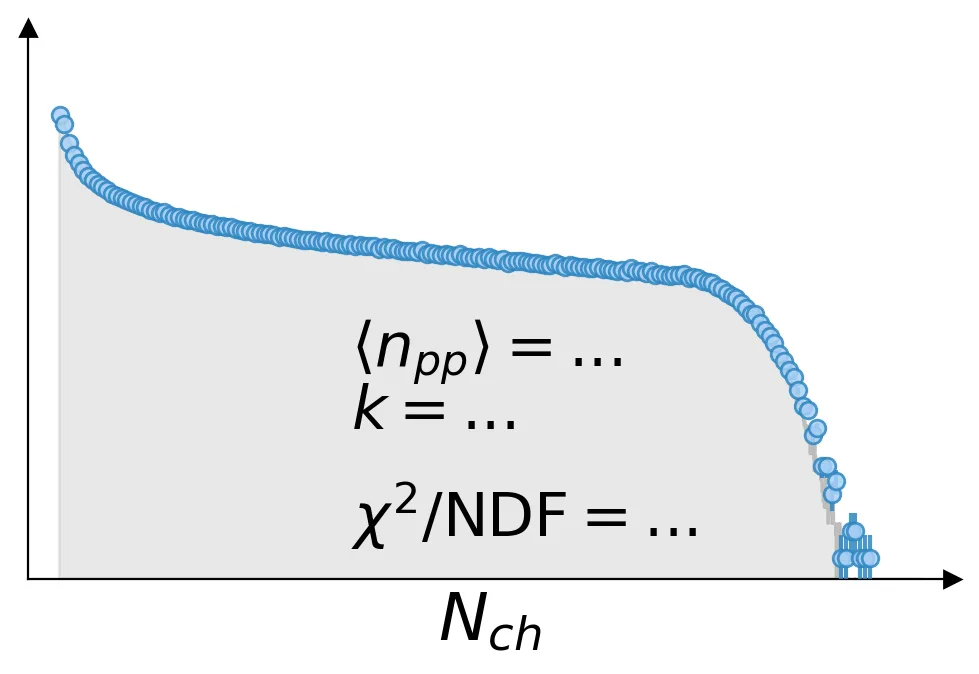
When two heavy nuclei smash into each other at enormous speeds, they don't collide as whole objects like billiard balls. Only part of their matter comes into contact. How many nucleons (protons and neutrons) actually took part in the collision, and how many flew past, is not known in advance. All subsequent measurements depend on this number, but it cannot be observed directly.
Previously, events were sorted by the number of produced charged particles: many particles meant a head-on collision, few meant a glancing one. But this sorting is crude. Events with the same number of particles can have different numbers of participants. It's like trying to guess the size of a kitchen from the number of guests at a party: sometimes a small room is crowded, and a large one is spacious.
The new method works differently. Instead of assigning each event a single class, it computes the probability for each possible number of participants and binary collisions. This uses a known model of how nuclei overlap and statistics of how many particles are typically produced for a given number of participants. The result is not a hard label but a probability distribution.
This approach removes some of the uncertainty that was previously masked as event "centrality." Now we can honestly say: we don't know the exact number of participants, but we know how likely each value is. It's like going from a black-and-white photo to a grayscale one — details become visible even if the focus isn't perfect.
In a single collision of two gold nuclei, up to 400 nucleons can participate, and the number of produced charged particles can reach several thousand.