The binomial distribution describes the number of successes in a fixed number of independent yes-or-no trials, each with the same probability of success. For example, flipping a coin 10 times and counting heads follows a binomial distribution with parameters n=10 and p=0.5. It is one of the most fundamental discrete probability distributions, serving as the basis for many statistical tests and models.
History
The distribution was introduced by Jacob Bernoulli in his 1713 work 'Ars Conjectandi', where he proved the first version of the law of large numbers.
How it works
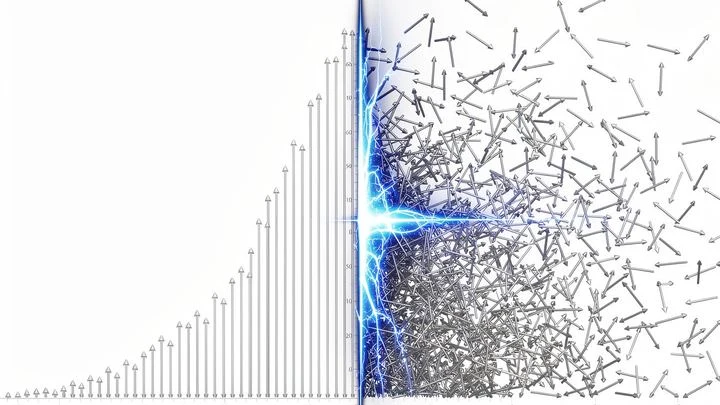
The probability of getting exactly k successes in n trials is given by the formula P(k) = C(n,k) * p^k * (1-p)^(n-k), where C(n,k) is the number of ways to choose k successes from n trials. The distribution is characterized by its mean (n*p) and variance (n*p*(1-p)). As n grows large, the binomial distribution approaches a normal distribution, a key result used in many approximations.
In practice
It is used in quality control (e.g., number of defective items in a batch), clinical trials (e.g., number of patients responding to a drug), and A/B testing in web analytics.
Fun fact
The binomial coefficient C(n,k) appears in Pascal's triangle, and the distribution's shape can be symmetric, skewed, or even U-shaped depending on p.
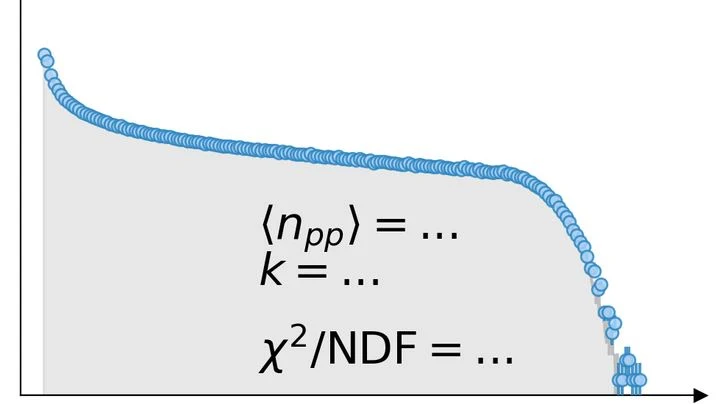
When two heavy nuclei smash into each other at enormous speeds, they don't collide as whole objects like billiard balls. Only part of their matter comes into contact. How many nucleons (protons and neutrons) actually took part in the collision, and how many flew past, is not known in advance. All subsequent measurements depend on this number, but it cannot be observed directly.
A hundred thousand stars in the dense core of a globular cluster move like steel balls in a giant pinball machine. Each 'bump' — a gravitational encounter between a binary system and a single star — triggers a cascade of unpredictable events.
The mergers of black holes, first predicted by Karl Schwarzschild, are the main source of gravitational waves picked up by LIGO detectors. Over the years, 259 events have accumulated, each one an encrypted birth story of a pair. But is there a hidden system in this data?
In mathematics there is a sieve that sifts not dust, but infinity itself. It’s called a Q-space: here any subset turns out to be a Gδ set — a countable intersection of open sets, as if sifted through an unimaginably fine mesh.
On a topographic map, raindrops choose their path: falling on one slope, they flow into River A; on the other, into River B. An observer sees only the winding rivers (the response variables Y) and knows which slope the water came from (the instrument Z), but cannot see the drops themselves (the unobserved factors ε).
A lab robot counts molecules, and gets it wrong. One tube shows 0, another 12, a third 3, though in reality they all hold roughly the same amount. Such 'raw' numbers are common in biology: DNA sequencing, counting species in a water sample, gene activity. There's plenty of data, but it's sparse and more scattered than simple randomness would predict.
We're used to thinking that noticing only confirmations of our guesses is a mistake. But recent calculations, inspired by wave behavior, flip that view. It turns out that the habit of seeking the familiar is the best way to reduce information noise (scientists call it entropy).
Waves sort pebbles on a sandy beach. Small stones lie close together, nearly identical in size. Farther from shore, there's a scatter of larger and more varied ones. And right at the waterline, where the surf is strongest, the biggest and most rounded fragments pile up. Nature sorts black holes by mass in much the same way when they merge in pairs.
In space, merging black hole pairs are common, and often one is noticeably more massive than the other. This mass difference isn't just a number: it's a key to their shared history.
Astrophysicists studied the stable mass transfer channel — a process where matter flows smoothly from one star to another without disrupting the system.
After a game of Scrabble, the board looks like a mosaic: tiles are scattered but form a connected pattern — islands of words in a sea of empty cells. Such a pattern can be described mathematically, but usually that requires complex rules.
Three people sit in three corners of a room. Each receives a sealed envelope from an invisible courier, but the couriers do not coordinate and have never met. The people open the envelopes and see a note with one word: "yes" or "no." They choose nothing themselves: they just read.
A thin film for a solar cell or display is like a dense crowd in a square: each person faces a different direction, and whether light passes through the crowd or gets stuck depends on which way everyone is looking. In organic electronics, molecules play the role of passersby. Until now, instruments could only measure the crowd's overall direction — the average head tilt and its spread.
Comparing two scents is easy even without knowing their ingredients, just tell if they're alike. This everyday principle became the foundation for a new class of Bell inequalities, reimagining tests of the spooky connection between particles. Previously, you had to measure precise properties, like spin direction, but the authors showed that simply comparing outcomes is enough.