physics.data-an physics.data-an

58 articles

articles

Hidden Rhythms of El Niño: What Daily Data Reveal
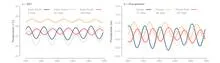
A barometer on the island of Tahiti and a barometer in the Australian city of Darwin show different pressures. Subtract one from the other, and you get a number that climatologists call the Southern Oscillation Index. It changes every day, but within these daily jumps hide steady rhythms, just as the beats of a metronome hide within the noise of an orchestra.
El Niño's Seasonal Pulse: How Delayed Ocean Waves Lock the Phase
The ocean is like a pendulum with a memory. A push from seasonal winds returns not immediately but months later, when a wave crosses the Pacific. This delay, the authors argue, is what makes El Niño and La Niña repeatedly peak at the same time of year.
Climate Networks Untangle El Niño Types
Picture a giant spiderweb stretched across thousands of points on Earth's surface. Each strand connects two places where air temperatures move in sync: if one node warms, so does the other. You can build this web from data for any given year, then compare how it looked across different years.
Percolation as a Precursor to Transition
In 1988, the surface temperature of the Pacific Ocean began to change long before meteorologists declared the onset of El Niño. Points on the map scattered along the equator started behaving in concert: if water warmed in one place, it did so in a neighboring one too.
The Ocean Conducts Its Own Orchestra: How Nonlinear Analysis Reveals Hidden Rhythms of the Indo-Pacific
An orchestra without a conductor: the instruments set their own rhythm. That is how one might describe the climate system of the Indo-Pacific region, where sea surface temperatures oscillate across many time scales, from seasonal to multi-decadal. Previously, to hear a single instrument, you had to pre-tune filters, cutting off everything else.
Seasonal Forecasts for China's Energy Sector: Where the System Really Works
Picture a map of China with sparse green patches scattered across a yellow desert. Those patches are where the GloSea5 climate model can genuinely look three months ahead, while the desert is everything else, where its forecasts are no better than a coin toss.
Climate as a Conversation: How to Hear Who Is in Charge
A translator who hears only the meaning, not the noise in the hall, can convey a conversation accurately. Climatologists have long sought such a translator for the ocean–atmosphere pair: their interaction resembles a dialogue where voices drown in the roar of extraneous sounds.
The Global Climate Web: How El Niño and Volcanoes Rewire Temperature Connections
Picture a web stretched across every corner of the Earth: each strand is a coincidence of temperature fluctuations at two points. In ordinary years, the web is neatly divided into regional clusters, but when El Niño arrives, the strands break and reweave, linking distant continents.
A Compass That Points True North, Not Grid North
Picture a globe divided into cells: near the poles they shrink into narrow wedges, while at the equator they stretch into wide bands. If you connect random points on such a globe with lines, the compass arrows will lie: connections will point to where there are more cells, not where the flows actually go.
El Niño: Forecasting from the Ocean's Memory
The ocean remembers its weather. Each month, its surface temperature forms a vast map, and if you find a similar map in the past, you can see what happened next. That is exactly how the new method for forecasting El Niño works: the warm current that, every few years, alters the climate of half the planet.
The Climate Orchestra: How to Separate El Niño and the Pacific Decadal Oscillation
The orchestra has been playing in the Pacific Ocean for over a century. Some instruments carry a fast melody, others draw out a slow bass line, and together they create a pattern of warm and cold patches on the water's surface.
eess.SY2020-04-233 minarXiv:2004.11411
How to Hear the Ocean's Voices
Earth's climate resembles a choir, where each member sings their own part at their own pitch. Some voices hold low notes, like multi-year ocean temperature oscillations, while others produce rapid trills, like short atmospheric waves. The conductor needs to hear each one, but the voices overlap and the notes blend into a mush.
cs.SI2020-08-113 minarXiv:2008.04887
A City's Pulse After a Natural Disaster
In February 2017, Lima, a city of over ten million people, was hit by El Niño: the warm current off Peru's coast brought torrential rains, floods, and landslides. More than a hundred people died, thousands of homes were destroyed, and roads turned into rivers. The city's economy, like a living organism, fell out of rhythm: shoppers visited stores less often, and their spending patterns shifted almost overnight.
A Translator Who Hears the Call-and-Response: Finding Causality in Nonlinear Noise
A translator in a meeting room hears not only individual voices but also how they bounce off each other: one speaker trails off, another picks up the thought, a third clarifies. Remove that interplay, and you are left with a set of monologues, and the meaning of the conversation slips away.
Climate Teleconnections with a Time Lag
In 1960, a meteorologist at a station in Peru records water temperature, while a farmer in India watches the sky waiting for the monsoon. There is no direct link between these two events, but months later one will echo in the other.
The Committor as a Compass: Where Climate Predictability Ends
In the Pacific Ocean, every few years the water off the coast of Peru warms up, and fishermen call it El Niño. Sometimes the warming is mild, sometimes so strong that it changes weather across the entire planet. Forecasting a strong El Niño six months to a year ahead is a task at the edge of possibility: weather is forgotten within two weeks, while climate remembers for decades.
math.ST2022-06-272 minarXiv:2206.13659
A Translator That Never Loses the Meaning
A meteorologist stares at a pressure map, trying to figure out where the cyclone will go. They have a model, but it is flawed, and fresh measurements, but they are incomplete. Merging the two so that the forecast remains physically meaningful is harder than it seems: classical methods sometimes produce negative temperatures or impossible probabilities.
West versus East: Who Really Drives El Niño
The Pacific Ocean spans half the planet, and its mood decides whether India gets rain or Australia gets drought. In the center of this giant, in a region that climatologists call NINO3.4, water temperatures rise and fall, affecting millions of lives.
A Network That Rings Before the Lurch
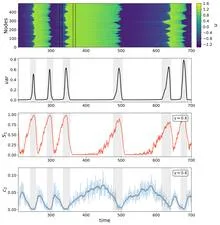
A fisherman pulls on his net and listens to it ring. Each strand quivers in its own way, but before a strong tug, all the strands begin to vibrate in unison. So it is with complex systems: before a sharp state jump, the individual parts suddenly start to oscillate in concert, and that synchrony betrays the coming jump.
A Translator That Follows the Meaning: How a Neural Network Reads the Ocean Two Years Ahead
A translator who gets distracted by every rustle in the room turns a one-hour meeting into two. That is how old statistical El Niño models worked: they picked out individual numbers from ocean maps but missed how a warm patch off Peru connects to a cool tongue near Australia. The new neural network behaves differently: it follows not every word but the meaning of the paragraph.
Disentangling Complexity: How to Tell a Direct Signal from a Chorus of Voices
An orchestra without a conductor plays a complex piece. The listener hears the overall music but wants to understand who leads the melody and who merely echoes it in unison.
Trees Predict Chaos Without Tuning
An orchestra without a conductor: the musicians take their seats, tune their instruments, and begin to play in harmony because each one hears the common rhythm. That is how TreeDOX works, a method that predicts chaotic time series without requiring the user to choose parameters or fine-tune anything.
Untangling Climate Complexity: Methodological Insights
Climate is like an orchestra without a conductor: each musician hears the others with a delay, and the score changes mid-concert. The ocean, atmosphere, ice, and land continuously exchange energy, and the slightest hiccup in one instrument can escalate into a shift of the entire melody.
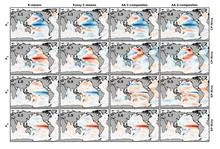
El Niño Flavors: An Ocean Palette Instead of Two Colors
An artist painting the ocean does not limit themselves to two colors: warm and cold. Likewise, climatologists studying El Niño increasingly speak of a whole palette of shades. El Niño is a warm current off the coast of Peru that, every few years, alters weather across the planet. Its counterpart, La Niña, brings cold.
A Ceiling of Randomness
Each Atlantic hurricane season is like a game of dice, where the number of spots depends on three major climate forces: El Niño, ocean temperature in the 'hurricane nursery,' and the North Atlantic Oscillation.
The Entropy of Climate Swings
You can sit on a seesaw and pump your legs, or you can just tip from one side to the other. The Pacific Ocean does both. Every few years, warm water off the coast of Peru gives way to cooler water, and rainfall patterns, winds, and entire ecosystems across half the planet reshuffle. These shifts are called El Niño and La Niña, together known as ENSO: Earth's climate seesaw.
Statistical Mech2026-01-031 minarXiv:2601.01293express
How Soaring Pilots Outsmart the Wind
Paraglider, hang glider, and glider — three different wings, but in the sky they behave the same. Pilots catch invisible warm air currents, rise on them, then glide to the next. Such flight is like a game of hopscotch: a jump upward, then a glide forward, and again a search for a place to jump. Scientists analyzed thousands of real routes and found a common law.
Tibet's Moist Respite
The Tibetan Plateau is a giant sponge that soaks up rain and snow, then releases water to Asia's rivers. Since 2000, the sponge has been getting wetter. Scientists decided to check: does this moisture make the sponge stronger, or does it soften it? They used a measure of disorder — entropy.
Statistical Mech2026-01-111 minarXiv:2601.07096express
A Search Where the Team Changes on the Fly
A group of people searches for a lost item in a large park. Some get tired and leave, others join along the way. The number of searchers is constantly changing. How does this affect the search time? Until now, science had no clear answer. In a new study, a general model of such a process has been built. In it, independent participants randomly enter and leave the search.
Chemical Physics2026-01-151 minarXiv:2601.10791express
Particle Physics Accelerates Molecules
In the Large Hadron Collider's detector, each proton collision leaves thousands of points — tracks of flying particles. A neural network learned to spot patterns in this scatter and predict what happened at the moment of impact.
Instrumentation2026-01-161 minarXiv:2601.11415express
How Gravitational Waves Help Us Listen to Bearings
A neural network originally trained to distinguish real gravitational waves from noise in a gravitational wave detector recognizes bearing wear from vibrations without retraining.
q-bio.BM2026-01-311 minarXiv:2602.00660express
How Proteins Find Their Minimum
To tell one protein from another, you need to describe its shape and composition. There are dozens of such descriptions: molecular length, charge, solubility. But not all are equally useful. A method called Differentiable Information Imbalance (DII) can pick out the most informative features while discarding the rest.
Machine Learning2026-02-011 minarXiv:2602.01045express
Overlapping Features Speed Up Learning
A neural network can be compared to a dormitory where each resident gets their own room. Usually, each feature in the data occupies a separate neuron, and learning proceeds sequentially: first one feature, then another. This is slow and depends on which data you happen to get. But if you allow several features to share a room, overlap them, the picture changes.
Distilling the Ocean: How to Compress Thousands of El Niño Models into Twelve Pure Drops
Thousands of models simmer in a single cauldron, and the steam rises thick and impenetrable. Each whispers something about the future of El Niño, but in the general din you cannot tell who is right and who is just boiling over.
Instrumentation2026-02-172 minarXiv:2602.15296express
Orbiting Clocks Hunt for Invisible Fields
In August 2017, gravitational wave detectors caught a signal from the merger of two neutron stars — the ultra-dense remnants of exploded stars. At that very moment, life on Earth was business as usual: planes were landing, cars were driving, and navigators were plotting routes.
Instrumentation2026-02-171 minarXiv:2602.15780express
How Stellar Blur Gives Away Dark Energy
Light from a distant star, after passing through air and telescope lenses, loses its sharpness, like looking at a streetlamp through wet glass. Astronomers call this blur the telescope's "fingerprint": each instrument has its own, and you need to know it down to the smallest detail.
Materials2026-02-191 minarXiv:2602.17225express
A Furnace for Material Maps
On a silicon wafer the size of a dinner plate, you can place not just one substance but an entire map of thousands of different compositions. A laser knocks atoms off targets and deposits them in thin layers, varying the proportions from point to point. The result is a materials library: more of one metal here, more of another there, and all combinations visible at once.
physics.data-an2026-02-211 minarXiv:2602.18949express
A Forecast That Remembers the Cycle
A solar panel on a roof produces little current in the morning, a lot at noon, and stays silent at night. Wind doesn't blow randomly either: it's often stronger in the morning and evening than during the day. Energy providers need to know in advance how much energy will be available in an hour or three, so they can switch on backup plants or store electricity in batteries in time.
Machine Learning2026-03-141 minarXiv:2603.13727express
How a Machine Learns to Derive the Laws of Nature
When a typical computer searches for a law of nature from data, it tries to guess a complete formula in one go. It's like a cook who, without knowing the recipe, dumps all the ingredients into a pot at once and hopes for soup. Most often, the result is an inedible mess: the formula is long but meaningless, and it fails on new data.
Neural Network Cleans Up Noise to Catch Xenon Decay
In a dark mine under the Italian Alps, a tank holds three tons of liquid xenon. When a particle hits it, it knocks faint flashes of light and electron clouds out of the atoms. Following these tracks, physicists hope to see an ultra-rare decay: a xenon-136 nucleus turning into barium-136, emitting two electrons and no neutrinos.