AI hunts for materials like a head chef express
Hunting for a new material is like cooking without a recipe: you try, try again, and often throw things out. Previously, scientists manually flipped through papers and tested compositions one by one. Now there's a "robot chef" that reads the literature itself, mixes components, and checks what came out.
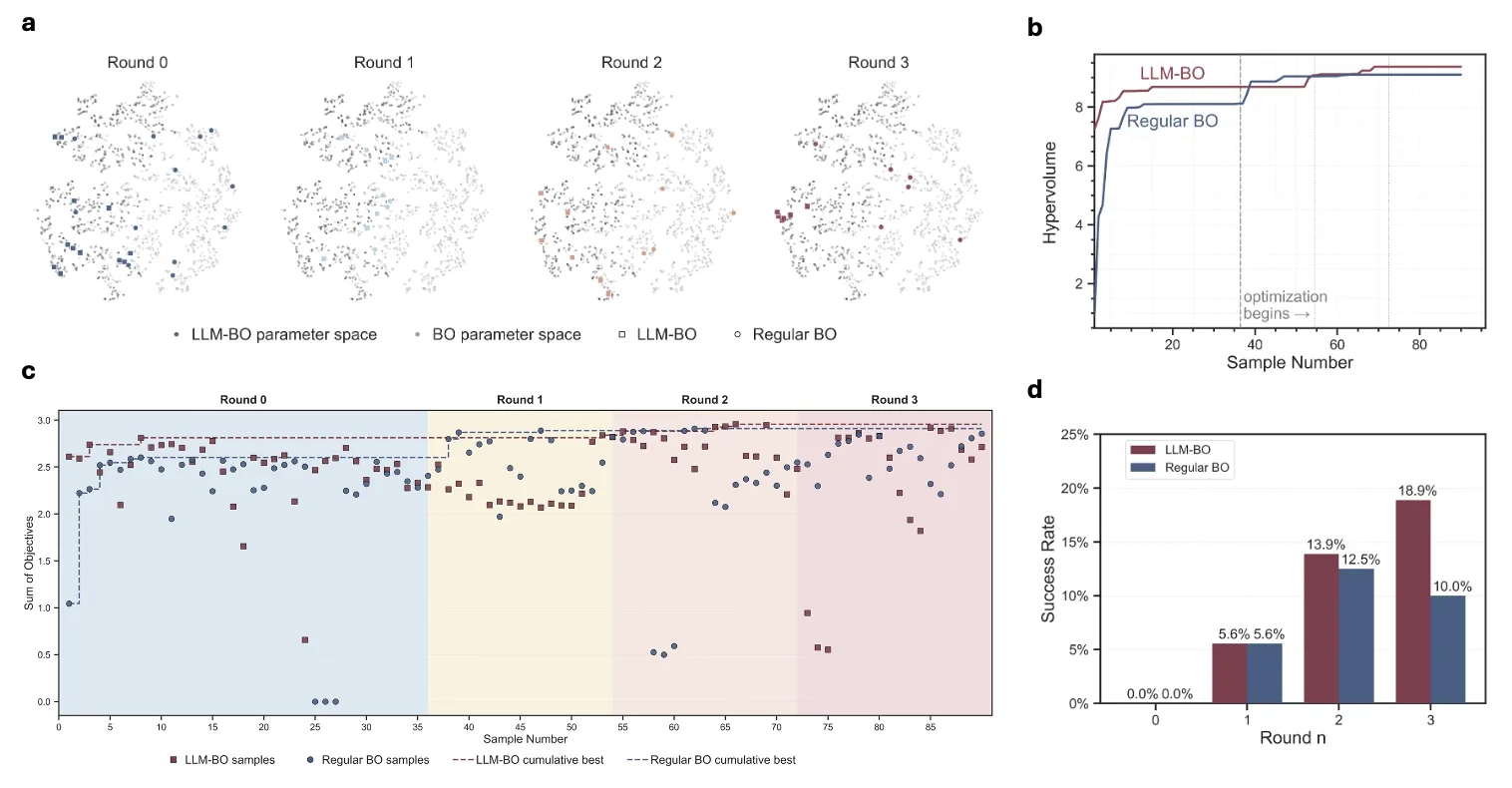
The robot doesn't just repeat others' recipes. After each attempt, it remembers what worked and what didn't, and next time it tries a better variant. In tests, this approach yielded more good samples from the start than random trial and error.
Now, materials discovery is turning from guessing into learning: the system gets smarter with each attempt. This is a path to fully automated labs, where new materials for electronics and solar cells could be found in days, not years.
Original abstract
as written by the authors arXiv:2608.15928v1
Most computationally predicted materials are never synthesized because conventional synthesis optimization is slow, expertise-dependent, and iterative. Here we present a closed-loop framework that automates this expert workflow by placing human tacit knowledge in the loop through a large language model (LLM) that distills synthesis knowledge from the literature, high-throughput hyperspectral imaging for rapid film evaluation, and multi-objective Bayesian optimization guided by experimental feedback. In a paired optimization campaign, LLM-assisted initialization produced more Pareto-optimal samples and higher hypervolume than a Latin hypercube sampling baseline at matched trial counts, and this advantage persisted throughout iterative optimization. We demonstrate the framework by synthesizing the previously unreported perovskite-inspired compound Rb3BiI6 as thin films and validating the optimized films by optical bandgap analysis and X-ray diffraction. The framework transforms synthesis prediction from single-shot recommendation to iterative learning, providing a generalizable strategy to accelerate automated and fully autonomous experimental materials discovery.
The language model reads papers like an experienced chemist: it picks out synthesis recipes from the text that the authors themselves might have only mentioned in passing.