A Magnet in a Suitcase: Open MRI for Everyone express
An MRI scanner is a big magnet that aligns hydrogen atoms in the body and then picks up their response signal. Such machines usually take up an entire room and cost as much as a nice house. Engineers from several labs decided to build a scanner that fits in a suitcase and released all the plans as open source.
The device is built around a permanent magnet with a field of about 50 mT — thousands of times weaker than hospital scanners, but enough to see tissue structure. The weak field means less noise and less power, so the machine runs from a regular wall outlet. The authors tested the system on phantoms — plastic containers with solutions that mimic different tissues. Geometric deviations stayed below 2 mm across the entire field of view, and measured T1 relaxation times matched reference values with an error of just 3.1%.
Two independent teams built such scanners from the published plans and obtained identical image quality. That means any university or clinic can replicate the design without costly tweaking. In the future, such devices could be used in remote areas, on ships, or in field hospitals.
Open documentation is like a cookbook with precise recipes: if you follow the instructions, the dish turns out the same in any kitchen. Same here: two different groups built the devices, and their results matched.
Original abstract
as written by the authors arXiv:2608.19062v1
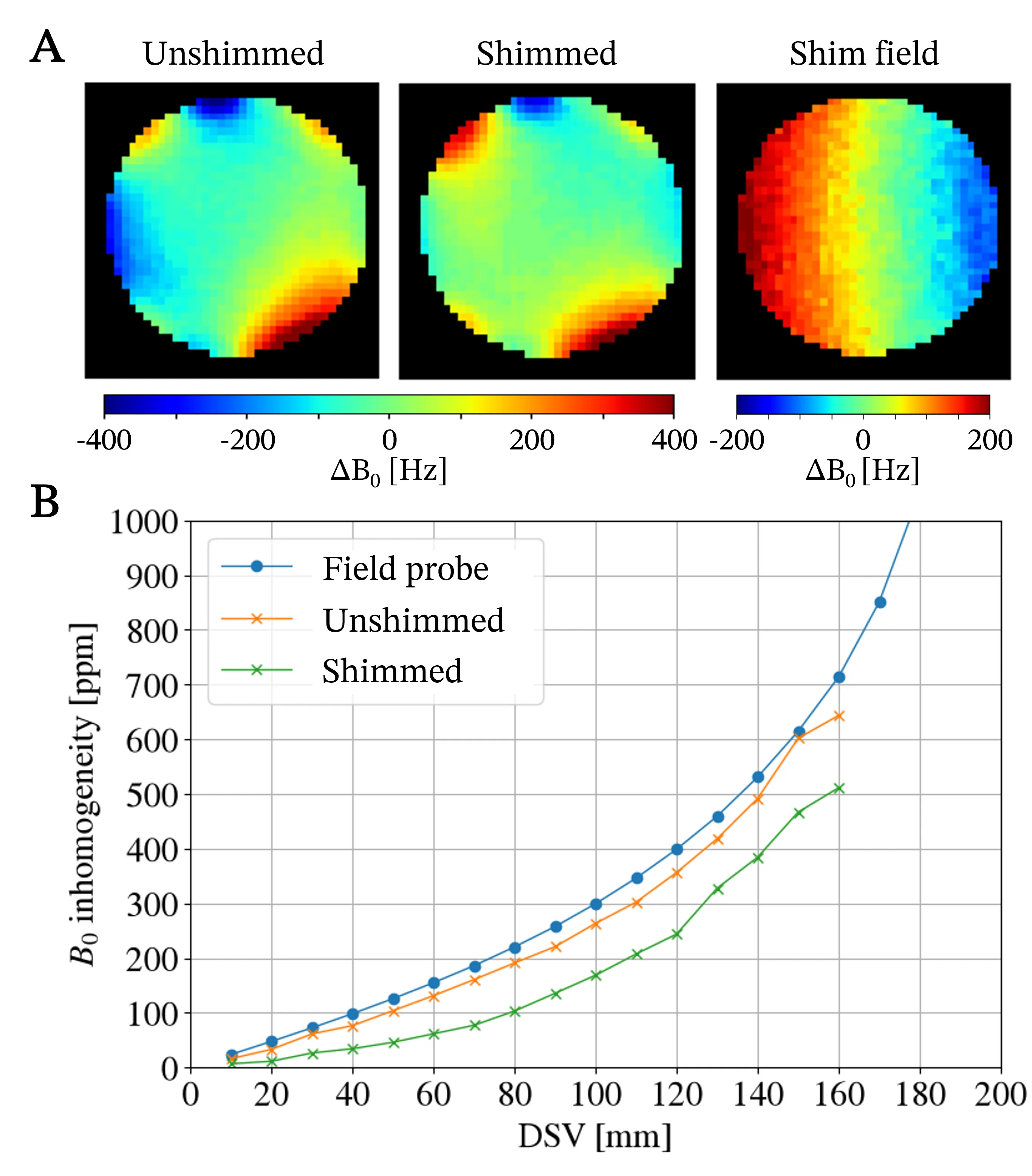
Despite its renewed attention, the pathway to point-of-care portable low-field MRI systems remains challenging, limiting adoption across research groups. Incomplete documentation limits reproducibility, causing redesign and complicating cross-system comparison. Moreover, non-standardized testing and characterization complicates ethical approval for clinical studies. We present an open-source reference system for portable low-field MRI designed to support replication, reproducibility, benchmarking, and quantitative comparison. The system is fully open source, based on a ~50 mT permanent magnet, and integrated with a cloud-native acquisition platform. Pulseq-based calibration, characterization, and imaging sequences assessed noise level, eddy currents, image-based SNR, and geometric accuracy. Quantitative T1, T2, and B0 mapping sequences were developed and evaluated against reference values. Initial results from independent replications at two sites were compared. The system reached a noise level of 1.4 relative to the thermal noise floor and short eddy-current decay constants of 27-32 us across all gradient channels. Geometric deviations were below 2 mm over the field of view. Image-based SNR were consistent between the independent replications. Measured T1 values closely matched specified values, with an average absolute error of 3.1(1.8)%, while T2 values were overestimated by 10.4(5.8)%. Simulations showed only marginal errors for both quantities, suggesting experimental error sources for T2 mapping. The reference system combines openly documented hardware, software, calibration procedures, phantoms, quantitative MRI, and simulation tools in a reproducible ecosystem, aiming to support cross-site comparability, reproducible research, and collaborative development of future portable low-field MRI technologies.
The permanent magnet for such a scanner can be made from a neodymium alloy, the same material used in powerful headphone drivers.
In the series 'The Expanse,' portable medical scanners on spaceships work on a similar principle, a compact magnet and open-source software.