For the human eye, the field of view is about 130 degrees vertically and 200 degrees horizontally (including peripheral vision), but only a small central region, the fovea, provides high acuity. This is why we move our eyes and head to scan a scene. In photography and videography, the field of view is determined by the lens focal length and the sensor size; a wide-angle lens has a large field of view, while a telephoto lens has a narrow one. In virtual reality and augmented reality, the field of view is a key factor in immersion, with wider fields providing a more convincing sense of presence.
History
The concept of field of view has been understood since the early days of optics, with Galileo and Kepler designingtelescopes with specific fields of view. The term became more formalized in the 19th century with the development of photographic astronomy. Modern wide-field surveys began in the 20th century with Schmidt cameras, which were designed specifically to provide large fields of view for sky surveys.
How it works
The field of view is determined by the geometry of the optical system. For a simple lens, the field of view is given by the angle subtended by the image sensor (or film) at the lens's nodal point. Mathematically, it is approximately 2 * arctan(d / (2f)), where d is the sensor dimension and f is the focal length. A shorter focal length or a larger sensor increases the field of view. In telescopes, the field of view is also affected by the eyepiece or camera attached to the focal plane. For wide-field surveys, telescopes are designed with short focal ratios (fast optics) and large detectors, sometimes using multiple CCDs arranged in a mosaic to cover a larger area.
In practice
Field of view is used in designingtelescopes for astronomical surveys, cameras for surveillance and photography, and optical systems for autonomous vehicles. In medicine, endoscopes and surgical microscopes are designed with specific fields of view to balance visualization and maneuverability.
Fun fact
The human eye's field of view is about 200 degrees horizontally, but if you hold your thumb at arm's length, it covers about 2 degrees—the same angular size as the full Moon.
A light ray passing by a massive body slightly changes its direction, like a stream of water bending around a rock in a creek. In the solar system, there are many such "rocks": planets, their moons, asteroids. And each one, with its own gravity, bends the path of light coming from distant stars.
The cameras of a self-driving car capture light like telescopes aimed at a distant galaxy. Each frame is a fragmented observation; together they must form a map of the road ahead.
The computer, like an astronomer, doesn't just stitch images together: it generates several possible bird's-eye views and compares them to real data.
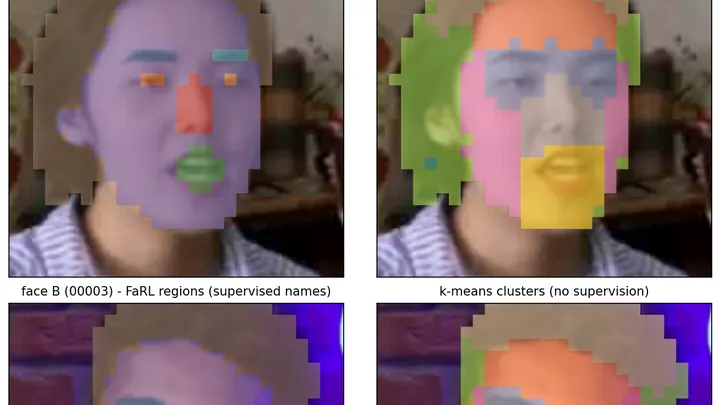
Trained on ordinary images, the DINOv3 model unexpectedly began to see faces as a spectrum: on its own, without hints, it isolates the eye, nose, and mouth regions. Like an invisible spectroscope, it breaks down a portrait into parts, just as a prism splits light into colors.
Across 200 videos, feature labeling accuracy reached 83% (random guessing is 23%).
On the screen is the result of a complex simulation: two planets collided, a shockwave ripples outward. A couple of clicks in an editor, and harsh shadows soften, noise smooths out, the background darkens. This kind of digital retouching (image editing to enhance appearance) has long been part of the scientist’s toolkit.
The aurora borealis is like a distant theater: the show may be on, but whether the audience sees it depends on the curtain. Here, the curtain is clouds and moonlight. Earlier forecasts tried to predict both the occurrence of auroras and viewing conditions at once, mixing everything together.
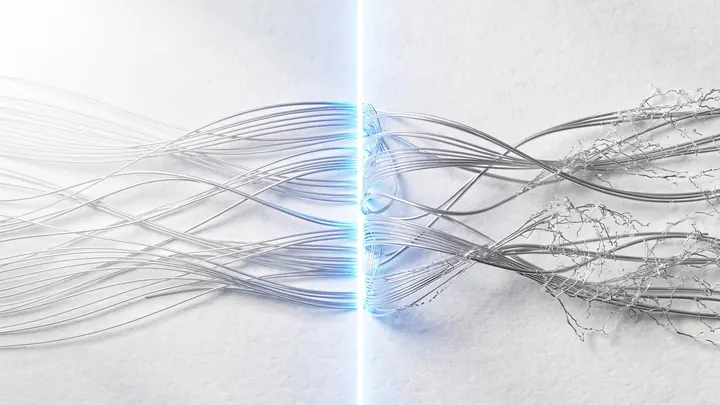
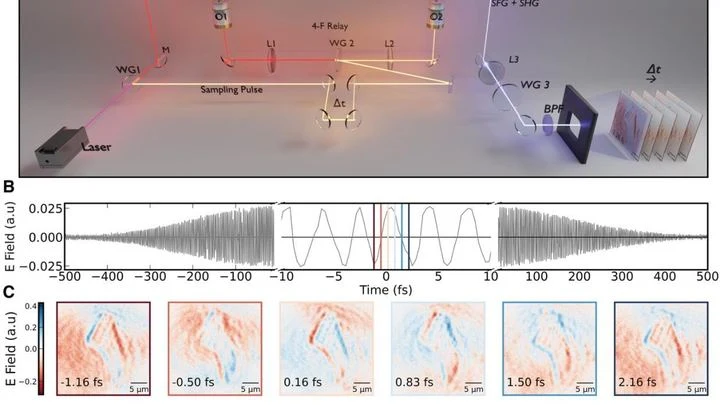
Light is not just a beam but a wave with an electric field that changes at a speed unimaginable to ordinary clocks. Until now, this field could only be measured at a single point, like taking temperature with a single thermometer. Now researchers have created a method that shows the entire field at once, like a thermal imager showing a heat map.
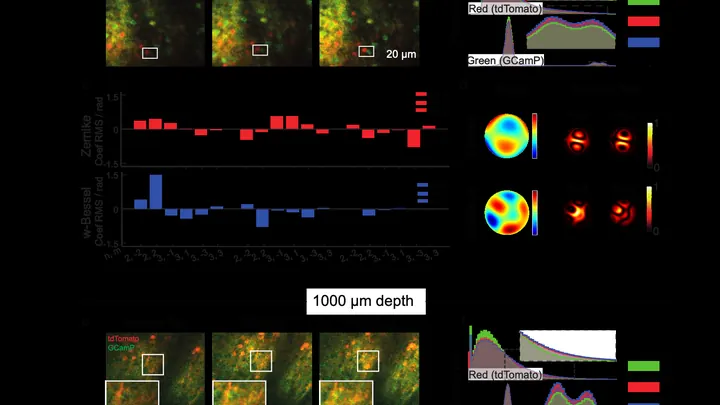
The laser beam in a three-photon microscope works like a flashlight shining through murky water. The deeper you need to illuminate, the more the water scatters light and the dimmer the picture gets.
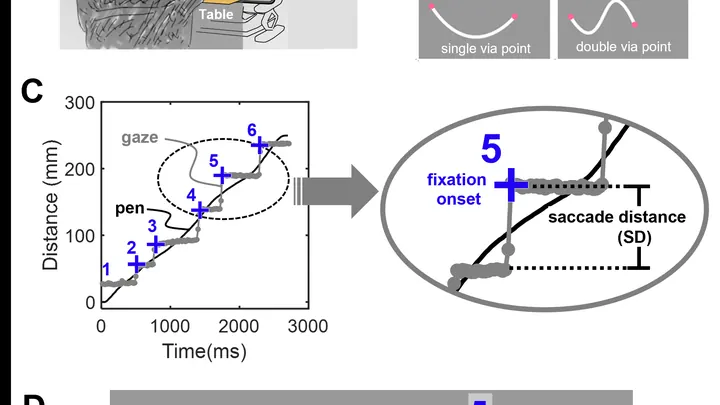
When the hand draws a line, the gaze almost always runs ahead, like a scout peeking around the corner before the column turns. But how far ahead? It turns out that each person has their own distance, and it does not change from attempt to attempt.
In the experiment, professional calligraphers and ordinary people traced a contour on a screen while instruments recorded eye and pen movements.
Shine a flashlight through a narrow slit, and the beam doesn't stay a thin stripe; it spreads out sideways. Light has a habit of bending around obstacles, and because of that, the smallest spot you can get with an ordinary lens is no smaller than half a wavelength.