Dancing Clouds: Measuring the Transverse Motion of Gas in L1688 ✛
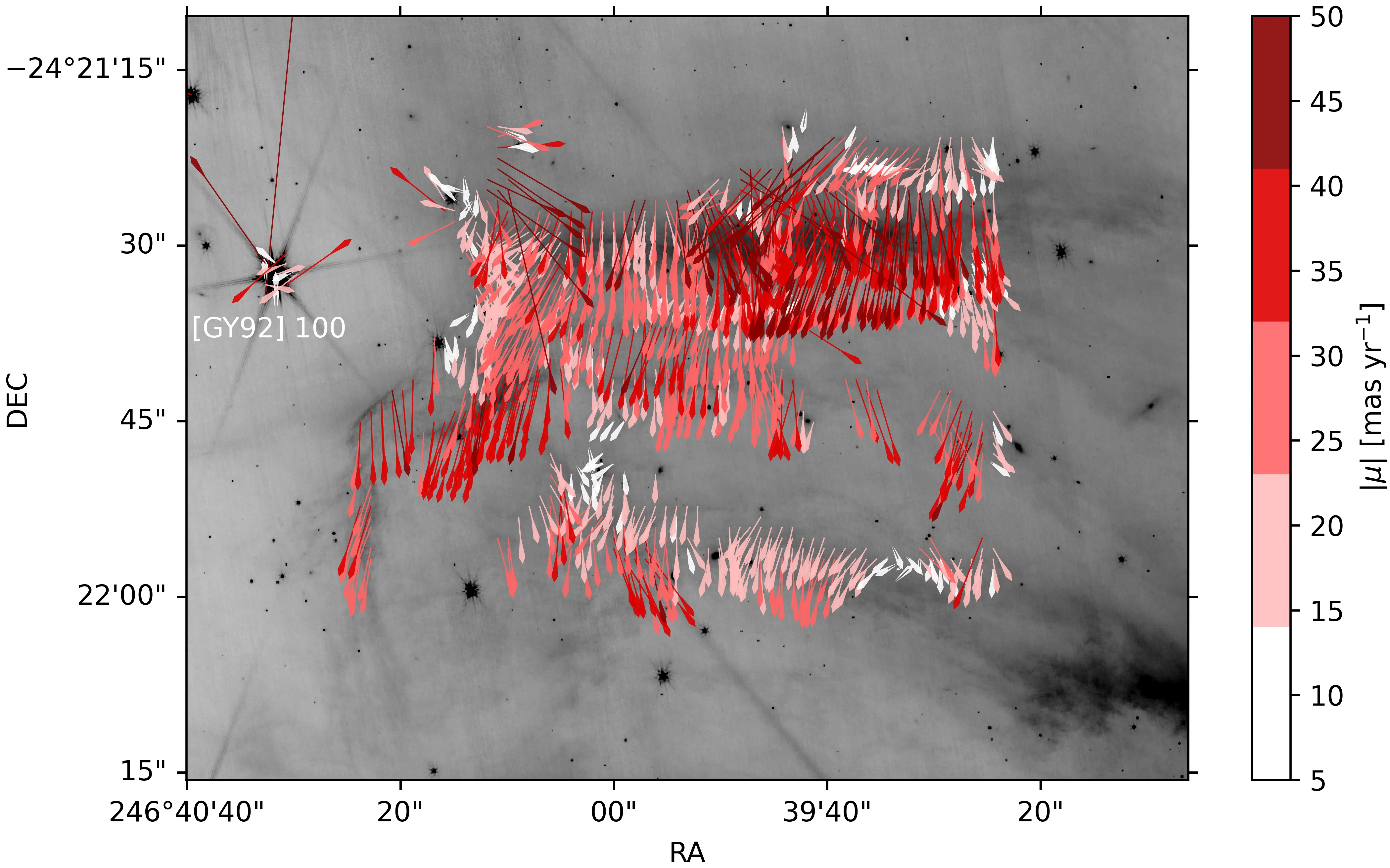
The cloud L1688 in the constellation Ophiuchus resembles a dance floor where partners don't always hold hands. Astronomers have long assumed that gas in molecular clouds moves together with the young stars born within them. But until now, no one had tested this directly: only the gas velocity along the line of sight was measured, while its transverse shift across the sky remained invisible.
Now the HURACAN team compared archival images of the same region taken by the Hubble Space Telescope in 2016 and the James Webb Space Telescope in 2023. Over 6.5 years, the gas shifted by a tiny but measurable amount. To compute this shift, the images were aligned using distant galaxies in the frame, and then a computer algorithm searched for how much the gas patterns had moved.
The result was surprising: the gas does not move like the young stars. The median proper motion of the cloud, (−3.0, −24.1) milliarcseconds per year, differs from the motion of Upper Scorpius stars by 3±1 km/s. This is a statistically significant discrepancy. It means that stars cannot always be used as precise tracers of the gas motion from which they were born.
Previously, the transverse motion of gas in molecular clouds had not been measured at all. Now the image registration method allows us to "see" the cloud's dance in full. This opens a new window into the dynamics of the interstellar medium and will help us understand how stars form and how they influence their surroundings.
The L1688 dance floor turned out to be more complex than thought: the cloud and the stars each move to their own rhythm. And now astronomers have a way to follow every step.
The proper motion of the L1688 cloud is about 24 milliarcseconds per year, which is like the thickness of a human hair seen from a distance of 400 meters, observed over a year.