An interstellar object is an asteroid or comet not gravitationally bound to any star, arriving from interstellar space. It is distinguished by a hyperbolic orbit with eccentricity >1 relative to the Sun, indicating its extrasolar origin. Two such objects have been confirmed: 1I/ʻOumuamua (2017), a rocky body without a cometary coma but with non-gravitational acceleration, possibly elongated; and 2I/Borisov (2019), a comet with a typical coma and tail but extremely rich in carbon monoxide. It is expected that interstellar bodies pass through the Solar System regularly, but they are difficult to detect due to their faint brightness.
History
The idea of interstellar comets was discussed by theorists (e.g., Jan Oort) as early as the mid-20th century. The first detection was on October 19, 2017, by the Pan-STARRS1 system in Hawaii — object C/2017 U1, later renamed 1I/ʻOumuamua. Its interstellar nature was confirmed by a hyperbolic orbit with v_inf ~ 26 km/s. The second object, 2I/Borisov, was discovered on August 30, 2019, by Gennady Borisov; cometary activity facilitated spectroscopy. Missions (e.g., ESA/JAXA's Comet Interceptor) are being developed to intercept future objects.
How it works
Objects form in protoplanetary disks of other stars as planetesimals; giant planets scatter them, imparting speeds above the parabolic limit relative to the star. Some escape into interstellar space. Upon approaching the Sun, orbitalmomentum and energy determine a hyperbolic trajectory. Observational manifestations: astrometry for orbit determination, photometry for shape and rotation, spectroscopy for composition. For ʻOumuamua, a radiation pressure model was applied to explain the non-gravitational acceleration. Laws: Newton's law of universal gravitation for the trajectory, the law of conservation of energy for a hyperbolic orbit, equations of motion with non-conservative forces. Gravitational lensing is not applicable (masses are small).
In practice
Tracking interstellar objects helps prepare for sudden encounters with hazardous bodies. Their material is a direct sample of the building blocks of other planetary systems, accessible without traveling to other stars.
Fun fact
ʻOumuamua means 'scout' or 'messenger from afar' in Hawaiian, and its speed was so great that it left for interstellar space just a few months after discovery.
The family album of this stellar pair has been filling up for 45 years, but the pictures were blurry and the captions contradictory. Now astronomers have pulled out the old photographs, taken new sharp shots, and put everyone back in their proper places. Gamma Cephei is a bright star visible to the naked eye, and it has an invisible companion that orbits it every 70 years.
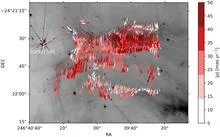
The cloud L1688 in the constellation Ophiuchus resembles a dance floor where partners don't always hold hands. Astronomers have long assumed that gas in molecular clouds moves together with the young stars born within them.
Twenty thousand years ago, the star that would become supernova 1987A put on a ring. Not one — three. The two outer ones, like lampshades, tilted relative to the equatorial ring, and the star's light, struggling through them, barely reached an observer who happened to be in the plane of the equatorial ring.
Every morning, a janitor sweeps leaves into a pile. The Sun, as it travels through the galaxy, does something similar: its gravity gathers diffuse interstellar gas into an invisible cone — a giant funnel.
A star wrapped in an invisible blanket warms up more than it should. That's exactly how ten red dwarfs look, which astronomers from the Hephaistos project have been monitoring. These stars lie within 300 parsecs (about 1000 light-years) of us and emit far more infrared energy than their modest sizes can explain.
In the silent ocean of the Galaxy, mature civilizations have likely long chosen an unexpected strategy: instead of loud beacons, they scatter quiet fireflies — autonomous interstellar laser beacons, drifting in the void and dropping microsecond flashes. These 'seeds of contact' are not tied to their home stars and do not drown in their glow.
In 2024, the Hephaestus project sifted through millions of stars and flagged a few dozen suspicious ones: they shone brighter in the mid-infrared than a normal red dwarf should. Two of these candidates, labeled D and E, looked especially tantalizing, as if an invisible heater were working next to the star.
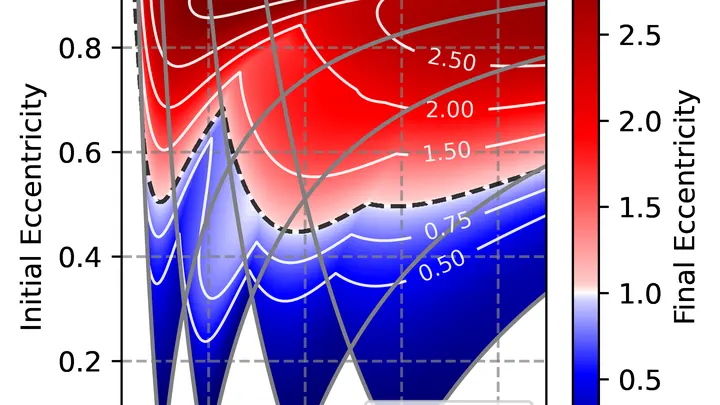
Remember the sensational comet 1I/‘Oumuamua — the first object to come to us from another star? Its hyperbolic trajectory left no doubt: it was a wanderer from the interstellar void. But astronomers wondered: could some of these visitors not be strangers at all, but our own, escaped from the Solar System millions of years ago?
Remember the sensational comet 1I/‘Oumuamua — the first object to come to us from another star? Its hyperbolic trajectory left no doubt: it was a wanderer from the interstellar void. But astronomers wondered: could some of these visitors not be strangers at all, but our own, escaped from the Solar System millions of years ago?
The light of a distant star is no perfect beacon. Passing through the gravitational field of another star, it bends, splits, and magnifies, creating a fleeting Einstein ring in the sky. This is how gravitational microlensing manifests, predicted by Fritz Zwicky back in the 1930s.
Tiny seeds of life can cross the black void on icy wanderers like comet 3I/ATLAS. The James Webb Space Telescope found water and methane on it for the first time, and light analysis revealed an unusual gas composition.
In 2019, an unusual visitor, comet 3I/ATLAS, zoomed into the Solar System. It came from another star, and for the first time, astronomers were able to see what its dusty tail is made of.
The giant cloud of icy chunks on the outskirts of the Solar System, the Oort cloud, resembles a transparent bubble stretched to a light-year across. Usually, these chunks hang quietly in their distant corners, but sometimes something disturbs them.
Most often, it's the tidal influence of our Galaxy.
On April 1, 2026, satellites recorded a bright fireball blazing in the sky over the South Atlantic. Photometric tracking satellites detected the entry and demise of the object at an altitude of 90.5 km. An ordinary asteroid? No. Astronomers recalculated the velocity vector into the heliocentric system — and gasped: 51.73 km/s.
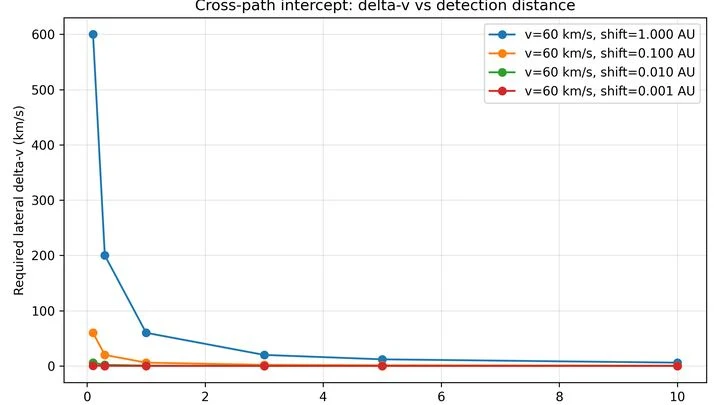
Interstellar space is not a cosmic desert, but a super-fast highway. Trillions of asteroids and comets from other systems race past us, yet camera-telescopes only catch a few. Imagine a night highway: the headlights of a distant car flash brightly, but if it zooms by too fast, the camera shutter can't click in time.
On April 1, 2026, satellites recorded a bright fireball blazing in the sky over the South Atlantic. Photometric tracking satellites detected the entry and demise of the object at an altitude of 90.5 km. An ordinary asteroid? No. Astronomers recalculated the velocity vector into the heliocentric system — and gasped: 51.73 km/s.
Interstellar space is not a cosmic desert, but a super-fast highway. Trillions of asteroids and comets from other systems race past us, yet camera-telescopes only catch a few. Imagine a night highway: the headlights of a distant car flash brightly, but if it zooms by too fast, the camera shutter can't click in time.
In July 1988, the automatic station Phobos 1 lifted off from Earth. Its target was Mars and its mysterious moon, Phobos. Two months after launch, an incorrect command was sent, communication was lost, and the probe fell silent forever. Since then, it was considered lost.
Decades later, astronomers spotted a strange object—1998 KY26.
Among the icy chunks hurtling through the void, there are special travelers — interstellar comets. They were born around distant stars and happened to wander into our neighborhood. One of them, 3I/ATLAS, came under the gaze of telescopes as it approached the Sun. Its material, frozen gases and refractory dust, began to evaporate, leaving a glowing tail behind.
A research probe is planned for the nearest black hole — a region of spacetime whose gravity traps even light. After a hundred years of flight, the spacecraft will enter orbit around the mysterious object to answer a key question: are we looking at a black hole or a neutron star — the ultra-dense remnant of a massive star, compressed to nuclear…
When the interstellar comet 3I/ATLAS approached the Sun, its tail lit up with a metallic sheen, as if a tin can full of nickel and iron had burst open. By breaking down its light into colors, astronomers detected the lines of these metals using spectral analysis.
Recently, astronomers spotted three interstellar comets coming from deep space. One of them, 3I/ATLAS, turned out to be unexpectedly large: its nucleus is several kilometers across.
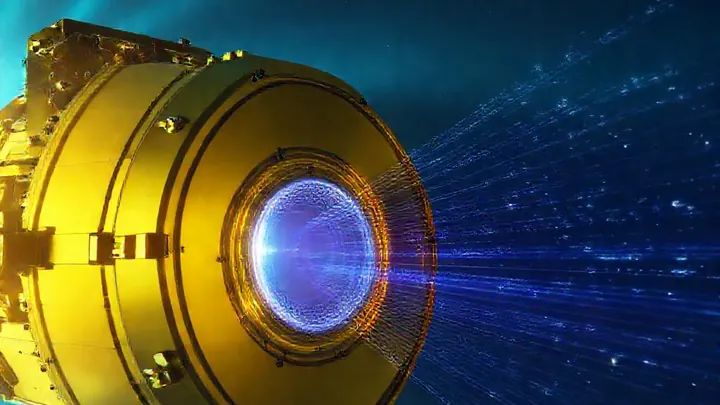
A handful of coins accelerates to one-fifth the speed of light. That's what Coracle interstellar probes will be like — tiny spacecraft weighing just a few grams, each with an ultrathin sail film. A powerful laser beam pushes them forward: light presses on the sail like wind fills a yacht's sails, except instead of air, it's a stream of photons.
A glowing cloud in a telescope looks like a wisp of fog about to dissipate. Planetary nebulae are gas shells cast off by dying stars. Young nebulae are bright and compact, but as they age, they expand, cool, and become increasingly transparent until they vanish into the interstellar medium.
Astronomers occasionally spot interstellar objects — rocky chunks or comets from other star systems. Most look ordinary, but some puzzle us with their shape, speed, or shine. To stop guessing, scientists applied the Loeb scale: from 0 (plain rock) to 5 (technosignature — an artificial signal from space).
A lighthouse blinks every few seconds, but then begins to slowly brighten and dim over the course of a year. That is exactly what about a third of red giants do — huge stars in the late stages of life. Their normal pulsations take days or weeks, but on top of that, long secondary periods are visible: months and years.
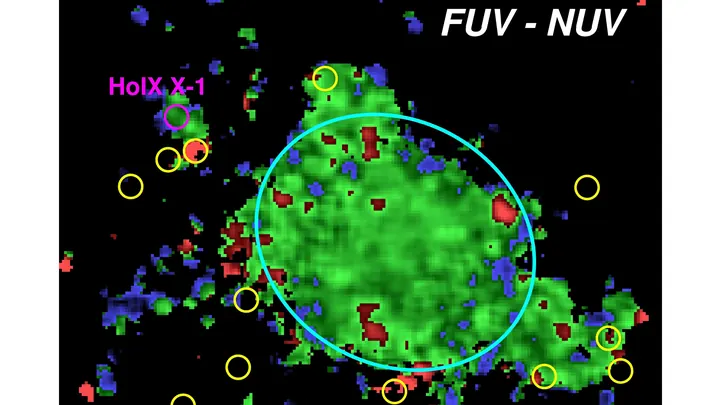
The galaxy Holmberg IX is like a city where construction of new houses suddenly stopped, even though building materials are everywhere. Astronomers peered into it with various telescopes and saw a strange picture: plenty of gas and heavy elements, but almost no dust. Usually, where there's gas, new stars are born, but here it's different.
Around distant icy bodies the size of a city, circling beyond Neptune, rings of dust and ice have been found. Small moons often whirl nearby. Mathematical analysis shows that a moon's gravity rocks the ring like a swing, making it tilt.
There are faint points in the sky that slowly crawl among the stars. They are cooler than embers in a fireplace and smaller than the Sun: these are brown dwarfs. There are so many of them that astronomers can't keep up with reviewing all the images. That's when volunteers stepped in: ordinary people examined pictures from the telescope and flagged moving objects.
Comet 3I/ATLAS was spotted when it entered the Solar System from interstellar space. The James Webb Telescope split the light from its gas cloud into a rainbow, a spectrum, and in this pattern, the lines of rare molecules with deuterium (heavy hydrogen) appeared.
The Gaia space telescope measures star positions with an accuracy of a microarcsecond, like spotting a coin on the Moon from Earth. In 2022, it noticed that the bright star HD 12800 was wobbling slightly, as if tugged by an invisible companion. Astronomers hypothesized that a planet orbits the star.
But a wobble can be deceiving.
A comet hurtling through space is a mountain of ice and dust that carries itself across the Solar System. If you mount small engines on such a mountain, it becomes a ship with its own fuel: gas from the interior can be vented through nozzles to change course.
An icy rock is flying through the Solar System on an open trajectory — coming in from interstellar space, swinging around the Sun, and heading back into the dark.
Comet 3I/ATLAS is a rare guest: it came from interstellar space, from another star. As it passed near the Sun, ice on its surface began to sublimate, and gas jets acted like tiny rocket engines. This force, called non-gravitational acceleration, nudges the comet off a purely gravitational trajectory.
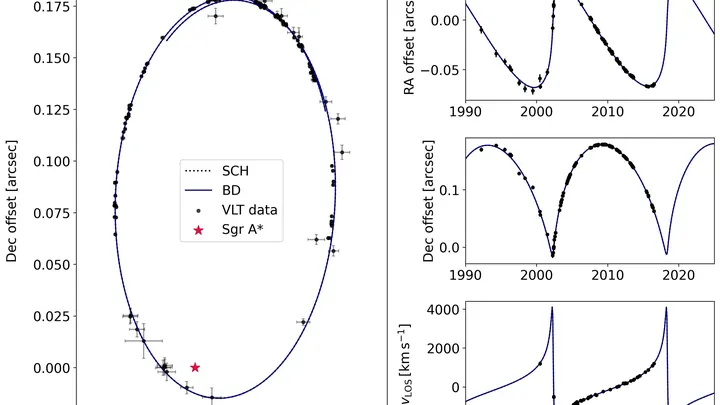
Something massive hides at the center of the Milky Way — four million times heavier than the Sun. The star S2, like a racer on a steep curve, loops around this object every sixteen years in an elongated orbit, accelerating to 7650 kilometers per second. By tracking exactly how it moves, astronomers are trying to figure out what that 'something' is.
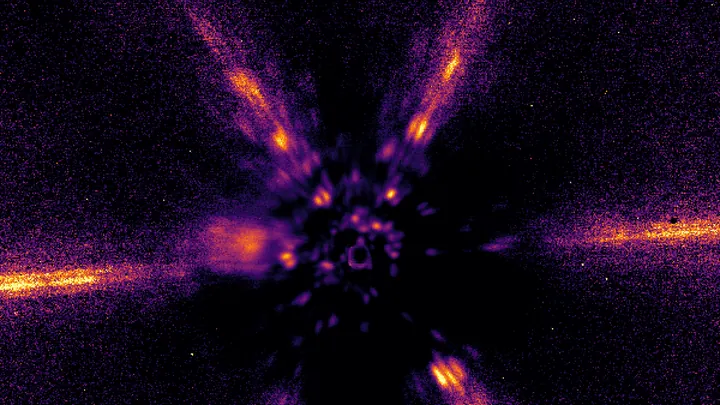
In the dark clouds of gas and dust where new stars are just igniting, the Keck Telescope in Hawaii picked out two faint points of light next to young stellar objects. These aren't stars but their companions — too light to shine on their own.
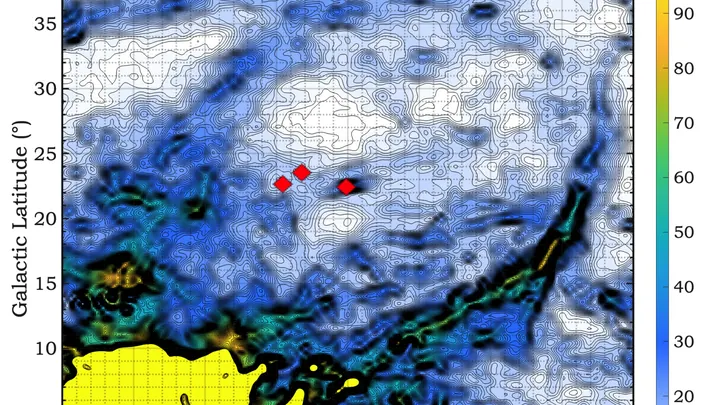
In radio sky data, like on old photographic film, two bright gas streaks have emerged. They move at different speeds but hang near the same dim star. The star and the streaks turned out to be inside a huge empty bubble in the interstellar gas. This bubble is like a blown soap bubble left over from an ancient supernova explosion.
Interstellar wanderers are rocks and icy chunks that have broken free from their home planetary systems and now drift through the Galaxy. The first such visitor, 'Oumuamua, zipped past the Sun in 2017, followed by Comet Borisov and the ATLAS object. Where do they come from?
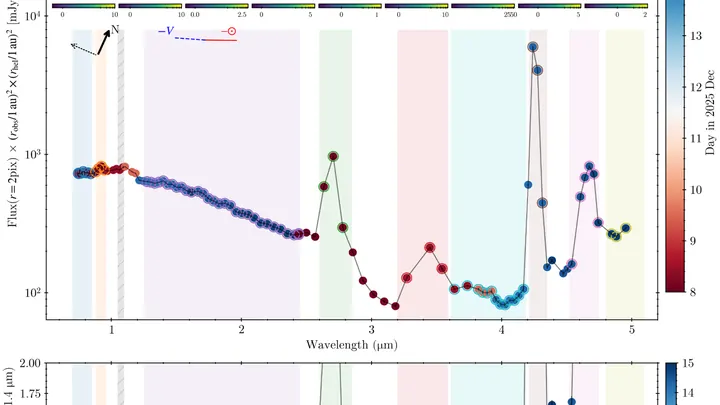
In December 2025, the SPHEREx telescope, using spectroscopy (breaking light into chemical 'fingerprints'), re-examined object ISO 3I/ATLAS — a wanderer from another star system.
In Andromeda's stellar stream, a long ribbon of stars ripped from a small galaxy during a collision with a larger one, astronomers spotted a star that outshines all its neighbors. It pulsates, swelling and contracting every 89 days, like a heart beating in rhythm. Such stars are called Type II Cepheids, and this one is the brightest known.